
Don’t read Blythe blithely
In the early 2000s, Matt Weiland and Sean Wilsey, two American editors, found themselves with a hunch and a conviction which led to them publishing a collection of essays under the title: State by State: a Panoramic Portrait of America. The conviction, as described in Matt Weiland’s preface, was the “easy part”. They believed that American life goes “surprisingly underdescribed”.
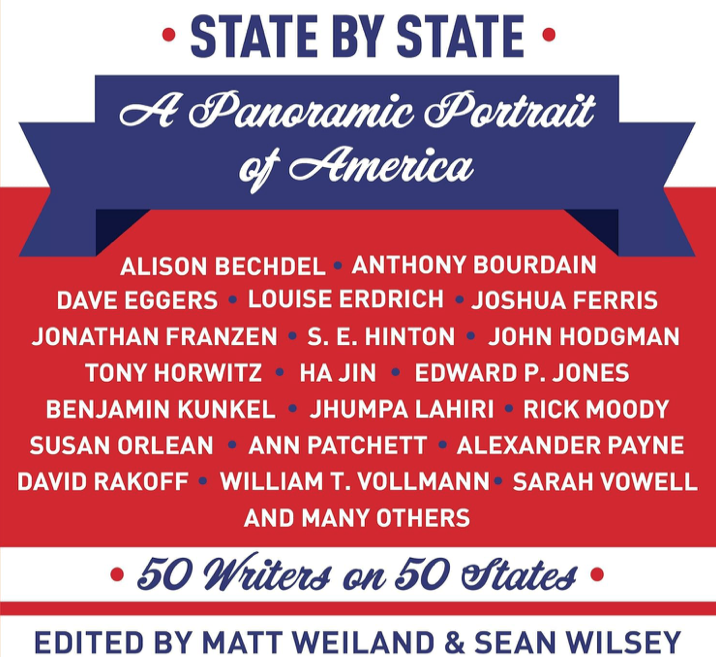
Conversely, their hunch was “less obvious”. They believed that, despite the growing homogeneity of American life, remnants of regionalism still remain. Weiland states that the USA “retains an essential deepgrained variety,” and even though “the increasing sameness of everywhere is plain”, we “stubbornly resist blending”. In the same way the WPA Writers’ Project in the 1930s sought to present the unique qualities of each state, they hoped to put together a collection of personal essays that would fit together not seamlessly, but wholly. The hunch, Weiland asserts, is that “the personal fact that defines American lives as much as gender, ethnicity, or class is where you’re from, which means more than anything your home state” (xii).
But if we are so molded by our home state, how can we be unbiased critics of it? The “personal fact that defines American lives” maybe isn’t exclusively the home state but instead the experienced American – the places beyond state lines providing the opportunity to be an outsider looking in. Is one’s home state truly so identity-defining that it supersedes any other interpretation of American life? Perhaps life experienced and the values rooted in the Declaration of Independence outweigh any aspect of gender, ethnicity, class, or even home state.
As a born and raised Californian, I cannot deny that there is a sense of ego present within my state, and also within myself. And whether it is fueled by our economy, culture, or power, it is easy to notice our overwhelming self-confidence. As Will Blythe states in reference to his own home state, North Carolina, “We presume ourselves at least your equal”. Well then, California is quite the contrast – we presume ourselves superior until otherwise proven wrong (and even then we would be averse to admit it).
It is unlikely that Blythe ever got the chance to read Weiland’s preface before completing his writing, but it is clear they were on the same page. Weiland prompts these American authors: ”Tell us a story about your state, the more personal the better, something that captures the essence of the place. Not the kind of story one hears in a musty lecture hall or one reads in the dusty pages of an encyclopedia. The kind of story the enlisted soldier tells his boot-camp bunk mate about back home” (preface, xv). Blythe’s essay, while wandering and disconnected, effectively “captures the essence” in a way that would never be heard in a lecture hall. The essay’s spotty recollection mimics the “kind of story the enlisted soldier tells”. Blythe mirrors Weiland’s wishes in many interesting ways. And beyond that, the goal of State by State is to echo the WPA Federal Writers’ Project: “a rowdy, idealistic, sometimes farcical experiment… that refuses to be forgotten” (preface, quoted from Malcolm Cowley, xvii). .
Blythe’s exploration is a little wild. From blogs and gardens, to presidential elections and scandals, to Puritans and chicken sandwiches, to waiters and country lingo, Blythe yet manages to capture the personality of the New Hampshire as both old and new, stagnant and evolving.

Will Blythe was born in North Carolina in 1957 and attended the University of North Carolina at Chapel Hill, a school rooted in three generations of his family history. His father, William Brevard Blythe II, was a true North Carolinian, inseparable from the land and culture of his state. In Blythe’s book, To Hate Like This Is to Be Happy Forever, he describes his father, saying, “He loved his home state (trees, birds, soil, fish, crops, coun-ties, ladies, barbecue) in a way that few people seem to love their home”. This inheritance informs Blythe’s writing, returning to his questions of authenticity and regional loyalty. Beyond this work, Blythe has built a substantial career in writing. His work has appeared in The New Yorker, Rolling Stone, Sports Illustrated, Elle, and the Oxford American, and he has also written several short stories.
Well, it should be noted that Blythe’s essay is a tad unorthodox. In fact, an experienced State by State reader, one with a few essays already under their belt, would have noticed that most authors originate from (or at least are experienced in) the state they are chronicling. However, Blythe has little experience in New Hampshire at all, but this doesn’t mean he was a ‘backup author’ or a last minute addition – it was the intent of Weiland and Wilsey. ”We wanted some pieces by writers native to a particular state, of course, but we also wanted some by newcomers, and others by writers we’d send to states they’d never been to, to get a sense of the place as only a writer with a map and fresh eyes and a deadline can get” (preface, xv).
Will Blythe’s essay on New Hampshire begins not in the state itself, then, but in NYC. He launches into a rant against a new age of bloggers, calling out their compulsive oversharing. Perhaps, as a seasoned literary expert himself, Blythe resents the ease with which these amateurs self-publish without care or craft.
Blythe looks inward, taking on a self-deprecatory tone. He describes himself as isolated and out of step with the modern day. His longing is not for connection, though, but for a different kind of place entirely — a place without the ego of the digital age. The contrast between “souls rather than psyches” and “vegetable gardens rather than blogs” highlights a desire for authenticity, and is a good expansion of his tone.
Blythe continues his annoyed rant against bloggers. He compares how much time they spend on “their sites” to how obsessively suburban homeowners (or their Mexican yardmen) clean up their yards. He mocks how they post polished videos and photos of themselves, tweaking everything from their skin tone to the background — all to look more glamorous. He argues it has created a new kind of pressure to look amazing all the time (which nowadays is a common argument to be heard).
Within the first page of Will Blythe’s essay, he calls himself “friendless,” “misanthropic,” “lazy,” “despairing,” a “narcissist,” and “sick to death of myself.” While this may appear to be common self-deprecation, it could be rooted more deeply, as he goes on to say: “I want to be away from my ordinary self. Older remedies, even fear… all the antidotes to the small self. I want to disappear into history. Instead, I go to New Hampshire”. The “instead” throws us for a loop. Does he mean that New Hampshire is lacking in history or rich in it? Is New Hampshire the next best thing to his desire for disappearance or does he remain unsatisfied with what new lands and stories have to offer?
Now, such a statement is, for the most part, unheard of – New Hampshire isn’t exactly vacation spot #1. So that begs the question: is Blythe only visiting for the check from Weiland and Wilsey? Maybe. But through his seemingly aimless adventures in New Hampshire, he does disappear into history, and he does seem to immerse himself into the culture of New Hampshire.
So why did W&W choose Blythe? It turns out he’s only been to the Granite State once before, has no relatives there; it was only in “the spring of 2007 to cover the haphazard presidential campaign of John Edwards” that he visited there as reporter on assignment for Playboy magazine (one of the presidential primaries is New Hampshire). So does he have any skin in the game?
As a journalist for Playboy, Blythe identifies three distinct reactions New Hampshirites have to his affiliation: awkward embarrassment, humorous jealousy, and blatant oversharing. He muses on their varying comfort levels and awkward comments, but quickly dismisses any further thought, saying: “Even an inadvertent scholar of New Hampshire does not need to know about its citizens. Good People of New Hampshire, keep at least a few of your secrets to yourselves.”
Blythe refers to several factors which could lead Edwards’ campaign to appear “haphazard.” Edwards ran on a populist, anti-poverty platform, but this message clashed with his personal image (28,000 square foot mansion and $400 haircuts). He also struggled to compete with Barack Obama, who also ran as a reformer but with more clarity. Two of Edwards’ staff members came under fire from The Catholic League due to prior comments on personal blogs (Blythe hates bloggers!). And finally, Edwards was exposed for an affair with filmmaker Reille Hunter after repeated denial (all while his wife suffered from stage IV breast cancer). Edwards placed 3rd with 17% of the vote in the New Hampshire Primary poll before dropping out. Ultimately, Obama won that election and Edwards’ political career effectively ended.
“Like the candidates for President, the Devil, too, has apparently spent a lot of time barnstorming in New Hampshire, to mixed effect.”
From covering a scandalous politician for Playboy to decoding the double entendres of talkative couples, it is no surprise that Blythe shifts to yet another topic: puritanism and asceticism, which dominates much of the remaining text.
“In 1692, the Puritan minister Cotton Mather looked out from his pulpit in the Second Church in Boston and saw a New England being overrun by the Devil.”
Blythe’s draws on the reader’s pre-existing knowledge of Puritan witch trials, from texts The Scarlet Letter and The Crucible, to remind us how Puritan impulses never really left us – they just changed mediums. “The stone descending, the bones cracking… blogs, ha!” Blythe hands the analysis right to us. Blogs, and the obsessive digital age accompanying it, can be compared to rampaging Puritan hysteria – the crushing force of communal judgment. It’s grotesque and comedic and that’s the point.
Cotton Mather was an influential figure in Colonial New England during the late 1600s to early 1700s. He is known for his role in the Salem witch trials, where he supported the use of spectral evidence (based on the belief that witches could send their spirit to haunt others), though he later doubted himself. Mather wrote over 450 books and pamphlets on religion, science, and history. Blythe mentions a couple of the most notable victims including Giles Corey, crushed to death, and Goody Cole. “I’m looking for ghost traces” he says, but all he finds is a warped commercialization of historical events – a “Goody Cole Chicken Sandwich”, about as much of a jarring contrast as one could imagine.
“Maybe as a traveler, I’m like the mistress to a great man; my nocturnal privileges allow me to know things the good wife can only dream.” This is Scarlet Letter-level imagery. He reflects on how his perspective enables him to notice and reflect on things a native may pass by.
Blythe’s cursory mention of the Goody Cole Chicken Sandwich is more thematically significant than it might first appear. Having just read The Scarlet Letter, I am reminded of Nathaniel Hawthorne’s exploration of re-purposed language. Throughout his novel, Hester Prynne’s utility as a member of society shifts, and with it, the meaning of her title as “adulterer”. “Such helpfulness was found in her,—so much power to do, and power to sympathize,—that many people refused to interpret the scarlet A by its original signification. They said that it meant Able.” This exposes our human, or perhaps American, tendency to reinterpret symbols for our own purposes. From condemned witch to shock-value marketing, from letters of shame to signifiers of achievement, Blythe reminds us once again that we have not really changed.
But sometimes Blythe seems to be irreverent – his comments don’t add up – or do they? Is his reflective probing really a complex statement on the New Hamshirite condition? Does he know the New Hampshirites so well, that he can be a mistress, privy to “things the good wife can only dream”? The question with Blythe remains: is it all buttoned up, or is it simply a stream of consciousness, meandering about through New Hampshire’s history and culture? Blythe’s wandering tone suggests that an overarching thematic statement might be too much to hope for.
In just one page, he moves from North Carolina’s reverse-vanity, to frigid winters, to the Confederacy, to “twee self-righteousness”, all while weaving in Puritanism, and finally capping it off with a hint of transcendentalism with references to Thoreau and Emerson. Frankly, I’m lost. Will Blythe’s style is one that demands the highest attention from his readers. And while this should make the analysis rich and the payoffs large, I for one am left confused, yet with a desire to understand. This could be a powerful tool if he is doing so intentionally, but if not, it is a wild goose chase.
Henry James once visited Chocorua, New Hampshire. Henry mused on what he perceived as a loss of etiquette in America. A local comes to the house of a “summer person”. “The 19th century marked the advent of the summer person in New Hampshire.” We can gather that this “summer person” and their house are of the moneyed class.
“‘He makes it a condition of any intercourse that he be received at the front door,’ James write of the local. When the lady of the house appears, the local asks, ‘Are you the woman of the house?’ He has a message, he tells her, from ‘the washerwoman’. James ascribes great importance to this, detecting a breach of etiquette suggestive of the general loss of ‘forms’ in America. […] But his distaste for the New Hampshire man at the front door makes my democratic, Scotch-Irish heart rise in revolt. That errand man is one of my people. My people turn wry, then truculent in the face of authority. We presume ourselves at least your equal. And we resent the implication that you might think otherwise.”
This hints at a characteristic of New Hampshire: their unwavering self-assurance despite class. He compares this to his native state, North Carolina, saying, “they evince that same paradoxical pride in one’s modesty. This can result in an amusing contest in which everyone tries to outdo each other in not being too big for their britches.” He believes this competitive humility leads to quite the opposite—“a perverse and monstrous vainglory.” Perhaps he is implying that this characteristic is shared across many of the United States.
Blythe discusses New Hampshire “countryspeak,” saying, “Words in New Hampshire are car parts. Words are tools, worn by usage, carefully maintained, stored nightly in barns and sheds. Words are not for show.” Ironically, in the very next sentence he uses two parentheticals: “Words are not for show (an excess of self-display is contrary to the spirit of farming and Puritan effacement); they’re for milking, cutting firewood, digging (how else would one get down to understatement?).”
As the author tries to bring the essay to a close, he profiles a Shaker named Irving Elmer Greenwood, and explores an old Shaker museum.
“Dusk is fast approaching. The wind swirls. Snow crowds the Dwelling House in gust-sculpted waves. The rooms darken and the window glass reflects my face, angular and haunted. The old world —the Shakers’ world – is invisible. But in the bluing light, I detect emanations, faint as ancient radio signals from Brother Irving Elmer Greenwood’s Westinghouse with the Magnavox trumpet. I don’t know where they’re coming from – inside the house, inside me? Or what they are. Or whether they will last. But they are coming.
I feel for a moment, in spite of everything, delivered. Here in this old place, I strain to listen.”
As he strains to listen, so do I. When tasked with capturing the life ingrained in nine thousand square miles, listening may be the only honest method. Blythe listens for traces – for what remains when history recedes, walking the line between past and present. And I follow him in this effort to understand New Hampshire, a state where we are both outsiders looking in. His essay ends inconclusively. There isn’t a statement on New Hampshire as a whole, like one might expect, implying that the wandering tone is intentional.
You, too, are invited to strain and listen.