Monthly- Archives: January 2012


This chalk is crumbly: it has been quite a while since the Homeroom board lit up.  Off to a strong start with the AP Prep course (which I am officially renaming “Intro to Rhetoric”), and having some heavy dealings with Middle Earth, Frodo, Gandalf and company, course work is continuing apace, barreling toward a strong showing of student work. By the way, please acquaint yourselves with student work as it is published.  You will see your classmates Larry, Ben, Christine, Sophia, Oscar, and Hannah have had their work published this year.


It is your job to locate writing competitions online and to aim for submitting. Three students submitted for the Letters about Literature contest: good job, Robert, Hannah and Christine!


I have great hopes for this year. Some of them have to do with continued excellence, the second summer intensive author study, to prep school admissions for some of my 8th grade students. Other hopes include a gradual expansion of the student body, the taking on of another teacher who complements my style and adds to the endeavor … the list goes on. For now, though, stay tuned to Homeroom for thrilling and unexpected writing prompts!


LARRY H


In the Eyes of a Veteran

In Travels with Charley: In Search of America, John Steinbeck’s purpose is to journey across America in order to rediscover the nation by interacting with different people; he also describes the beauty of the landscape that he sees, and lets the readers meet the characters themselves with well-written dialogue.  Finding that his health was declining, Steinbeck had the urge to be free before he was old and disabled, and this led to his visits to the Iowa hometown of Sinclair Lewis and a New Orleans stop where he observed the beginnings of the Civil Rights era, to camping in Maine and interacting with wild coyotes in the Arizona desert. Steinbeck has a way of letting the readers connect with America of 1960 the way he connected with it himself.

As recorded in these travels, he makes several reflections on the American culture, and some of them I think are very clever. At one point of the story Steinbeck accidentally trespasses and is caught by a guard. He thinks quickly about how their conversation will be unpleasant and cause an argument. This shows an American’s attitude related to their own belongings and how far they will go to keep them safe. I think that this is a general trait: how rich people in America are spending money on guard dogs and fences to really protect their property.  Steinbeck acted in a calm way and relaxed the guard, which led the guard to trust him and they became friends.  From Steinbeck’s attitude the reader can tell that he thinks that everyone should be friendly and not be so hostile to people about their property; perhaps during Steinbeck’s time people were more open about their property and not so hostile.

Another interesting cultural reflection that Steinbeck makes is when he describes the food and the radio. He says “We’ve listened to local radio station … it has been as generalized, as packaged and as undistinguished as the food.” Steinbeck is saying that the food and radio are very similar because they are the same from place to place and lack variety.  He is making a reflection about the homogeneity of American culture – this perhaps is a new development that disturbs him. All this disappoints Steinbeck because it is dull. When Steinbeck was young he loved to play outside instead of staying inside and he loved to eat homemade cookies. Now everything is factory-made and the entertainment is colorless to Steinbeck.

When the author travels to California, he reflects on politics. He argues with his sisters over what party is superior: the Democrats or the Republicans.  Steinbeck would say “You talk like a communist,” and his sister would say “Well, you sound suspiciously like Genghis Khan.” This reflects on the divisive political scene during 1960 and how Americans thought of foreign power and political philosophies differently. It further indicates Americans’ fear of foreign dictators.

Steinbeck describes human interactions and nature differently. Steinbeck describes nature by giving the reader a feel of the atmosphere. In Steinbeck’s stay in the redwood forest, he uses this style effectively. Steinbeck describes how there is almost no sound or movement in the forest and how “the thick soft bark absorbs sound and creates silence.”

Steinbeck describes human interactions in conversation and lets the reader feel what the characters are feeling.  When he is about to enter Canada, a customs worker stops him and tells him that he needs a certificate for his dog.

The worker says, “Please step in.”

Steinbeck replies, “I told you I have not been to Canada. If you were watching, you would have seen that I turned back.”

The worker asks again: “Step this way, please sir.”

They argue even more and when Steinbeck leaves, the reader can feel the tension in the conversation and how furious Steinbeck is that he cannot go to Canada.

I think that in many places in the book, Steinbeck confronts multiple themes like community, human interactions, and perspective. In every chapter Steinbeck observes human interactions and reflects on the community. In the beginning of the book Steinbeck observes how people in Maine interact. He observes that people barely talk and when they do they say very little. Once when he was in Maine he talked to a waitress and noticed how all her responses were formalities.

Steinbeck talks about time and its passage in the beginning of the book. He says, “When I was very young and the urge to be some place else was on me, I was assured by mature people that maturity would cure this itch …” Then Steinbeck goes on to saying that the itch has not been cured. This shows that he has wanted to do this trip for a long time. Steinbeck looks into many views of humans and animals. At one point of the book he actually writes about how Charley, his poodle, would respond to his questions like “Where should we stay for the night?” and imagines how Charley would respond.

When one is reading it seems that Steinbeck is one of those wise men who have seen many different things and is observing these changes. He explores the nation and thinks about the past, present, and the future. If he were alive today he would be surprised. Why? Because the country has not changed as much as one may think it has.

As Steinbeck toured the country, he experienced people staying indoors with their radios and televisions. In the present day, entertainment also occurs indoors like video games and time spent on the computer. Mainly I think that the people in the US and their habits, haven’t changed. Americans’ willingness to spend money to protect their private property, for example, hasn’t changed. Over all America may have changed during Steinbeck’s life, but it has not changed dramatically after Steinbeck’s death.


BEN H

Dear Mr. Stompell,                                    January 18, 2012

I believe that the land being sold by Main and Johnson should be sold to build a hospital. Peoples got them clothes already, they don’t need shopping stores, but what we need to keep them healthy and safe. We live in Pascow, Wyoming. We’re the smallest place in all of them states. We shouldn’t just put up skyscrapers and whatnots all over this town and pretend to be big. Hospitals help the ill. If we gonna waste all that dough putting up useless buildings we’ll have none for sicknesses. The government don’t care for us, the whole country ain’t know we exist. Even our sister city probably forgot our name a couple years ago. So we have to do it ourselves. We have to keep our community and them people in it clean and well. It’s not like some white house manager gonna fly here in some fancy helicopter and build us a hospital and make us all good in a jiffy. Malls are what we WANT, hospitals are what we NEED. So I wish you a pleasant day and hope you’re gonna make the right decision.


Sincerely,


Matt Callas


SOPHIA G


If you have read Mrs. Frisby and the Rats of NIMH, or perhaps seen the movie, you will recognize some of the below characters. Sophia worked very hard within a set rhyme scheme to add to the great story. Enjoy.
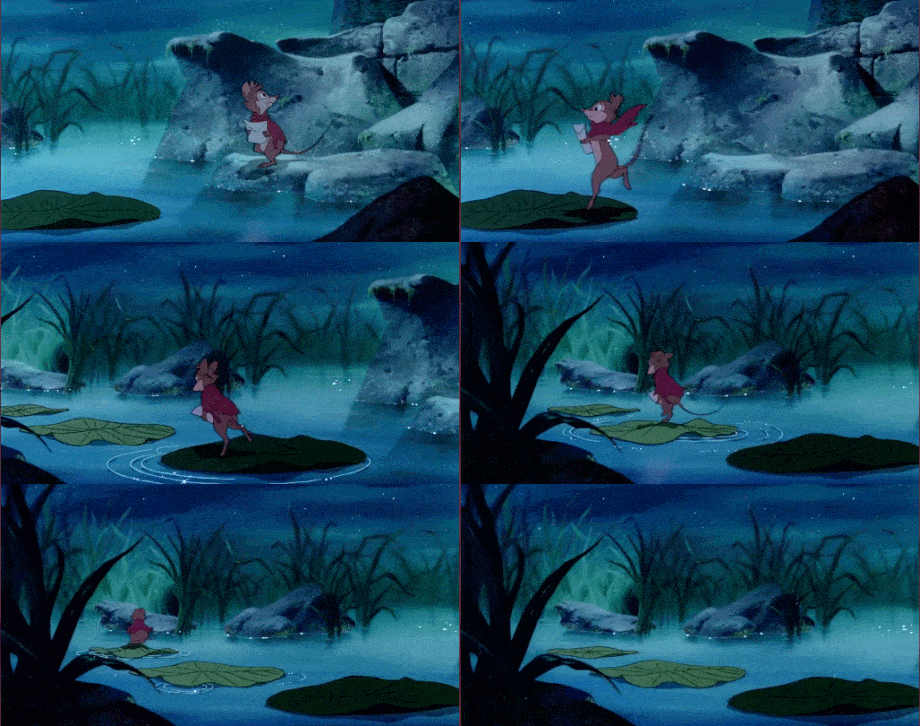


Timothy’s Adventure


By Sophia Guo and Mr. Watt


Timothy was digging for an entrance

Into the Mayor of New York’s mansion

His claws were rubbed raw but his resolve strong

His nose bumped against the edge of the bastion.


He shrieked in delight, his heart pitter-pat,

He looked left and right and licked his poor claws

And spat, whereupon a ladder appeared

Manned by a city rat, with wide smiling maws.


“Hey Tim! You made it,” said the Mayor’s rat

“You are pretty brave for a country brat.”

“Knock it off, Olaf,” said Timothy, hot,

And the two of them got ready to chat.


“Did you find the letter from the mayor yet?

How many hours before the verdict is read?”

Timothy nervously asked, tail twitching.

“You must be famished, kid,” said Olaf, “Bring


Cheese and more cheese for the wee mousie mouse!”

Tim sank his sharp teeth into juicy cheese,

His paws were dripping and onto his blouse

He wiped the rennet and whey, if you please.


In the bastion’s office they listened close

And as the mayor spoke, Tim took good notes

He looked through the hole and at the mayor

He was interested in of what the mayor spoke.


Tim said to Olaf ”We’ve got to warn them!’

The rat agreed and gripped the wall fan.

Timothy trembled in anger, “Listen!”

The mayor was detailing his sick plan.


As the Mayor spoke with hatred the two

Hurried through a tunnel to his office:

Olaf was digging through the Mayor’s desk

While Tim was reading through his correspondence.


Tim yelled, “You’ve got to get over here now!

Here is the plan to make us puppy chow!

But wait, an important page is missing!”

The rat and mouse trashed the mayor’s work scene.


“Here is the missing page in the packet!”

Olaf hurried over, not skipping a beat.

“Read it aloud, Tim, and be very quick!”

The mouse spun his eyes down the planning sheet.


“Step One: Bomb the rat houses everywhere!”

Tim noticed that half of the sheet had gone missing –

Again! Tim was filled with anger, then he

Found it! He was so happy he was kissing


The ground! Torn and dirty paws connected.

Page 2 said, “Step 2. Take all the rats to

The dumpster …” and that’s when Tim lit up!

Tim said to Olaf “We’re going to stop them!”


“But how?” Olaf asked, and clever Tim smiled,

But the smile vanished as his mind blanked

“We’re going to … somehow … take all the garbage

And eat cabbage, and …” Tim spluttered, not mild.


Olaf was so confused. What had happened?

To Timothy, was he out of his mind?

What had happened to the brave country brat,

Thought Olaf, the crazy out-of-his-mind rat?


Tim was so excited that he fell off the

Table onto the cement hardwood floor.

And his elbow started to bleed non-stop

And all the blood leaked through the wooden door.


Olaf tried to help Tim up but Tim was hurt,

Badly. Olaf had to call his friend for help –

Here comes Curt! The most famous rat Nurse

Dashed through the door with his first aid kit.


As Curt unpacked his instruments, he glanced

Worriedly at the mouse, squinting warily,

Firmly testing Tim’s skin and bone. “Nothing

Seems to be out of the ordinary:


Could it be he is just dying of fright?”

“Never!” shouted Olaf, “Tim is mighty

And brave – he is in no way a scaredy mouse!”

They pulled him to the safe part of the house.


Then Curt and Olaf heard Tim say a word.

“Mommy!” he cried, and his small eyes fluttered,

“Where am I, I need water, dear Mommy!”

The rats crowded above him, and shook him:


“Tim! If you can hear me, move your paw please.”

Curt watched the breathing of the mouse, and, shocked,

Said, “Hey, the Ray! We forgot! He’s needs a shot!”

The Ray vaccination they’d forgot.


Curt pulled out a big pointed needle for

Tim, the shot that all the rats got, but Tim

Wriggled like a worm. They strapped him screaming,

As he’d never had pointy things stuck in him.


Tim was as scared as a scaredy mouse,

He closed his eyes and hoped it wouldn’t hurt.

Then Tim felt the tiniest pinch ever,

There was blood on the floor, but only a splurt.


“Tim, do you know what you said in your dream?”

“No, why?” Curt was adamant and unstressed.

“You said something very interesting.”

“And that thing was?” “Your room is a mess.”


“Well, that’s technically true. It is a mess,

And I was dreaming of mom’s secure nest…”

“Is that it?” “Well, you also said that you …”

“Guess?” “That you know something about computers?”


Suddenly Tim’s eyes widened, memories

Flowed in, and he became bold. “I do

Remember!” he cried, and his legs did a dance,

“I was with the rats of NIMH when a toad


Informed us of the Fitzgibbons’ machines

That blink and compute and tell everything,

And we learned what all the buttons mean,

And how the computers work and throw beams.


Where’s the computer here?” Tim inquired, “Get

a pointy thing, we are required to affix

a mitt to it. Tap the table one time.”

“Tap, tap.” “We found it! Ready to crack it?”


“No. I’m not done, yet. A fan, a stand…

I got it! I’m getting a notepad and a pen

So we can take notes while we search for the

Solution,” Tim said. “What about that man


Ben? Isn’t he the head of all workers here?”

“Yes!” said Olaf, “and he speaks Rat! Very near

He has a desk, underground, where he peers

Into the gloom, watching for furry buccaneers!”


Tim smiled when he heard of a human ally

Knowing this was the key to the rats’ success:

The overturning of all the mayor’s plans

The absolute destroying of this crime.


“Lets find Ben right now! He will know how to

Destroy the mayor’s horrible plan,” said

Tim, throwing his paws onto Olaf’s neck;

“The underground paradise will survive!


Hey Olaf, how far underground are we now?”

“Lets see … we are 20 feet underground

How far is the underground secret lab?”

“About ten, twenty more feet to go.”


Ding dong! “Is anyone home? Ben? Are you there?”

The elevator arrived and with it

A rat and a mouse, intent on saving lives,

carrying loads of tools and a menacing air.


Ben had been sleeping with his feet propped up

With his latest invention half-done, he

Spoke in dream, waiting for the answer,

Listening to a very interesting beat.


“Aha!” he shouted, “I see the answer is tiny!

They’re furry, have different sizes –”

“Ben! We’re here to stop the exterminating!”

They squeaked, prancing, jumping, and shaking him fast.


Ben, the inventor, the mice and rat technician,

Worked to find the right combination

His hands were greasy, his hair unkempt, his

Bedroom a mess, but what concentration


With a quick motion of his wrist, Ben snapped

Timothy up in his palm, petted him, and

Led them to his secret lab through the mist

Entering thousands of doors and halls.


Finally, Ben pulled out a rusty key,

Unlocked a small door and led them in.

Then Ben picked up a new slice of cheese,

Dust flying around the brooms and the bin.


Tim swiped a chunk of cottage cheese from Olaf

“Hey!” the rat yelled, chasing Tim around a bunk,

The mouse squealed in pleasure, and with a laugh,

Ran around Ben’s office, dodging all the junk.


They ran to another room and stopped at a bunk.

Under the fan Ben waved his handkerchief.

They fanned themselves with paper clipped to a

Wood chip, but both mice were in a froth.


SNAP! The fan broke into two pieces.

The cheese split and they swatted dust away.

They ran as fast as they could to get out,

Then returned back to Ben’s office.


Still laughing, Olaf tripped on a piece of junk.

Ben sighed and wrenched his face red, scratchy,

He picked his hat from the floor. He was grouchy.

“All right! You crazy vermin: sit on the bunk!”


Timothy and Olaf walked and sat down.

“Alright, what is your idea to get the mayor

in town at the right time so your great plan

will succeed and bring peace and a profound


End to this madness!?” Ben frowned and then smiled.

“I’ve got it! The mayor visits here with

The inspector tomorrow.” Timothy’s

Eyes popped: “Ben, you need to run about a mile,


To bring back tripwires, tranquilizers, and

Pillows, blankets, a cup of cocoa, blindfolds….”

“What’s that all for? I thought all we needed

Was a plan to keep you rats civilized?”


Tim snorted. “Here’s the plan: make sure the mayor

Is here at 9:00 sharp. We will have everything

Ready. When he walks through the double door

He’ll get the ray blast and know our feelings.”


“Go get the stuff now, Ben! And we’ll start to

Prepare. Olaf, you get the laser warmed

Up, and I’ll place everything so the mayor

Can get a jolt of who we are down here.”


Early, Timothy and Olaf woke up

And found themselves sleeping next to the ray,

Ben yelling at them, “Wake up!!! The mayor’s

On his way down!” The two got into


Position and luckily, zapped the mayor.

The mayor fell to the ground, knocked

Unconscious, and when he woke up he freaked out,

Finding rats all over him. He was caught


When he woke up, he got a rash where he

Got hit. He was really ferocious. But

For some reason, he felt really strange.

He didn’t dislike rats anymore.


The mayor asked “What just happened to me??

It feels like I just got stung by a bee!”

Timothy answered: “You just got hit by the ray.

Yes, the one you made, that caused dismay!”


“How can I understand you?” the mayor asked.

“The ray has a potion inside it so

Humans can understand us. Now when you

See a rat or mouse, you may be confused,”


Timothy said scientifically.

“This is awkward…” the mayor said, standing up.

“Now you know how we, rats, feel,” Olaf said.

“Bloomberg – this is what I was trying to tell you.


When I got hit with the ray, I started

To understand rats. But you wouldn’t

Believe me,” Ben said. “Do you understand

Rats now? Do you still want to destroy them?


“No, not anymore: Timothy, Olaf,

Would you like to become my pet rat and mouse?”

Bloomberg asked. “Sure we would. As long as you treat

Us nicely.” But Tim missed Mrs. Frisby.


“How about this, I’ll drive you to visit

Your mom and to ask her if she wants to

Live with us, ok?” the mayor asked.

“I would love that,” Timothy responded.


So they lived happily together in the mansion.



OSCAR S

The Hobbit by J.R.R Tolkien is an amazing book. The Hobbit was published on September 21, 1937 to wide critical acclaim, being nominated for the Carnegie Medal and awarded a prize from the New York Herald Tribune for best juvenile fiction. The book remains popular and is recognized as a classic in children’s literature. Because of the book’s quality and profitability, the publishers asked Tolkien for a second book. The Lord of The Rings was the result, and it has three books to it. It took Tolkien about 20 years to write the trilogy. The Hobbit is an adventure story about a company of dwarves, a wizard and a hobbit. Their goal is to reach the Lonely Mountain and reclaim the land and treasure that is rightfully theirs. In The Hobbit, the characters make mistakes that lead them into many strongholds, both of allies and the enemy.

Bilbo is an adventurous yet shy hobbit and a descendent of the Took clan, a famous adventuring Hobbit family. Gandalf is a wise and old wizard who helps the company from time to time. Thorin and Co. are a group of dwarves, short and strong creatures. Thorin is the son of Thrain, son of Thror, and Thror was deposed after the evil dragon Smaug arrived and killed everyone at the Lonely Mountain, taking over the gold and jewels of the dwarves, three hundred years before. The first occurrence of going into a stronghold is when Thorin and Co. walk off the path and sneaks up on some hill trolls. The trolls do not treat the Company very well, putting them in bags and planning to make dwarf soup.  This pattern of running off the trail reoccurs throughout the book. The second time Thorin and Co. arrives in the strongholds of others is when they are kidnapped by goblins to be brought to the Great Goblin. It is a monstrous-sized labyrinth in the heart of the Misty Mountains. Then, Gandalf reappears and kills many of the goblins, and the Great Goblin. They are forced to run and in the process they drop Bilbo and lose him. This leads him to Gollum’s stronghold, a long, “wide and deep and deadly cold” (81) lake where he swims and finds his food. It is also where he commits his deadly adventures. He is relatively undisturbed unless the Great Goblin sends a goblin soldier to search for food; this is when Gollum kills and devours them.  Gollum also enjoyed fish and the visiting goblins never return. On the outskirts of Gollum’s lair, Bilbo finds something that changes the course of the journey. He discovers a mysterious, ancient, invisibility ring that will change the future of all of Middle Earth.

The third time the Company find themselves in another stronghold is at Beorn’s place. This stronghold, however, is an apiary, a bee farm, and a haven for all sorts of animals, the place where Thorin and Company re-energize and gain their bearings again, after the trials with the goblins. They are led to this stronghold because they were rescued by the Eagles (and led to the heart of the Eagle’s eyrie which also saved them from the wolves called Wargs and the goblins) and are in too poor a shape to continue traveling. Beorn will also keep them safe from any Wargs or goblins. The fourth time they are taken to a stronghold after they try to find food and water in Mirkwood. Mirkwood is a giant forest with many dangers and traps. The only safe path is to follow the road and never stray from it. When they are in the forest, the company is dying of thirst and starvation. They are lured by music and singing off the trail and into the forest, which is exactly what they’re not supposed to do, what they’ve been informed is a very bad decision. Beorn said, “And in the dim shadows of that place I don’t think you will shoot anything, wholesome or unwholesome, without straying from the path. That you MUST NOT do, for any reason” (146). Everyone is captured except for Bilbo with his ring by the spiders and is taken away to the center of the spider’s lair. This mistake causes them to be captured at the wood-land elves’ citadel after escaping from the spiders. They are prisoners for a very long time until they escape, again with the help of Bilbo and his ring. The Company arrives at the stronghold of the men of Esgaroth, ending up there after escaping the Wood-land elves through the river in barrels. The company should’ve stayed away from the village but instead they go on in and have a feast. The last stronghold the company is in is the Lonely Mountain. Bilbo taunts and aggravates Smaug enough to make him leave his cave and start hunting their ponies and then the men at Esgaroth.

Lonely Mountain becomes a stronghold in the Battle of Five Armies. The Wargs, Goblins, Men, Elves, and Dwarves all fight a bloody battle against each other. “The elves were first to charge. Their hatred for the goblins was cold and bitter. Their spears and swords shone in the gloom with a gleam of chill flame, so deadly was the wrath of the hands that held them. As soon as the host of their enemies was dense in the valley, they sent against it a shower of arrows, and each flickered as it fled as if with stinging fire. Behind the arrows a thousand of their spearmen leapt down and charged. The yells were deafening. The rocks were stained black with goblin blood” (305). This expresses how the Lonely Mountain becomes a base for the Men, Elves, and Dwarves and storage as well for the treasure the Company had found.

In conclusion, in The Hobbit the characters make many mistakes that lead them to many strongholds of other people.