

Monthly- Archives: January 2020


SIMON LIM

Mr Watt´s Literary Services

QJ’s dilemma

“I can do this,” a boy at a dinner table said to himself. He wasn’t the only one there. His mother and father were sitting with him. “Can I talk to you guys?” he asked. His mom and dad’s eyes looked automatically to him.

“Yes?” his mom asked. QJ paused.

“If you’re going to say something, say it,” his father said, forking a piece of fried Spam into his mouth, along with some corn. Unlike his mom, Quinn’s dad had a low raspy voice. Staring at QJ was an old habit for him. Quinn Jepson, (everyone just called him QJ), was incredibly shy at this young age. Luckily for the parents, after fourth grade, he had changed. He opened his mouth to speak, but just then all the words that he had been reciting in his head were now gone, his mind was blank.

“Uuuuu ummm, thanks for dinner,” and with that he left the table and went into his room.

​ QJ sat on his bed thinking about when he would tell his parents. A week ago as QJ had been walking home he had seen an abandoned old dog lying in a box that was tilted over. He walked over and petted his rough skin. The dog looked up at him as he petted him. The dog had brown eyes and big floppy ears as if they were stretched out like LaffyTaffy. The dog was so skinny that he could see its whole ribcage; he reached into his backpack and pulled out a couple of blueberries. Moving his hand with the blueberries closer he noticed the dog’s brown body and its light brown spots, and he guessed that it was really old. The dog greedily ate the berries in his hand and looked at him expectantly – Quinn realized that the old skinny dog wanted more food. He spent another ten minutes sitting there, feeding the it the remainders of his lunch.  He fed the dog meatballs from his spaghetti, which the dog first licked all the sauce off of, then inhaled the sauceless meatball. He also fed him some sourdough which QJ never really liked, but it seemed like the dog loved it: he ate it one tiny nibble at a time.

​QJ had been trying to tell his parents all week about the dog that was sleeping in the garage, but whenever he tried to tell them he would forget every word he was going to say. 

QJ thought back to the moment when he decided to care for the old dog. He had carried it all the way home. Even though the dog hadn’t eaten in a long time it was still heavy. Keeping him a secret was hard too. Although his parents almost never used the garage that their car didn’t fit in, they didn’t mind parking it outside. They were basically hoarders: their garage had boxes stacked up, and on shelves; every once in a while a stack of them would fall, the contents spilling out of the boxes; there were old things such as umbrellas, pencils, unused board games and more, scattered across the floor. There was also an elliptical that barely was usable (after many years of it being there), and also three trash bins: one for compost, one for trash, and the last one for recycling. So keeping the dog quiet was easy. There were still some close calls. Once his dad went into the garage to get something, but luckily he didn’t see the dog. QJ had also been very hungry ever since he found the dog. He saved half of his lunch every day for him.

Even though his stomach was empty, his heart was full with love. He guessed that the dog had grown to like him too. Whenever he entered the garage he would look up to him and lick Quinn’s face while wagging its tail as if it were an ancient feather duster.

He sighed deeply and then got up from his bed and headed toward the garage, holding some Spam wrapped with a napkin that he’d stolen from his dinner. He only sometimes stole food from his dinner, but when he did, he only took a little to avoid any suspicion. Qj’s parents could be heard through the wall, discussing a problem that they had been having for awhile: the raccoons. Racoons had been sneaking into their garage, eating all the trash. They had no idea how they got in the garage, and had recently been securing the trash bin tops. But recently they had noticed that the racoons hadn’t come for the past week. He could hear them deciding to ask QJ. 

Later before bedtime, they all sat down on the old gray couch (it used to be white but twenty years of use can do things to couch) for their “before bed family bonding talk”, which was what his mom called it: it was basically a talk they had before bedtime, about the day. They talked for about 5 minutes about what they normally talk about, school, work, new fun things, et cetera. Then his mom asked him, “Have you noticed that the raccoons haven’t been eating our compost lately?”

“Nope,” he said to them.

But he knew why the raccoons weren’t coming, it was because of the dog. It had been scaring the raccoons off. QJ could hear him barking at night. He hoped that they had not. His mom and dad knew he was lying (but not because of the barking at night, they thought it was the neighbor’s dog). It was because whenever he said “nope” he was always lying. Usually he said no, or not at all, or definitely not.

“Are you lying?” asked his mother. Her voice was sweet and clear.

“Don’t lie to your mother,” said his dad. They both stared intently at Quinn.

“Uuuuuum got to go to bed, see ya.”

QJ ran into his room, turned on the white noise, turned off the lamp light, and leapt into his bed. As he lay there he was thinking about if he should tell his mom and dad soon. Maybe they will let me keep him if he keeps scaring away the raccoons, he thought to himself. But deep inside he worried that they wouldn’t let him keep the dog. He knew he had to tell them soon or else they would find out themselves. And if they did, they would probably not let him keep it.

He had asked for a dog before but his mom had said no. He asked her why not and she said: “Because I said so”. He once also asked his dad but he also said no.

That night, QJ was awakened in a very strange way:

Loud barking noises were coming from the garage. He looked at the time: it was ten past two! He leapt out of bed and ran downstairs.  Millions of thoughts rushed through his brain. What if my parents were downstairs just this instant and were looking at the dog? What if they see the dog and get really mad at him?  But what he was worried about the most was the dog. If they weren’t happy, they might send him to the pound or the kennels! As he got down there he saw his parents about to open the door to the garage. He ran downstairs, knocking down the water cup next to his bed but he didn’t stop to clean it up – he just kept running, almost tripping on the stairs. He leapt in front of the door to the garage, blocking his parents’ way. His parents looked at him but not because he was holding the door shut, but because blood was gushing from his elbow. He had hit it on the stairwell.

Next thing he knows he’s in the bathroom while his parents are wiping off the blood on his elbow. While there, they kept on saying, “Are you okay?” over and over again.

“Why do you keep asking me that?” 

“Because we love you and want you to always be okay, we will never hurt you and you will hopefully never hurt us, we will never lie to you and we trust that you will never lie to us…”. And with that, QJ burst into tears saying words that the parents couldn’t make out because of the crying. All they heard was “I am sorry.” 

They waited around 30 seconds for him to stop saying things that they didn’t understand, then they told him to take deep breaths. They sat there for two minutes waiting for Quinn to calm down. The tears that were falling from his eyes had stopped but looked red, because of the cheeks. When he did they asked him to repeat what he had said to them. He told them all about the dog in the garage, finding him, and feeding him, and how much he was sorry for lying to them. 

The parents didn’t freak out like QJ expected them to. 

“Now QuinniePoo we have something to tell you…” 

“Yes we do,” interrupted QJ’s dad. 

“QuinniePoo we have…” 

“MOM!!! Would you please stop calling me that!” 

“Don’t interrupt your mother while she is trying to tell you something important.” 

“Only if she stops calling me Quinniepoo.” 

To the mother, it seemed like the discussion was getting a little bit off track, so she blurted out louder than the two males arguing. “WE KNEW THE WHOLE TIME!!!”

Then there was silence. “You knew the whole time?” QJ said with his tone slowly rising as he spoke, his parents nodding in unison. There was another pause of silence as QJ thought about how his parents hadn’t screamed at him or gotten angry, they had just waited for him to be brave and had hoped he would tell them.  

Then he asked the question he had been thinking of ever since he told them about the dog. 

“Can I keep him?” He asked this quietly as if he wasn’t sure this was the best time to ask. His mother kindly and calmly responded to him.

“Me and your dad think that it would be best to advertise the dog, it might be someone else’s.” The dog entered the room (from the kitchen) and jumped onto Qj’s lap. “But we are gonna do it…” the mother said, glancing at QJ. “We’re gonna do it as a family.”

ANNA QIN

Mr Watt´s Literary Services

Traveling through Different Worlds

Mrs. Whatsit sighed. “Explanations are not easy when they are about things for which your civilization still has no words. Calvin talked about traveling at the speed of light. You understand that, little Meg?” What does that have anything to do with anyone’s civilization?! Why is Mrs. Whatsit talking about explaining? Why is she calling Meg, “little Meg”? Meg isn’t “little”: she is 13 years old.   

The genre of fantasy and mythology basically both deal with things that aren’t real, and can’t happen in normally-accepted 3-dimensional reality.

The difference between fantasy and mythology is that fantasy is more of a made-up thing. For example, it would be fantastic if there were flying bicycles, right? In The Magic Bicycle by John Bibee, John Kramer gets lift-off from an old heavy bike, and whizzes through the air. On the other hand, mythology can be defined as exaggerated versions of reality, held in common by a group of people. Therefore, some myths are acknowledged as commonly-held fact within a small group, and these are rejected by other groups. For example, the Greeks had gods like Jupiter and Mercury which are… also planets. But modern people don’t think of these planets in our system as gods, so much, but as the components in our solar system. But where does modern myth intersect fantasy? 

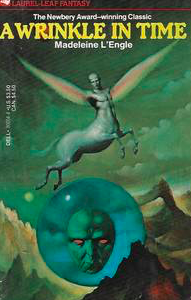
In A Wrinkle in Time, by Madeleine L’Engle, Meg, Charles Wallace, and Calvin O’Keefe were sent through a tesseract to a whole different world to find Meg’s dad who had been lost for four years. With the help of Mrs. Who, Mrs. Whatsit, and Mrs. Which, they stuck together and found a way out. Through thick and thin, Meg, Charles Wallace, and Calvin pulled through to save and bring back Meg’s father. 

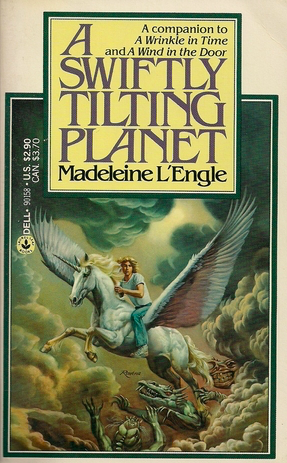
In fantasy, you will see more of flying bicycles and time traveling than gods and goddesses. The authors can get creative and basically write whatever they want: “I looked up into the sky and there it was, the flying cow!” Because it is a fantasy story, if the author did throw that out at you, as the reader of the book, you are almost forced to believe what the author says. When you say fantasy, in my mind, the first thing that pops up are unicorns, princesses, flying, goblins, castles, etc. I think fantasy is for people who like to believe things that are not real. I personally don’t like fantasy. I think that it is too confusing, especially with all the characters in it. It is harder for people to remember because they aren’t real so they can’t relate to it or see from their point of view. Oh, of course, if you like rainbow sprinkles on the mane of a smiling unicorn, or princesses who disappear at the stroke of midnight, perhaps you might enjoy reading fantasy. But in A Swiftly Tilting Planet I was not at all annoyed when Gaudior the Unicorn appeared, saying, “This is what you call me. Yes.” He didn’t consider himself as a unicorn like most would in fairy tales or princess books; nor were my hackles raised when Mrs. Who became a princess and helped Meg, Charles Wallace, and Calvin on their mission. 

The Magic Bicycle is about a boy named John Kramer whose bike got run over. He went to the dump because he was so desperate to find a new bike before a bike competition he was entering. In such a hurry, he took a broken-down, rusty, dirty, old bike home. He thought that he could fix it up before the competition. Soon he found out that his bike could fly and it could move on its own. A man named Horace Grinsby found out that he had this bike and did everything possible to steal it. John had a bad temper and frequently got mad at his bike: one time he almost even ditched the bike because he got so mad at it. He went to Grandpa Kramer’s house and Grandpa Kramer showed him all these cool objects that were so interesting, like goggles that helped him see deeper into the world, interdimensionally. 

In A Swiftly Tilting Planet, Meg’s dad has a connection with the president and gets a call saying that there is going to be a nuclear war. They are sent to go back in time to change a “might have been” and basically save the world. They meet loads of people along the way – some bad, and some good. Gaudior, the unicorn, helps get Charles Wallace to the places he needs to be. However, Gaudior doesn’t see himself as a unicorn as most other single-horned horses would, always disappearing into the distance. Gaudior treats Charles Wallace almost like a partner and helps Charles Wallace through it all. 

Out of all three books, my least favorite was A Swiftly Tilting Planet because there were so many characters involved. It got so confusing and towards the end I couldn’t even remember who was who. Especially because you can’t relate to it as much, since these things probably have never happened to you, it seems a stretch, or an unneccesary obligation to try and really feel as if you are there. With L’Engle’s writing, although you can get a feel of what it is like in their shoes, it isn’t easy to say, “oh yeah, that has also happened to me.” So, it is the fantasy author’s job to walk the fine line between their high-blown imaginations and what could be at least justified, in some way. Therefore, because in A Swiftly Tilting Planet, the number of the characters got confusing for me, I lost interest. My suspension of disbelief was too taxed. But in A Wrinkle in Time, and A Magic Bicycle you get a taste of what it feels like to travel through the tesseract or fly in the sky. You feel what the character is feeling – but what is so different about each character?

Each memorable character has different personalities and traits, just like us. John Kramer from The Magic Bicycle, in my opinion, is brave. He fought back against Horace Grinsby and did all he could to protect the bike. I think of him as brave but you might think of him as defensive, yelling at the bike, but when Mr. Grinsby wants it and offers to buy it for a huge bundle of money and also give him a brand new bicycle, John refuses. When John is by himself and gets super angry at it, he wants to destroy it (but thank goodness he doesn’t)… then, when Mr. Grinsby comes, he is protective of it. Just like in A Wrinkle in Time when I think Charles Wallace is just really smart. You may agree with me or think otherwise. You might believe that he’s not necessarily smart but he is just psychic and can see into the future and get to know a lot of important and magical people. In A Swiftly Tilting Planet in the beginning, (before the onrush of multiple characters) I think Mrs. O’Keefe (Calvin’s mom) is very negative. However, you may just think she is lonely without Calvin at the family Thanksgiving party and that she just really misses Calvin. 

The challenge for fantasy writers is to make the leap from realism to fantasy effectively. In the beginning of A Wrinkle in Time, Meg is scared because there is a storm and her bedroom is in the attic, so she goes downstairs. Then it becomes fantasy because Charles Wallace knows that Meg is going to come down stairs and he has prepared a sandwich for her. When in A Swiftly Tilting Planet, Meg and her family plus Mrs.O’Keefe are having a realistic Thanksgiving meal, they get a call from the President of the United States saying there is going to be a nuclear war and that they have to go back in time to stop it. This call from the President adds veracity to the situation, and as he instructs them about the time travel, the reader has a sense that this could indeed happen. And from A Magic Bicycle, realism changes to fantasy when John Kramer is riding his bike around and all of a sudden it lifts up off of the ground. Because of the thrill the reader experiences when this happens (and because the reader expects it from the cover illustration), the magic is readily accepted.

How the author goes back and forth… from the world in which we live to things we wish we could experience, or from hard truths to things that are imagined, or that appear in our dreams – these are the components that make or break the leap of faith for the reader. The author goes back and forth from what we wish were real and things that actually do exist, to things we have dreamed about, or experiences that we know we can’t have. This is what makes the jump from realism to fantasy.

In A Wrinkle in Time, they travel to a different world; in A Swiftly Tilting Planet they travel through time; in The Magic Bicycle, they travel through the sky. Each are different but all involve traveling somewhere that most humans don’t go.  A reality that you find in The Magic Bicycle is that John lives in a real world but as soon as he puts the goggles from his grandpa on, he sees and interacts with, so much more. From the cobra symbol to the three crowns, he can see so much deeper things in the sky. By seeing these things through the goggles, we have to ask ourselves this: are we simply blind to these things?

In each book, the characters travel through different substances. One is time (Planet), another is space (Bicycle), and last, (Wrinkle), through dimensions. The Magic Bicycle is about a boy (John Kramer) who travels through space above the Earth, but who learns (as part of his inner journey) to look into space. A Wrinkle in Time is about three kids, Meg Murray, Charles Wallace (Meg’s little brother who is a genius) and Calvin O’Keefe. They travel through a tesseract which locates them elsewhere in the universe, but also through different dimensional area, including a 2 dimensional planet. In A Swiftly Tilting Planet, there is a “might-have-been” and they need to travel through time and change history as it is. Not only do they all travel through something, they also have a goal that they are trying to accomplish: The Magic Bicycle, to win the contest and keep the Magic Bicycle safe, A Wrinkle in Time, to get their father back, and A Swiftly Tilting Planet, to change the course of history. They all have certain things that keep them motivated and push them to get moving forward, whatever type of space it is. Not covered in this essay is the Madeline L’Engle book, A Wind in the Door, which explores travel through the micro-verse, which are the tiny areas which we can see in our cells, in molecules, and even inside atoms, with objects called quarks. This novel also features the Murray and O’Keefe families.

Something that baffled me was how did Charles Wallace know who Mrs. Whatsit, Mrs. Who and Mrs. Which were? How did Charles Wallace know so much about them when Meg knew nothing? How does Charles Wallace know when Meg can’t sleep and is going to come downstairs? He even made sandwiches for them because he was so sure that Meg was eventually going to come down. How can Meg just “kethe” things? How it is possible for her just to know what it is or see things? Is it basically like telepathy? How can some goggles just let you see a whole new world? Was it a coincidence that John found the bike that Grandpa Kramer knew so much about? How can a candy be so sweet and tempting that a boy would literally steal a bike from someone’s house and possibly get arrested? Was it just a coincidence that John accidentally was in a rush so he forgot to screw in a part and that was how it could fly? Was it faith? Or fate? These books lead to so many different questions. As I mentioned above, the authors of fantasy books can write anything their imaginations create, like mind-reading or teleporting, (many things humans wish were possible) and while I used to think that it wasn’t very interesting, I now realize that fantasy is more than children’s fairy tales, different from myth. In fantasy, there are so many different ways to see how the battle between good and evil can play out.