Monthly- Archives: March 2013


ALEX LIM

Mr Watt´s Literary Services

This week’s reading for me was a tense, nonstop mystery. The book that I am currently reading, The Mummy, the Will and the Crypt, by John Bellairs, is hard to put down, and it is exciting. This book is one of the top ten books I’ve ever read. This book however has some kind of violence in a way that is hard to describe. The Mummy, the Will, and the Crypt is a book more meant for kids age 8 to 11. This is because if the book is read by 13 year old it would be boring, and if it was read by a 6 year old he or she would not understand the book and what specific sentences mean. The book however is also somewhat tragic because Grandma gets a brain tumor, and Johnny’s dad also gets his plane shot down by the Koreans and they don’t know if he is dead or alive.

The part I am reading right now is when Johnny is going to sneak into the mansion and find the will. The thing with this story is that you could think it was over after something good happens, but then there is another problem that Johnny has to deal with. This book specifically is more mystery than action, and I personally like action more than mystery so that’s why it’s not my most favorite book, however, if you like mystery books I highly recommend you check this book out. It makes you feel tense and is somewhat scary. As I said before this book is tense, mysterious, and nonstop. If you like mystery books, go to your local library right now, get and read, The Mummy, the Will and the Crypt by John Bellairs. If you like it you can tell me (Alex Lim); if not than it’s no big deal.


OLIVIA SHEN

Mr Watt´s Literary Services


The Adventures of Anna and Sunshine: a play about an unknown unicorn and a stubborn bunny that go on adventures to discover the secret between humans and animals.

Interviewer to the camera:

“Have you ever:

•    Wished to see a Pegasus?

•    Wondered why a Unicorn has a horn but not a Pegasus, or why Pegasus has wings, while the unicorn doesn’t?

•    Why the legendary Pegasus became so famous?

“Well, Anna, a bunny, recently spotted one off of the coast of Hawaii. She has also been wishing, wondering, and whying about Pegasus, and with her luck, she saw one,” announced the news reporter on national television. “Can you tell us more about it?”

“I’ll be hoppy to,” answered Anna. “I was at my Hawaiian Islands a few months ago, on a mission to find out who on earth was RUINING my precious home. I had a perfect plan, but God decided to do his laundry (it is said that it rains when God is doing his laundry). So right in the middle of my mission the sky turned dense. I was so optimistic about finishing that I didn’t plan ahead, I mean, I knew that usually when the clouds turn dense, it will rain. Anyway, the sky was turning darker by the second, and I was getting worried.  I also didn’t think about the predators: coconuts squashing you, foxes, falcons, etc. I can give you a long list of things I didn’t plan for but, those were the most important ones. Anyways, like I said, I didn’t plan about my predators, I didn’t even think about a predator being about 5-6 feet away from me. A fox was sneaking up from behind, and since I saw the shadow, I was hopping around the forest screaming “Somebody help me!”

“Suddenly, a Pegasus with a long frosted mane came running, his head swaying back and forth to a bird’s song. I was so scared I almost fainted. I heard a running sound attacking my ears, and something grabbed my back and threw me onto his back! “Save me!” I cried, but luckily I landed right on target, in a big pile of cow manure.

“Sorry ‘bout that!” the Pegasus cried. He turned back and started to get me, as the fox was getting closer and closer, and the Pegasus grabbed me again and started running as fast as his legs could run; this time I landed on an even better spot: goat manure. I was covered in cow manure and goat manure, and I looked behind me. The fox was like, five feet away, and I was about to have a heart attack.

This time, unfortunately, the fox got me – he slung me over his shoulder and started running, but I had a spasm attack, and this loosened me from the fox, and again I fell. Luckily, I somehow landed on the sitting Pegasus, who took off like rocket blasting into outer space. This time, instead of having a spasm attack, I held onto Pegasus’ mane. The breeze and rain plastered onto my twitching face, and the sky was turning orange as the almost impossible-to-see sun began to fall. I was beginning to close my eyelids when I realized was at the end of Hawaii.

SCENE 2

“Hold on tight,” the Pegasus called out. “We’re going for a ride!”

“Where are we going?” I questioned nervously.  I, personally, am afraid of heights.

“China, here we come!” the Pegasus cried again.

“China! Isn’t that like, like, 3,000 miles away?” I screeched.

“Actually, its 5093.3 kilometers (3164.84 miles),” the Pegasus replied.

“Can’t we just somehow sneak onto an airplane?” I moaned. “Save me!”

“Do you have any issues?” the Pegasus wondered. “Because we can turn back if you have any issues.”

“No, will you go back if I’m afraid of heights?” I questioned.

“NO!” the Pegasus bellowed.

“Actually, I do have an issue,” I said, as a light bulb formed in my head.

“What issue do you have?” asked the Pegasus doubtfully.

“Um, I have Ulupalakuaities,” I answered.

“What is Ulupalaities or whatever it’s called?” asked the Pegasus.

“It’s a disease!” I cried, “Sheesh, Almost every bunny has it.”

“Really, because my friend is a bunny and she doesn’t have it,” the Pegasus yelled as he was flapping his wings.

“We’re near Africa,” the Pegasus yelled. The blazing hot weather of Africa flew into my skin. I cringed and twisted a wet nose. I shut my eyes… could this be just a dream? After I opened my eyes I saw all these circles and triangles gliding in the air.

“Africa already!” I exclaimed.

“See, time flies by when you’re complaining!” the Pegasus joked.

“Yeah, Yeah, How many more minutes until we get there and WHY ARE WE GOING THERE!?!?!” I shrieked.

“Well, I’m going on a mission – ” “And I was too!” I interrupted.

“Anyways,” the Pegasus continued. “I am on a mission to… Well, it’s hard to explain.”

“Well, whatever the mission was, it wasn’t as important as mine was!” I screamed.

The Pegasus thought for a minute. “Okay, I have a deal for you, ready?”

“Ready,” I replied.

“Okay, so, if you help me with my mission, I’ll help you with yours,” the Pegasus stated.

“Fine, I’ll do it.” I muttered.

“Okay, for my mission, just follow my lead, all right?” the Pegasus instructed.

“All right,” I sighed. “Follow my lead on my mission, all right?”

“Sure!” the Pegasus cheerfully replied.

SCENE 3

“So, as you can see, there is a long story behind this.  We are going to have a short break. Don’t change the channel!” said the news reporter.

“And… we are back live with Anna the bunny with her story of when she saw a Pegasus.”

“So, where were we again?” the bunny questioned.

“Um, we were at um, when, uh, I forgot…” the reporter blurted.

“Ah, yes, now I remember, we were at the part when you were telling the Pegasus what to do when you guys are on your mission,” the reporter shouted thoughtfully.

“Ah, yes, yes, yes, so:

“Okay, for my mission, just follow my lead, all right?” the Pegasus instructed.

“All right,” I sighed. “Follow my lead for my mission all right?”

“Sure!” the Pegasus cheerfully replied.

As the wind plastered my twitching nose, I looked around at the beautiful sunset, clouds, etc; trying not to fall asleep. Now, there could be a million ways to hold onto the Pegasus, but I did the most painful way from the Pegasus’s point of view: gripping onto the mane ATAP (As Tightly As Possible).

“So, since we have some time before we arrive, I’m going to start explaining the basics. AKA Ground Rules,” the Pegasus barked.

“#1: No running around like a wild dog, we are going into one of the biggest cities in China.”

“Which is…” I interrupted.

“Hong Kong,” the Pegasus answered.

“Can I quickly interrupt?” wondered the news reporter.

“Sure,” Anna replied.

“What is the Pegasus’s name, exactly?”

“Oh! Did I forget to tell you?” Anna cried. “The Pegasus’s name was Sunshine.”

“Okay, got it! Sunshine!” the news reporter cried. “Okay, go on.”

“#2. Do not get any food without my permission. It is dangerous out there and I need your help.”

#3. Stick with me no matter what happens.”

“Anything else?” I questioned.

“No,” Sunshine replied.

“Okay, so, when are we going to be there?” I asked.

“8…7…6…5…4…3…2…1…, we are in China!” counted the Pegasus.

“I mean, when are we going to be in Hong Kong?” I restated.

“5…4…3…2…1…, we are in Hong Kong!” counted the Pegasus again.

SCENE 4

As we started to land, I saw tall buildings standing very close together, a crystal ocean, and then I realized it was an island. I thought that Hong Kong was beauteous but, of course, dumb ol’ Pegasus thought it was normal! I mean compare a beautiful city to a typical house or apartment… I mean, yes, your house or apartment is large and pretty, but, seriously, you would rather see a typical house or apartment than a beautiful city? Sheesh, the Pegasus is crazy.

Anyway, the landscape was obnoxiously beauteous. We started to land in a crisp green forest when we came upon a strange man who looked like Confucius. I know that Confucius died a long time ago so I knew it couldn’t be him, but I thought about Confucius’ story. According to the story, Confucius knew he was going to die soon when he saw a unicorn. But, wait, Pegasus wasn’t a unicorn; he was a horse with wings!  Could a Pegasus bring luck to a wise, old, person? I figured that Pegasus’s mission was to show someone that he/she had good luck.

“Hey, Sunshine?” I started. “Is your mission to give a wise, old person luck?”

Sunshine snorted in surprise. “Yeah! Why?”

“Because I have a question.”

“What?”

“How is that hard to explain?”

“Well, if you didn’t know that Pegasus brings luck then it’s hard to explain,” Sunshine replied.

“It is Not Hard To Explain!” I screamed.

“Is Too!”

“Is Not!”

“Is Too!”

We were fighting for a while.


SCENE 5

“Stop!” shouted the Confucius twin. “You’re all being such babies, ridiculous babies; it doesn’t matter how easy or hard it is, it’s about working together.”

“Annnnnnnnnnnd?” Sunshine asked.

“And, you are suppose to be working together to help each other out,” Confucius tried to explain. “You’re supposed to be helping her and she is supposed to be helping you.”

“So?”

“So, you’re supposed to be helping her.”

“Well, she’s supposed to be helping me; not the other way around!”

We were in a lush forest, and bright green trees swayed to the gentle beat of a bird’s song. Now, you might be wondering how on earth Confucius was here after he died…oh, you’ll figure out later. Anyway, Confucius-ish acted exactly like Confucius, I mean, he acted so teacher-y, commanding, and like he’s the boss; he also looked exactly like him.  I was starting to wonder if we were back in time.  As I said before, his acts so teacher-y, commanding, and like as if he’s the boss. Confucius-ish started to blab about something like… chemistry. He started to then blab about the linear equation. He said something like… – x + 5 y = -4 – 5 y = 0. Anyway, the problem was sooooooooo confusing. I mean who knows that? He was talking for a very, when I mean very, I seriously mean VERY, long time. I thought his mouth didn’t know how to close. Sunshine told me at least FIVE times to listen to Confucius. Wait a minute, could this be the real Confucius?      

“20 minute break; be back by 8,” Confucius commanded. I dashed over to Sunshine. “What year are we in?!” I shouted.

“Um let’s see here; 479 B.C.”

“479 B.C!”

“Yep.”

“You never told me that!”

“Well you wouldn’t come if I did tell you!”

“Well, YEAH! That’s the point!”

“So, you’re following me! If you didn’t come, then I wouldn’t have a helper! Are you still following me?”

“Yeah.”

“Without the help, I wouldn’t be able to accomplish my mission.”

“What about my mission?”

“What mission, Anna?”

“My mission was to see who was ruining my home; I was trying to gather up some conclusions. Well, guess what? I’m leaving!”

“You wouldn’t dare!”

“Try me!”

“Sure, first of all you need to cross the ocean, which leads us to number 2; you have to travel back to 2013!”

“Oh yeah, I could still do my mission here.”

“It’s not the same as Hawaii!”

“But it’s similar.”

“True that, true that.”

“Hey, look, it’s 7: 58, we should get ready for Confucius’ lesson about linear equations.”

“Sure, let’s go.”

 SCENE 6

Back with the reporter

“Anna, I’m confused, didn’t Confucius die in 479 B.C.?”

“Yeah -”

“So, Pegasus is a time traveler?”

“Yes.”

“Ohhhhhhhh, now I get it, go on.”

Confucius must have talked about four different subjects per hour, covering ten total, because he didn’t let us go to sleep until midnight! When we were preparing for bed I asked Sunshine,

“How much longer do we have to stay here?”

“About one more day. Can you manage?”

“Yeah… I guess.”

“Good bunny.”

“Hey!”

“Sorry.”

The moment I fell onto the squishy, soft, comfortable bed I immediately fell asleep.

***

Confucius dragged me out of bed at 6 am. I mean, has he ever heard of beauty sleep? No, he hasn’t. All he thinks about is learning; learning, learning, learning; is the only thing in his noggin’?

I looked at Confucius carefully. After all, today we got to play educational games.  I noticed that the morning sunshine reflected on his pink-white beard.

“The first game we will play is Mindblaster. Someone thinks of ten colors and the players have to guess it. ”

I couldn’t exactly hear what he was saying because of the wind heavily blowing.

All of a sudden, Confucius had trouble thinking; I thought it was just because of old age. He was sputtering and gasping in between words. I thought and thought about why he was doing this. Perhaps, I thought, Confucius is going to die… today!

“Hey, hey Pegasus!” I whispered.

“Yeah, what’s up?”

“I need to talk to you!”

“I can’t! I’m trying to hold someone from falling onto the ground,” he whispered as he pointed to Confucius.

“Here, I’ll grab him. You drag a big rock over and rest Confucius on it.”

“Okay, what did you need?” Sunshine questioned. “Someone’s dying here!”

“Look, we can’t get suspected for assassinating Confucius which only leads us to going back to…”

“2013!” we chorused.

SCENE 7

Sunshine boosted me onto his back. He started to run and we lifted off the ground.

As we flew back to Hawaii the fresh air plastered onto my face like rubber glue. I looked around; everything was moving so quickly, and I could only see patterny shaped things, like circles swirling in triangles… all I could hear with my tiny little ears was a buzzing sound. So Sunshine was right! We were traveling back into the future! Within a few minutes Sunshine came to a sudden halt. I looked around… We were in HAWAII! I leapt off Sunshine’s back with joy swiftly flowing through my fur to the prestigious air. I ran around the area I was in… okay, fine, I hopped around the area, inquisitively.  I then started to hear drilling. I hopped through the area with my nose stuck up high, and listened for the RUINERS. I hopped around for a few hours on Maui Island and finally came upon a construction site… at least I think it was. I saw humans. So that was it! Humans are destroying my precious home – the place I grew up, the place I was born, the place Mother bunny and Father bunny met, the place where Father bunny gathered food. Now, my home was being ruined.

My ears burned with fury. Why would anyone do this to me? I didn’t harm them or anything. I really wanted them to stop, to stop ruining my precious memories, to stop ruining my home, to stop cutting down trees, to stop pouring concrete foundations, to stop framing it up with wooden beams, to stop hammering their nails, and to stop everything! They didn’t know how it was harming animals. After all, humans are also animals. The horrible sound of the drilling flowed through my eardrums. The noise was more and more painful by the second. I could tell my eardrums were going to explode any moment now. I was so anxious to get revenge. After all, the workers do deserve a something something.  I was thinking over a plan when Sunshine appeared, singing! As I listened, I thought, wait a minute, I can put on a show! I can visually represent how we are being damaged and Sunshine can sing a song about the habitat destruction. I’ll call it the DESTRUCTION SHOW! I can make tickets, customize flyers, have VIP seats, (for the construction workers) and hand out programs.

“Do you have a copy of the program,” the reporter questioned.

“Yeah, wait, let me find it… Ah ha! Here it is!”

This is what it looked like:

The Destruction Show!

Starring: Anna Bunny and Sunshine Pegasus

 Fee: $10

Date: 1.20.13

“Wow impressive! Go on.”

“Anyways, we started to put up all the posters, near where there was a lot of recreation.” Anna hesitated. “Ok, mostly at the construction sites and parks but we still but some up at other places! Oh yeah, and I composed my first piece of music for Sunshine! It went like this:

“Hey People! In case you haven’t known!

Hey Humans! The earth isn’t on a loan!

Start listening! Animals are talking to you!”

After rehearsing, we thought we could advertise the show on the radio, but we needed money so we decided to have a… Lemonade Sale and Bake Sale! For the lemonade sale we made lemonade out of freshly squeezed lemon juice and sugar. For the Bake Sale we somehow managed to bake a variety of cookies, (sugar, chocolate chip, butterscotch, butter, plus a secret ingredient) cupcakes, brownies, and cakes. We decided to have it on the 5th of January, 15 days before the show. That day we raised $5,000! We definitely had enough to have an ad on the radio. We needed to buy costume supplies (Mother bunny taught me how to sew) and then we might have enough to rent a theater!

Luckily we tracked down all the posters we put up and added ‘Place: The Maui Island Palace Theater, 521, Kings Street, Ulupalakua, Maui Island, Hawaii.” On the 7th we traveled to the theater. The place was gigantic. Sunshine leapt onto the stage screeching the song I wrote for him. I folded my ears the best I could. He sounded horrible!  I walked up to him.

“Hey Sunshine! Let me teach you how to sing!” I hopped onto the piano, starting to play the introduction. Halfway through the song the door creaked open. A faint, far-off voice yelled “Security! Call the Animal Control! Bunny and Unicorn spotted… Exit 4 right wing!”

I glanced at Sunshine. “Run!” he shouted.

“I can’t,” I cried. “I hop! Not run!” Sunshine sighed and told me to hop on his back. I was next to Sunshine until he kicked me with his leg; the next thing I knew, I was flying through the air onto his back.

“Ready?” he asked.

“No need for ready-or-nots. Just go!!” I yelled.

“Okay, okay, but you don’t need to shout,” he replied.

“Just go!” I shouted once again.

We realized as we flew away that we’d neglected to get permission to use the theater.

End of Act 7

Act 8

“What are we going to do?” I cried.

“The only thing we can do is travel back in time!” Sunshine answered.

“But we can’t! What about Confucius!”

“Right, What if we traveled to 179 B.C.? That way we can’t get accused of murdering Confucius?”

“What if we just go back 5 days or something?” I asked.

“We can’t!” he snorted.

“Why?!” I wondered.

“It’s either we stay where we are or go back to 179 B.C.”

“Well, I choose or.”

“Or isn’t a choice.”

“Fine, I choose choice.”

“Okay, stop messing with me and we can go back five days.”

“So, you were lying?”

“No, I was just saying that you had to choose one or the other.”

“So, you were lying!”

“How?!”

“You said we couldn’t go back five days.”

“No I said it was hard to – finding the right second to move out of the time warp is really tricky!”

“But you said we couldn’t!”

“It’s just hard since every day goes by extremely quickly. If miss it by one moment you can be really off.

“Just try… please?!”

“Fine, I’ll try but don’t say I didn’t warn you!”

“Okay.”

Sunshine started running really fast. As soon as I could see faint shape of triangles and circles, Sunshine started diving down. Sunshine quickly looked at the date.

“Yes, exactly 5 days!” he yelled.

“Yes!” I screamed. We landed exactly where we were last time, Maui Island. I knew exactly how to get to the theater. First you turn left, then right, then left, then left again.

“Aha,” I shouted, and then read the sign: The Maui Island Palace Theater, 521, Kings Street, Ulupalakua, Maui Island, Hawaii.

We lined up to speak to the front office. Once we got to the front we came across a nice women behind the desk. We discussed renting the theater. We decided to rent it every Monday, Wednesday, and Friday from 12-2 for two weeks. That gave us two hours to practice each day, totaling six hours each week. So it led to being charged for 12 hours of practice.

“That should be enough!” Sunshine cried.

“But a lot of money and effort,” I grumbled.

“Okay… that costs $3,000.” The lady calculated.

I pulled out of my wallet out of my fur and handed three $1000 bills to the lady.  Since it was Wednesday, and was noon, we walked into the theater and started rehearsing. We started with a vocal warm-up. Then we started with the play. We found some tape and marked where we were located on the stage, adding props and making notes about costumes. That took us about an hour and we had an hour left to practice. We started with the Grand Finale because well, it’s the grand finale alright?! It has to be perfect.


SCENE 9

After a week of work and acting we decided to hire fifty of my relatives to take part in the play. Mostly as staff – lighting technicians and backstage crew. These bunnies make it possible to run the play. We also needed a stage manager. We decided it to have my mom be the stage manager since she did some acting when she was younger, and stage managers are in the same union as actors.

“Anna!” cooed the news reporter.

“Yes?”

“What was the secret ingredient to the cupcake recipe?”

“Uh…uh… It was secret alright? A secret ingredient is sec ret! Hence the word… SECRET!”

“Okay… Please finish the story.”

“Alright, after all, it made sense since that my mom would stage manage since no one else in my family did acting. Anyways, it was quite tough to find my relatives and make sure they knew how humans are harming animals. It ended up that they understood imperfectly how humans were harming animals so, we basically spent three hours lecturing them for nothing.

“That was a extreme waste of time.” Sunshine sighed, after we were finshed.

“Yeah,” I agreed.

We improved day by day. At the end we decided to not have costumes since it took too much time and money. We also decided to postpone the play since we felt we didn’t have enough time. We decided to have it on the Thursday, January 30th so humans would  have time to settle down after the New Year. On the 25th we decided to have an extra three days of practice including two mandatory dress rehearsals. The problem with the mandatory dress rehearsal is that since it is a dress rehearsal we have to pay extra money since there are more people participating. At the end we had to pay an extra $2000 for the extra three days.


SCENE10

The Play

It was January 30th, the day of the play. The theater was getting extremely crowded. Just before the play I peeked out of the curtain.

“Sunshine!” I cried. “It’s a full house!”

“Yes! We did it!”

“And I couldn’t do it without your help!”

Sunshine blushed, his frosted mane turning pink.

“Alright everyone! Ten minutes!” yelled my mom. “If you didn’t get makeup yet, go to Uncle George and Aunt Isabel now!

“Okay, 5…4…3…2…1…It’s show time!”

We started out with a couple of bunnies dressed as humans using construction tools to build something. Then we had five bunnies coughing away from the smoke and dirt. From that we had a couple bunnies pretend to die. This changed the audiences’ face. I even saw a couple of faces with tears rolling down their cheeks. After a few more scenes most of the audience had tears in their eyes. Some of the construction workers looked as if they were about to quit. After all of the skits we first took a bow than went onto the Grand Finale. By the time I started to play the intro to the final song, most of the audience was already clapping!

“Hey People! In case you haven’t known!

Hey Humans! The earth isn’t on a loan!

Start listening! Animals are talking to you!”


SCENE 11

Happily Ever After

At the end of the finale we took one last bow and walked off the stage. We gathered at the lobby of the theater for snacks and drinks.

“That was awesome!” my cousin Isabella exclaimed as she started munching on a chocolate chip cookie. Isabella loved chocolate chip cookies, especially with milk.

Someone then tapped on my back. It was Sunshine!

“Listen,” he whispered. “I really got to go. I have another mission: I’ve got to make sure Ghengis Kahn is kept away from India! I have to go back to 1215!”

“A.D. or B.C.?” I asked.

“A.D.,” he snapped. “Do your history timelines!”

My heart sunk. I really wanted him to stay.

“It was really nice meeting you,” he continued. “I wish you all the best.”

“Thanks, same to you.” I sniffed and my bunny eye blinked away a gigantic clear teardrop.

I watched him take off. Once he was in the sky he turned his head back and waved. I smiled and waved back.


SCENE 12

“Thank you Anna!” smiled the reporter. “That was a very touching story. Well that’s all for today.”

“See you tomorrow!” waved the news reporter to the camera. Anna waved and smiled, and one last drop fell from both her bunny eyes.

THE END


 [U1]


DOMINIKA BRICE

Mr Watt´s Literary Services

The Prussian IV Corps in the Battle of Waterloo


Friedrich Wilhelm Freiherr von Bülow was the commander of the IV Corps of the Prussians. The soldiers he commanded were highly skilled in combat. Bülow was a white man who wore a white wig with a small ponytail, a red and dark blue high-collar jacket, and epaulets that look like braided ropes. There were many moving parts of the Prussian Army, and one of them was the IV Corps. The IV Corps usually battled in long lines of soldiers, stretching horizontally as far as the eye could see. They had no more than 10 rows of soldiers, but huge columns made of these rows.

The Prussians’ IV Corps consisted of about 32,000 soldiers in total, double the size of Napoléon’s IV Corps. There wasn’t just one IV Corps in the Battle of Waterloo. The French had their own: the commander of the French IV Corps was Marshal Nicolas Soult. To give you an idea of the IV Corps’ size, let’s study its components. General Bülow’s Prussian IV Corps was composed of the 13th, 14th, 15th, and 16th Brigades. The 13th Brigade was commanded by von Hacke with 6,560 men, the 14th Brigade was commanded by Ryssel with 7,138 men, the 15th Brigade was commanded by von Losthin with 7,143 men, and the 16th Brigade was commanded by von Hiller with 6,423 men. In the IV Corps cavalry, the 1st, 2nd, and 3rd Brigades were commanded by Prince Williams of Prussia, consisting of 5,586 men on horses, almost five times more than the French IV Corps’ cavalry. Finally, in the artillery, commanded by Braun, there were 1,202 men, which was about six times bigger than the French IV Corps’ Division d’Artillerie.

The Duke of Wellington was the commander of the Anglo-Allied Armies, Napoléon Bonaparte was the commander of the French Armies, and Gebhard von Blücher was the commander of the Prussian Armies. Napoleon’s army had 72,000 soldiers while Blücher had 50,000 and Wellington had 68,000. Napoleon’s enemies had a slight disadvantage with the numbers when they fought, but when they joined their armies in the end, they had 118,000 soldiers, which was 46,000 more soldiers than Napoleon. The I, II, and III Corps consisted of a total 32,500, 33,000, and 25,000 soldiers, respectively. So why was the Prussian IV Corps so well known after their victory at the Bois de Paris Road? Well, the Prussian IV Corps had lost every battle prior to this. But in the Battle of Waterloo, the Prussian IV Corps was instrumental, especially the 15th Brigade, in preventing more of the French army from arriving at Frichermont, and from using the Bois de Paris Road.

In every battle leading up to Waterloo, the Allied armies had been unable to defeat Napoléon. In the Battle of Ligny (June 16, 1815), the Prussians lost to Napoléon. The Battle of Quatre-Bras was where the Anglo-Allied Armies lost but the Prussians held a the French at the Battle of Wavre. On June 17th, 1815, the Anglo Allied Armies arrived at Waterloo first, in the morning. Then at night, Napoléon’s army arrived.  They started fighting the next day before the Prussians arrived. When Wellington was in trouble, the Prussians came, and together the Prussian Army and the Anglo-Allied Armies fought together long and hard, determined to end Napoléon’s reign over France.

Napoléon Bonaparte was born 15 August, 1769. He was of Italian nobility, born in Ajaccio, Corsica, a French Mediterranean island. He was teased when he was in school for his Italian accent. He was the second born of eleven, with eight of his siblings, Joseph, Napoléon, Lucien, Elisa, Louis, Pauline, Caroline, and Jérôme Bonaparte, making it through early childhood. His parents were Leticia and Carlo Bonaparte. His first wife was Joséphine da Beauharnais, and was the first empress of France. Since she didn’t bear Napoléon any children, he divorced her and married Marie Louise of Austria. She agreed to marry Napoléon, even though she was raised to despise the French. They had one son together.

When Napoléon was 35 years old, the Senate declared him emperor of France. The weird thing was that his father was an anti-French lawyer. In school, Napoléon was very focused on his studies, which was part of the fact why he was chosen to be emperor. From being studious, he thought of more intricate and complex battle strategies and he could read the battlefield like an open book. Napoléon’s reform was called the Napoleonic Code.  The Napoleonic Code was one of the few documents that have influenced the whole world, according to historian Robert Holtman. This code forbade special privileges given to one, based on who you were born to, and the code embraced freedom of religion and made it possible for the more qualified to land a better job, not just because they were blood-related. This code also replaced feudal law, which had allowed lords to protect the people that worked on the land, who basically had to work for free. This code was spread throughout Europe, making a great impact on civil laws. Napoléon led his country to many victories around Europe for nine years as emperor. He kept winning territory for France until in 1813 he was exiled to the island of Elba, a Mediterranean island near Tuscany, Italy. He stayed there for a year before he escaped and made it back to France. His soldiers were so loyal to him that when he came back, they cheered and they executed the emperor who was  assuming the throne. The people said that the old king wasn’t as great as Napoléon was. Napoléon was also very inspirational. He increased his army in preparation for  the Battle of Waterloo from 200,000 to 300,000 by encouraging many of his veterans to reenlist.

Napoléon defeated many coalitions before the Battle of Waterloo, including the First Coalition from 1792-1797, when Napoléon was attacked by the Habsburg monarchy of Austria. Napoléon’s France invaded Central Europe, Italy, Belgium, Netherlands, Spain, and the West Indies. The Second Coalition, the Habsburg monarchy of Austria and the Russian Empire, from 1798-1802, tried to eliminate Napoléon. He was attacked in Europe, the Middle East, Mediterranean Sea, and the Caribbean Sea. The Third Coalition, an alliance of Austria, Portugal, Russia, Great Britain, and Italy, from 1803-1806, was defeated by Napoléon in Central Europe, Italy, and on the Atlantic Ocean. The Fourth Coalition, (Prussia, Russia, Saxony, Sweden, and the United Kingdom), from 1806-1807, lost to Napoléon. They fought in Saxony, Prussia, Poland, and East Prussia. The Fifth Coalition, the Austrian Empire and the United Kingdom, in 1809, lost to Napoléon and Bavaria. They fought in Central Europe, Italy, and the Netherlands. The only coalition to defeat Napoléon before the Battle of Waterloo was the Sixth Coalition, (Austria, Prussia, Russia, the United Kingdom, Portugal, Sweden, Spain, and many German states), from 1812-1814. They fought in all of Europe and Napoléon’s defeat led to his exile to the Mediterranean island of Elba, near Tuscany, Italy. But he escaped that same year to return to his rightful throne.

Napoléon wasn’t really happy to go into the Battle of Waterloo. He didn’t really want to go to battle about one year after he escaped his exile. He asked both the Austrians and Prince Regent of England for peace, but both ignored him and the letter to the Prince Regent of England was returned unopened. Napoléon requested his father-in-law, the Emperor of Austria to send his wife and son to him so if he died, his son would take his place as emperor, but the request was ignored. Napoléon told the National Guard to protect France while he was gone, so France wouldn’t be open to attacks.

The Prussian IV Corps knew to be at the Bois de Paris Road to stop the French, because the Duke of Wellington and Gebhard von Blücher were exchanging telegrams (through Semaphore lines, a telegraph system that used towers and pivoting shutters) a day before the battle. During the battle when Wellington requested Prussia’s aid, Blücher came right away. The IV Corps of the Prussian army was sent first to stop the French.

Napoléon knew in his mind that he was triumphing over Wellington’s armies. Many soldiers were on the ground either dead or seriously wounded and a murky smoke was covering the entire battlefield from the cannons blasting. Wellington was about to surrender and was trying to make his last stand: his soldiers were getting weak and tired from battling and they were starting to slip out of their long rows. He was worried, but then at around 16:30, the sound of thundering horses came roaring into the clearing. The Prussian IV Corps has arrived! The IV Corps has arrived! Wellington’s eyes lit up; he was saved! Bülow gave Napoléon one last chance to surrender, but he refused. “Charge!” yelled Bülow and his soldiers went running and screaming into battle. The French were in trouble as Bülow surrounded Napoléon’s men, arranging them into bunches inside their circle. The Prussians defeated the French easily, because the IV Corps coming in as reinforcements almost instantly defeated Napoléon’s men; the entire Allied/Prussian army was not needed.

The overwhelming numbers of the Anglo-Allied and Prussians weren’t enough alone, but when they fought together, they made Napoléon surrender. After Napoléon was defeated at the Battle of Waterloo, he was exiled to the island of Saint Helena. He stayed there for six years until he died. The Prussian IV Corps saved the day! If they had not came to Wellington’s aid, Napoleon would not have had to abdicate the throne and he would have still been conquering more territory for the French. The Prussian IV Corps ended Napoleon’s 15-year domination.


JING-WEI LEE

Mr Watt´s Literary Services

Joan d’Arc and the Siege of Orléans

What happened during the Siege of Orleans? Who is that mysterious, heroic figure leading the French to victory? Despite being a female peasant, Joan d’Arc was able to capture the attention of King Charles at a time when France was most desperate. Because the French were continuously losing to the English during the Hundred Years’ War, they were starting to lose hope, as it seemed that England would eventually win the war and take the throne. Then Joan appeared, claiming to be able hear the voices of dead saints and leading the French to miraculous victories. Who was this girl, and why and how was she able to wrest power and authority in a time where women were considered inferior and subordinate to men?

In 1328, King Charles IV of France died, leaving no male heir to the throne. King Edward the Third of England sat in his throne room in London, and schemed with his advisers. This was it! Finally! The perfect opportunity to claim victory over those bloody Frenchies! And what better humiliation than to lose their country to England? This was a chance to seize France! King Edward had a blood relation to the deceased French king because his mother was Charles’ sister. But getting the French to comply with his wishes would be troublesome. Edward gritted his teeth. No matter. In the end England would prevail, the nation of France would disappear, and the French would be forever humiliated. He was the King of England, and he had legitimate claim to the French throne. If necessary, he would use force to get what he wanted.

But Edward’s plans encountered a minor road bump when Philip VI became King of France. So ten years later, Edward led a raid in French territory in 1338. That year was the start of the Hundred Years’ War. In 1340, Edward declared himself the true king of France. At first the French had the upper hand, being far richer than England and being successful both on land and at sea. The triumphant Philip beamed with pride and glory on his throne. Though the war was far from over, France was well on its way to emerging victorious. Now all he needed to do was continue beating back those cowardly English brutes and let the discouraged English fall into despair and surrender. Phillip smiled at his beautiful wife, Queen Joan, beside him and squeezed her hand lovingly. What fools! How could they possibly think to win against mighty France with idiotic claims to the throne?! However, the Battle of Crecy (August 26, 1346) turned the tide for the English, and afterwards King Philip could find no support in the Estates General, the legislative assembly, tired as they were of the seemingly endless battles and unwilling to tax their fortunes for a cause they no longer believed in. In 1348 France was struck by the Black Plague, resulting in inner turmoil, unrest, and economic instability. Devastated by the ruined state of France and the death of his Queen Joan during the Black Death, Philip VI died in August of 1350, leaving his son John II of Burgundy in charge.

Seventy-eight years later, during the summer of 1428, Thomas de Montacute, the Earl of Salisbury, captured the towns of Jargeau, Beaugency, and Meung, to prevent supplies and men from reaching Orleans by the Loire River. Montacute laughed, drank, and celebrated with his fellow Englishmen. The French? Ha! They were nothing! Look at all of our victories! England was sure to win the war. Of course, it was regrettable that people had to die, but in a war, death was inevitable. Montacute was sure that the dead soldiers on the battlefield were proud of the sacrifice they had made for their country. He grinned as he sipped his wine. Watch out Orleans, he thought with a gleam in his eye, you’re next!

Orleans was roughly halfway between captured English territory and French territory, and was therefore key to winning the war. However, because the English were slow to advance, the French had time to gather supplies and improve their defenses. The French rebuilt gate towers and added canons capable of firing 190 lb. cannon balls into the two towers  (‘les Tourelles’)  that controlled the bridge leading into the city.  They also scrambled to store food. There was yelling, shoving, crying and fear. “The English are coming! The English are coming!” The English had had victory after victory after victory. What would happen to them? Seeing their new weaponry and looking out from their high walls reassured the French a little bit. These walls shielded the inhabitants, but they also blindfolded the ordinary civilians from what was going on outside. Some had left the city to look for safe shelters elsewhere. Those who stayed reasoned that if the English took Orleans, there would be nowhere to run. But if some miracle happened and the French could hold their own ground and triumph, then there would be no need to leave their homes.

The siege officially began on October 12, 1428. Under the heavy English bombardment the walls and guard towers of Orleans fell. A soldier in the guard tower could hear his teeth chattering as the sound of the cannons deafened his ears and shook his heart. He watched the cannonballs punch through the walls and the guard towers. The guard was almost certain he could hear the English laughing outside as they fired their cannons and mocked the French. He should not be here. Forget patriotism and national pride; he should run, run quickly, into the city and away from the attack. Yes, run! Run, and save himself! He could hear the screams of the other soldiers as they were assaulted by cannonballs. They should run, get away while they still could, for surely France was doomed. So, on October 23rd, 1428, the French forces retreated into the city and the English came in and occupied the Tourelles.

In November, the English moved to a nearby location to shelter from the cold, leaving a small force to look after Orleans. This allowed fresh troops to enter the city. The English either had no idea that Orleans was being replenished, or they didn’t care, full of arrogance and the belief that they would win. Orleans was just stubborn. It would fall, as all the cities before it had fallen.

Unfortunately for the English, Thomas Montacute was killed by a cannonball, which would have amused the French had they not been terrified and hiding within the city. But there was no shortage of English commanders. Montacute was succeeded by Sir William de la Pole, Duke of Suffolk. Pole in turn, was later replaced by John Talbot, Earl of Shrewsbury, who was the leader the following spring. But when it seemed that the English would win, Joan of d’Arc arrived on March 6th, 1429. Surely, when the English saw this plain, petite girl they wondered: a girl? Do the French taunt us? They send a mere girl to fight us?

Joan of d’Arc was born on January 6th, 1412, to a wealthy farmer, Jacques, and his wife, Isabelle. A pious child who often spent her time praying in church, Joan claimed she could hear the voices of St. Michael, St. Catherine and St. Margaret, by age twelve. She believed these voices to have been sent by God. These voices told her that her mission was to rid France of the English, and help Charles VII (John of Burgundy’s great-grandson) gain the throne. Joan protested. She was just a young French peasant girl. How could she, of all people, help France win the war? It was too large a task for one such as she. How would she know what to do? But the voices persisted in their message and told Joan to go to Vaucouleurs, and Joan gave in to their words, reasoning, Since God had commanded it, it was necessary that I do it. She traveled with her uncle to the town of Vaucouleurs and offered her assistance to Robert Baudricourt, a representative of Charles VII, asking for his help and requesting an introduction to Charles VII, but he sent her away. He was an important French figure. Why should he listen to the crazed babbling of a peasant girl?

As the situation became more desperate, during that winter, and it seemed that English victory was imminent, Joan once again went to see Baudricourt. Although skeptical at first, Baudricourt eventually accepted her story and sent her to see King Charles VII. They were desperate. What did it matter if this French girl wanted to help? Baudricourt doubted that she would go any good. The French needed a miracle, and if the girl offered one, then they might as well indulge her.

When Joan went to see King Charles VII, she had to prove herself. Charles decided to test Joan’s claim of being able to hear saintly voices and disguised himself among a group of attendants. Joan identified him immediately and told him of a private prayer he had made in November for help in the war. Shaken and intrigued, Charles sent her to be examined by Parliament and clergy members, who confirmed her powers. When Joan returned, she refused the sword Charles offered her, and instead asked for the ancient sword buried behind an altar in the chapel of Ste-Catherine-de-Fierbois. When the sword was found exactly where Joan had said it lay, the French were amazed by Joan’s abilities. Was it not a trick? Was she a witch or a holy maiden? Despite a contrasting reception of her by Estates General, she proved herself to the king and the clergy. Joan now needed to rally her forces and lift the siege on Orleans. Would she succeed where many men had not? Could she succeed?

Convinced, King Charles gave her command over a small military force in Blois. Joan was disgusted by the daily lifestyle of the soldiers. They did not go to church, played around with prostitutes and had a fondness of shouting profanities. If she was going to lead these men into battle, there were going to have to be some major changes. Besides, what did these men think this was, all fun and games? Had they forgotten that they had a duty to their country? These men just needed a strict feminine touch to stop them from acting like sensuous pigs. Thus, Joan began to make reforms in the soldiers’ daily routine: banning prostitutes from camp, forcing them to go to church, to stop swearing and to stop looting civilian cities. In April, Joan and her force marched to Orleans and proclaimed her intentions to defeat and expel the English, declaring, “King of England, and you, duke of Bedford, who call yourself regent of the kingdom of France… settle your debt to the king of Heaven; return to the Maiden, who is envoy of the king of Heaven, the keys to all the good towns you took and violated in France.” Needless to say, the English were unimpressed, and furious. How dare she, a young peasant girl, make demands of they, the great, mighty, and experienced Englishmen? The loser’s job was to stay quiet and to comply to the winner’s demands, not the other way around!

Meanwhile, in Orleans, the French army commanded by the Duke of Alencon continued to hold the English at an arm’s length. The English had come expecting an immediate and relatively easy victory as they forced Orleans to raise the white flag, but the French continued to receive fresh supplies and troops. The English had maintained the siege on Orleans for six months and were discouraged by the fact that it had yet to fall to English control.

Inside the city walls, the people trembled in fear. Because the eastern gate was unguarded, they had been able to receive support, but what would happen once the English realized this and moved to guard the gate? What would happen if the English saw the supplies sailing across the river at night? The French were terrified. Days on end, the English had bombarded the walls of Orleans, shaking the city floors and ceilings like a never-ending earthquake. What could they do but wait and hope for a miracle? The people dared not run for fear of being caught, so they sat and waited in their homes, trembling like helpless mice in the presence of a hungry cat.

There had been prophecies from three different men, including St. Bede the Venerable, Euglide of Hungary, and Merlin too, about a Holy Maiden that would liberate them and bring glory and victory to France. The people had heard of Joan d’Arc. They knew that she was coming; they just hoped that she would arrive soon and be able to do something about their situation.

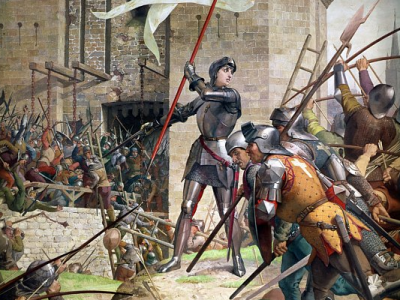
Once Joan arrived, she came out roaring for a fight and liberated the surrounding forts and cities that had come under English control and brought food into the city, bravely freeing her people in successful military campaigns as if she had God’s hand on her. She had been scared, yes, who wouldn’t be, going to war? But with God by her side and her voices to guide her, Joan was filled with the necessary courage to complete her mission. In May, she led an attack against the English forts on the south bank of the Loire River. On the first day of the battle, Joan was hit in the shoulder with an arrow, prompting the English to celebrate the ‘death of the witch.’ In fact, it was only a flesh wound and Joan returned to the battlefield the next day, leading the French to victory. Eventually, the English were cornered inside the Tourelles and retreated. The siege was lifted, allowing Jean to emerge a victorious hero. As she rode across the river bridge into Orleans, Joan received an ecstatic welcome from Alencon, the soldiers, and the inhabitants of Orleans. Joan had never felt better. The rush of victory, the love of the people. There was nothing quite like being welcomed as a hero by the people. And she was a hero. Joan had entered a seemingly doomed battle and had turned it around, sending the English scurrying for the hills.

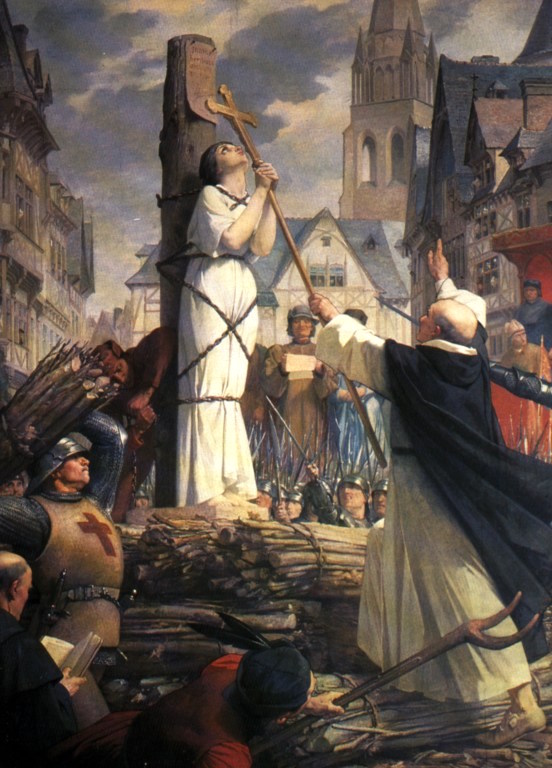
However, Joan did not have the happy ending that she deserved. While the French revered her for her miraculous successes in the battlefield, the English regarded her as a witch and heretic. In May, she was captured and sold to the English while in battle, and eventually burned at the stake as a witch. However, she displayed no anger towards those that had killed her and it is said that she prayed for God to forgive these sinful people. Today, she is revered as a French hero, holy maiden, and a saint.