Monthly- Archives: March 2019


HENRY YUAN

Mr Watt´s Literary Services

Decrypting Magic in The House with a Clock in its Walls

“Dr. John Dee, the personal astrologer to Queen Elizabeth I of England, and his assistant, Michael Kelly, raised the spirit of a dead woman in an English churchyard at midnight. The two men were standing inside a chalk circle drawn on the ground.” Ever since he was little, Dr. John Dee was a very smart student, and after he finished obtaining both a bachelor’s degree and a master’s degree, he set to work in the Royal Court under Queen Mary I. After his interest was diverted to mathematics and astrology, his relationship with the Royal Court deteriorated. In 1555, the esteemed Doctor was charged with treason (which was ridiculous because he had been offered lucrative teaching positions at the University of Paris and a Court appointment in from the Czar of Russia, Fedor I, which he’d turned down for patriotic reasons) and had to serve three months in 1555 behind bars until Bishop Edmund Bonner finagled his release. After a mere 3 years, in 1558, Queen Elizabeth I became the queen, and he regained his honor and was once again in favor of the court. She, unlike Mary I, supported Dee’s wide interests, including the occult. Dee helped pioneer the Voyages of Exploration that England started in the sixteenth century, aiding the various ship captains in their mathematical techniques of navigation, but he eventually gave up his work as a navigation specialist and chose instead to focus on his research into the forces of nature and the supernatural forces of the universe. What Dr. John Dee was most famous for was his work in attempting to commune with the spiritual world, particularly heavenly angels. Dee wrote his first astrological book called Monas Hieroglyphica in which he discusses the various facets of the symbol he created to represent the cosmos, but Dee’s struggle to find a prestigious patron continued.  Eventually he tired of this work on the cosmos and began to focus his efforts more seriously on his angelic search, eventually joining forces with a medium called Edward Kelley. Through their continued meetings, Dee and Kelley claimed to have been given the gift of a new alphabet, said to have been revealed to them by angels. They called the language ‘Angelic’ and later it became known as ‘Enochian’. After Queen Elizabeth I died, her successor, James VI and I, did not like Dr. John Dee. Despite becoming the Warden of Christ’s College in Manchester, England, Dee spent his final years in poverty at Mortlake, his big house outside London, forced to sell off various possessions to support himself and his daughter, Katherine, who cared for him until the end. He died a poor man’s death in 1608, or early 1609, aged 82.

John Bellairs was born in Marshall, Michigan in the year 1938. He was a very hard working person, graduating from Summa Cum Laude, going to the University of Chicago and obtaining his master’s degree at the University of Notre Dame. Here Bellairs developed his true passion for writing. His first book, St. Fidgeta and Other Parodies, was written in 1966. After St. Fidgeta and Other Parodies he wrote a few books but really developed his well known writing style in The Pedant and the Shuffly, also the first time ever featuring a wide variety of magic. He continued to write many books and series, one of the more known works of his were, the Lewis Barnavelt Series where he and illustrator Edward Gorey perfectly collaborated. Edward Gorey adds a creepy feel, perfectly complementing Bellair’s magical writing and bringing it to life. But they never talked or even ever actually met! He wrote about plenty of different kinds of magic: amulet magic (the power to control someone completely with a cursed object), time travel (self-explanatory), even necromancy (the revival of the dead), just to name a few. John Bellairs tragically died of cardiovascular disease at the age of 54. In the novel, The House with a Clock in Its Walls, Bellairs, with one foot firmly planted in European history, and the other stuck into the ooze of magic, provides the reader with instance after instance of magical shenanigans that can be corroborated in a basic encyclopedic search. The lessons from history that Uncle Jonathan teaches Lewis include the power of magic-induced time travel; the Hand of Glory Lewis so bravely identifies and counters against; the eclipsing of the moon (very exotic); and Mr. Izard enchanting the doomsday device within Uncle Jonathan’s house walls to drive him crazy.

“All the stars were out, and a large full moon was rising over the four elm trees at the far end of Jonathan’s yard.” For Jonathan to do the moon eclipse, the time has to be perfect. No more, no less. Timing is key for magic to work because timing pulls power from the different seasons. Even though Uncle Jonathan was a masterful wizard, he needed to prepare. He went to the north side of the house, to an “old mossy rain barrel. He breathed on the “dark water” 3 times, and “with his left forefinger cut the faintly shimmering surface into four quarters.” This must have been a very important preparation step in the process: breathing exactly three times on a very suspicious, mossy rain barrel, then cutting the water into four. After cutting the water into four quarters, he “leaned low over the mouth of the barrel and began whispering in a strange language”. This “strange language” described is probably Enochian, the language of Dr. John Dee and Edward Kelley. What surprises me the most is how even Mrs. Zimmerman is confused by what Jonathan is doing. “They craned their necks around a good deal trying to figure out what the wizard was doing.” Even though Mrs. Zimmerman has a D.Mag.A (Doctor Magicorum Artium) from a university in Germany, she is still somewhat confused by her friend’s actions. Uncle Jonathan went back to the spectators: “in one hand he held the cane, and in the other he had a saucepan full of rainwater.” Then he pours the rainwater into the birdbath. I believe he is doing this because the rain comes from the sky, and the moon, the thing Jonathan is trying to eclipse, is also in the sky. So possibly, by using rainwater, it could be a shortcut to eclipsing the moon. He poured in total three saucepans full of rainwater, again the number three. The number three must be a number that is good for magic. Then he continues to “mutter” most likely Enochian.

The number 3 is believed to be the first true number, meaning All. It represents the tripartite nature of the world: water, earth and air, or fire.  After Jonathan calls for the spectators to see what is going on in the bird bath, they see that “the water in the flat, shallow concrete pan had started to heave and pitch, like ocean water in a storm. Lewis was surprised to see tiny whitecaps forming”. Suddenly, the glass ball on the top of Jonathan’s magic cane starts to emit a “dusty, grey light”. Is this a makeshift moon for the mini-ocean in the bird bath? This makes sense because really only the moon sends out rays of “dusty gray light”. After all, it is merely a reflection of the sun, as the moon is dead. This supports how the tripartite nature is a big factor in magic. Then Jonathan cried, “Peace! Peace to the waters of the earth! Show unto us the round disk of the moon, even as she now appeareth in the heavens above!” This possibly could be lending the power of the Ghost Module of white magic, or you could say, an energy module of white magic. Ghost Modules includes the belief that there is a spirit behind all things; this could prove that Jonathan used Ghost Modules because he could be channeling the moon’s power to eventually eclipse it. After he finished chanting, he picked up a small boulder, and slammed it into the water of the birdbath. Then when the water calmed down, he reached down to the birdbath, but, instead of picking up the rock that he just threw down, he picked up the reflection of the moon! Lewis predicts that it was just a trick, but, “the cold, icy-gray disk he held up looked like the reflection that had floated in the pool a moment before.” Uncle Jonathan then waved it back and forth “as if it were a dinner plate”. The reflection “burned cold and bitter”. As if looking at the sun, “it hurt Lewis’s eyes to stare at it for very long”. Then Uncle Jonathan snapped his wrist and threw the disk like a frisbee. Right after Uncle Jonathan threw the disk, he immediately took off after it. When he came back he said, “Ha! Have at you in your bladder for a blaggard slacker! Hoo! Hunh! And the third in his bosom!” Then, suddenly, but very slowly, “a black, tarry, drippy shadow oozed down over the face of the surprised moon”, until the entire face of the moon was covered. As if everything surrounding the group of four absorbed the energy from the moon, everything became enhanced. Even their senses were much better than before. “Lewis put his ear to the damp earth” after Uncle Jonathan motioned the others to join him. “He heard strange things. He hear the noise the earthworms make as they slowly inch along, breaking hard black clods with their blunt heads. He heard the secret inwound conversations of bulbs and roots, and without knowing how he came to know them. He knew that there was a cat named Texaco buried in the patch of ground he knelt on. Its delicate ivory skeleton was falling slowly to pieces down there, and its dank fur was shrivelled and matted and rotten. The boy who had buried the cat had buried a sand pail full of shells near it. Lewis did not know the name of the boy or how long ago he had buried the cat and the pail, but he could see the red and blue pail clearly. Blotches of brown rot were eating up the bright designs, and the shells were covered with green mold.”

The enchanted clock which is the centerpiece of the novel fills up the entire house. Uncle Jonathan is obsessed with it, and not in a positive way. He and Mrs. Zimmerman are engaged in trying to fix the problem, and in fact, when Lewis first meets Mrs. Zimmerman, she is “standing, with her ear to the wall, listening.” But, as compared to the other magical events and objects in the book, the enchanted clock is hard to understand. It’s as if Bellairs wants to leave the secrets of this type of dangerous magic hidden. But we do find out that Mr. Izard has been planning something terrible. Jonathan recalls with a shudder that he’d see “…old Isaac’s evil face in the window of the cupola at the top of the house. He’d be holding an oil lamp and staring out into the night. … He seemed to be taking notes.” The ever-curious Lewis finds himself on third floor one afternoon, sitting at the bench of a parlor organ. “He touched the keys, but all he got was a gaspy tubercular sound. Darn.” Lewis continues to poke around the organ, messing with the organ stops. “The stops were supposed to change the sound of the organ in various ways, but he had never pulled any of them out. Well, now was the time.” He wiggles one free and finds that it is a dummy stop: it isn’t attached to anything. “But then he stopped and thought. He had read a story once where a car had had a dummy dashboard that came out so you could hide things behind it. What if this organ… ?” So he goes downstairs all the way to the “cellarway” where Uncle Jonathan keeps his tools and brings back up to the third floor a “screwdriver, a hammer, and a rusty butter knife that Jonathan kept there for prying things open.” He immediately sprints back upstairs as fast as he can, eager to see what was in the mysterious organ. Lewis sits down at the organ scanning the “long wooden panel” decorated with “seven round black holes” that “stared back at him”. There were only four measly screws that held the wooden panel to the organ case that surprisingly came out easily. Then, “Lewis stuck his fingers into two of the holes and pulled”, unfortunately, the panel was stuck. Using Uncle Jonathan’s rusty butter knife, he “slid it into a crack”. John Bellairs’s expert use of written sound effects not only just make his books more entertaining to read but more realistic. “Skreek!” the wooden panel was still stuck, so Lewis “moved the knife along to the right a bit and pried again. “Skreek!” again, and the panel “flopped out onto the keyboard”. Lewis tries to investigate further, but he “couldn’t see a thing”, as he forgot his flashlight! The smell of dust was strong, Lewis just decides to reach in and feel around. “His arm went all  the way up to the armpit.” That’s when he touched something… paper? Or money. He “grabbed hold of the bundle” and ripped it out, “his heart sank. It was just an old pile of papers”. Lewis was so disappointed: “so, this was the secret treasure of Wizard’s castle! Some treasure!” He was hoping for something worth a pretty penny due to it being Mr. Izard’s Castle for Christ sake. Then Lewis thought, well might as-well look through it, “there might be something interesting in them”. He flipped through the papers. Lewis figured the writing was Mr. Izard’s due to the first sheet being the title page of his “Cloud Formations and Other Phenomena – Observed from this Window” research paper. Then Lewis remembered Mrs. Zimmermann saying “that she had seen old Isaac taking notes on the sky”, obviously observing how he could eventually use the weather to help further his cause. Then suddenly a “spatter of rain hit the window” making Lewis jump. Then Lewis saw “thick masses of blue clouds piled up in the west” assuming the form of a hungry mouth opening up, “a ray of blood-red light shot into the room” as almost guiding Lewis to read: “Doomsday not come yet! I’ll draw it nearer by a perspective, or make a clock that shall set all the world on fire upon an instant.” Maybe the clouds understood what Mr. Izard had planned and tried warning Lewis before everything all went down. Or, maybe the clouds were angry at what Mr. Izard was doing. So how does the weather study and the placing of the clock match up? Bellairs doesn’t exactly say, but in a later book, The Dark Secret of Weatherend, he devotes an entire book to weather magic. That series stars Anthony Monday and Miss Ells, and is set in Minnesota. When you read widely in Bellairs, you see that he is constantly probing all aspects of magic, both good and bad.

It all started with Uncle Jonathan and Mrs. Zimmermann getting suspicious of Lewis when while eating dinner on Halloween evening. Lewis was pre-occupied, not participating in conversation which was very unusual due to his being a chatterbox. Lewis had already made his mind to try to revive the dead that midnight. When he was asked if he was all right, Lewis said he was fine and continued eating with his head down. Then Lewis very surprisingly said that he wasn’t going trick-or-treating, claiming that he was too mature for it. Mrs. Zimmermann then asked if he was going to join them for cider and doughnuts because if he wasn’t she was going to “show up at midnight at the foot of your bed in my role of Grinning Griselda, the resuscitated cadaver.” Lewis, visualizing what Mrs. Zimmermann just said, has a horrified look on his face, but forces a smile confirming his attendance to the her cider-and-doughnut party. Lewis quickly excuses himself telling the two that he has just arrived at an exciting part in one of John L. Stoddard’s books.

Before Uncle Jonathan and Mrs. Zimmermann were definitely suspicious, and Lewis’s reaction confirms the suspicion. They talk about why Lewis might be acting this way. Perhaps, it was Tarby’s arm getting healed and playing with the more athletic boys, leaving Lewis out. When the cider-and-doughnut party was set up, the three of them shared a bunch of doughnuts and glasses upon glasses of cider. After Lewis ate a few doughnuts and swilled four glasses of cider, Uncle Jonathan announced that the entertainment for that night was “Historical Illusions, or Famous Scenes from the Past” then asked Lewis what historical scene he would most like to see. Lewis immediately answered: “The defeat of the Spanish Armada. Not the battle scenes, because I’ve read all about them in John L. Stoddard. But he doesn’t tell what happened when they had to sail all the way around England and Scotland to get home. I want to see that part.” Uncle Jonathan intends to cheer Lewis up – he knew that Lewis was already acting weird and maybe even a little sad, so he’s doing what a good uncle who’s taking care of their orphan nephew would do. They walked to the fireplace, where three “big comfortable chairs waited for them. When they were all ready, “Jonathan pointed his pipe at the two electric candles over the mantelpiece.” What happens next? Read the book.

Later that evening Lewis does something so unutterably evil – but hey, you need to read the book yourself. The cruellest magic is the magic left unknown, and even if the book is read through and through, and each event deciphered, the understanding of Mr. Izard’s magic will forever be left untouched. It could be the devil’s work, or even an angel’s work, but the sad truth is, that we will never know.

All quotations from The House with a Clock in its Walls by John Bellairs. Dial Press, 1972


JONAH HUR

Mr Watt´s Literary Services

“‘It is also said,’ answered Frodo, ‘Go not to the Elves for Council, for they will say both no and yes.'” (Chapter Three Three is Company)

When Frodo was little his adopted father Bilbo Baggins was a legend in the Shire for bringing riches back from a journey that no one really expected him to come back from. So little Frodo grew up with hobbits adoring his uncle and looked up to Bilbo as a role model and probably wanted to be like him when he grew up. Only now, at the commencement of The Fellowship of the Ring, he knows how hard it is to do what Bilbo did and go out on a journey. Frodo’s task is to try and destroy the Ring. We learn now that Frodo is starting to regret going on the journey to destroy the ring because he is realizing all the challenges he will face. The fact that the elves won’t even give him a straight answer is also challenging. Frodo needs as much help and advice as he can get. For Frodo this will be a test of his strength, will, and mind. “‘I wish it need not have happened in my time,’ said Frodo. ‘So do I’, ‘and so do all who live to see such times. But that is not for them to decide. All we have to decide is what to do with the time that is given us.'” Gandalf agrees but he explains to Frodo that he is here and he has to make the best of it. Frodo is not a little kid anymore. Well he’s fifty but that’s in Hobbit years so that’s beside the point. He is going to start making life and death decisions and must deliver if he wants to keep the world intact.

What is usually the purpose of epic fiction? To find riches like in The Hobbit? Sometimes. But it usually involves trying to save the world. The Fellowship of the Ring demands that you look deep into the origin of the Ring. “It was Gil-galad, Elvin-king and Elendil of Westernesse who overthrew Sauron, though they themselves perished in the deed; and Isildur, Elendil’s son cut the Ring from Sauron’s hand and took it for his own.” This ring is a feisty little fellow. Get it? Fellow, like fellowship of the ring? Okay that was a terrible joke. Anyway the ring has overcome and possessed each person who has safeguarded it, and many others desire it. Sauron who seems very powerful, had the ring and with it was basically unstoppable. Isildur saved us all by chopping off his finger right? This restores order and peace. Oh wait, now Sauron is back. I’m sure Frodo is happy that he is. Now all Frodo has to do is destroy the very thing that Sauron wants and the only way to destroy is to go in the very middle of Sauron’s palace. No wonder Frodo’s scared. The ring is the main weapon, object, and possession in the books.

“A Ring of Power looks after itself, Frodo. It may slip off treacherously, but its keeper never abandons it. At most he plays with the idea of handing it on to someone else’s care – and that only at an early stage, when it first begins to grip.” Gandalf and Frodo discuss intently about what to do with the Ring. The Ring is all-powerful. Sauron is searching for Frodo and it seems absurd that it appears Frodo is delivering it straight to Sauron by going to his kingdom.

While Frodo and Gandalf may be discussing the fate of the world, Samwise Gamgee, Frodo’s best friend and gardener, decides to eavesdrop on them. Gandalf has been around for a long time and will live for an entire age which is 2,300 years. This is an extremely long time for a human, though Gandalf isn’t a typical human. It may be funny that he tells Frodo that they must make do with the times that is handed to them. Easy for him to say. He has 2,300 years. “A Ring of Power looks after itself, Frodo. It may slip off treacherously, but its keeper never abandons it. At most he plays with the idea of handing it on to someone else’s care – and that only at an early stage, when it first begins to grip.” It is all about the Ring. No wonder the Trilogy is called Lord of the Rings. In The Hobbit the Ring saved Bilbo’s life countless times and now Frodo has it. But this time it’s different: a lot different. Frodo can’t even use the Ring. In fact, the whole point of the journey is to destroy it. Frodo is terrified, terrified that he could fail on this journey. When Bilbo told Frodo about his success, Frodo might have thought that it was all fun and games. Now he is starting to realize what the challenges will be in his journey. And he is going to have to be mighty strong to do it.


ISABELLA WANG

Mr Watt´s Literary Services

Isabella is the youngest student to ever take my The Art of the Personal Essay (ed. Phillip Lopate) unit, and has just finished reading Virginia Woolf’s “Street Haunting”. Woolf is in need of a pencil one evening in London. It is a wintry evening as she walks across town, and “the champagne brightness of the air” and the “sociability of the streets are grateful.” Working within the stream of consciousness approach, Isabella wrote this amusing personal essay about her pencil. The setting is a regional scholastic competition in Connecticut, and the event happened the same week she read Woolf.

The classroom was cacophonous, the dozen people sharing conversation. I moved around and chatted with a few of my friends, talking about this and that, helping out with some notes or simply asking about how they did on their most recent event. People dropped into the room at times, and others left the room at other times. Most of my friends, though, seemed to be in the room for the majority of the time that I was there. My mechanical pencil, however, did not. The first time that I used my pencil that day was at one of my events, and when I got back I had set it down on the table. Mysteriously, when I decided to go fetch it a few minutes later – from my seat which was but a meter away – it had gone, simply vanished. I looked for it a bit, but had then reluctantly decided that it was a lost cause. It surfaced and showed itself to me around three hours later, when I had all but forgotten about it. By then, I had succumbed to boredom and decided to show my friends a comic ( in a video so that you could hear the characters speaking ), in which at the end, one of two main characters had yelled out the other of the two main character’s name in anger and exasperation – a bit loudly, in fact, so most of the others in the room heard it too and laughed. So I brought my pencil to my next event a while later, where it again decided to evade me. I soon discovered though, I had left it with my partner, and promptly lost it for a third time for around ten seconds, right after I found it. Alas, even that was not the last time that it evaded me. For the fourth time, it disappeared just as it had done the first time, and I had to ask for my friend’s assistance to track it down. And for the fifth time, it hid from me under the bleachers (where I had looked already) during the awards ceremony, but when I checked again, after the ceremony had ended, it was in plain sight. Let me tell you, from all of these happenings, I have gathered some very important information and data – that I should not put down my pencil, for whenever I did, that elusive yellow and black object hid itself away for a random period of time. Right now though, I am keeping track of it, and it is lying innocently on my desk.


ISABELLA WANG

Mr Watt´s Literary Services

Looking at the work of Garth Williams and his illustrations

In my own experience as a young artist, I find that drawing is a very relaxing and fun activity. I have had others ask me to draw specific things for them; you could say I’ve been commissioned, though I never asked for money. I appreciate the work of illustrators because their clarity of mind and allegiance to the author provides to the reader a mental movie of the story. If I were to be an illustrator, though, I imagine that it would be quite a bit more difficult than simply drawing for others, as the illustration drawn would have to satisfy oneself, the author, and publisher. In the many books that do have illustrations, the art is quite complicated – whether it is a matter of skill or artistic ability, or the feeling or emotion that the image was supposed to convey. For example, a simple image of many silhouettes, a dark background, and one colored-in person in the middle ground, may convey uniqueness, or even loneliness.

Garth Williams lived from April 16, 1912 – May 8, 1996, and he was born in New York City. Much of his work is in classical children’s literature, which includes The Rescuers, Charlotte’s Web, Stuart Little, A Cricket in Times Square and many more. His parents were both artists who had traveled from England, with his father a cartoonist and his mother a landscape painter. At first, Williams studied as an architect and became an architect’s assistant, but during the Great Depression, he changed his mind and decided to become an artist. Williams made lenses at a war plant and applied for the position of a camouflage artist, gave the British-American Art Center war-effort posters, and carried his portfolio with him to show to the major publishing houses.  With both him and E. B. White collaborating on their first book, (Stuart Little, 1945) you can imagine that they gained a friendship between colleagues. From this point forwards, Williams decided to become a freelance illustrator. His illustrations are mainly drawn with ink, and in most of the books that he illustrated he has drawn the cute and fuzzy animals of many people’s childhood – from Miss Bianca to Tucker Mouse.

A children’s book illustrator is drawing for a very large audience of children, and therefore, the art in the book has to satisfy these children. For most young kids, they like to see bright colors and simple figures, images that clearly and blatantly depict what is written on the page. This is different for teen book illustrators – many teens prefer more of a detailed, complex style of art to the simple illustrations in children’s books – meaning that teen book illustrators have to draw in a different style than children’s book illustrators, as each type of book illustrator draws what their viewers will enjoy more, but also keeping in mind what the author of the book wants. This is why normally you wouldn’t find a simple, colorful drawing in a teen book and a more complex, detailed drawing in a children’s book – but while one could argue that a teen book, say, would have more elaborate or detailed drawings, and that a book for younger readers would more likely have simpler drawings, it is not always the case. Take A Cricket in Times Square as an example. Even though it is a children’s book, Garth Williams (who illustrated this book) has given its illustrations detail and precision.

As a reader (and somewhat as an artist), I have analyzed some of Garth Williams’s many illustrations in two of his books – The Rescuers, and Miss Bianca: A Fantasy. In these books, I have tried to find the emotions Williams wove into the characters, and in depicting what their thoughts or intentions are. Small gestures signify a lot in each of these images, and I have captured their significance to me, and put them down on paper, to open up the images in perhaps, a new view. I have also tried to find what the illustrator wanted to portray to the readers, and to explore his intent in drawing these pictures of these specific moments in the book. What did he want the reader to see?

The Rescuers Picture One

On page 65, there is a picture of a wagon train going through the incredibly barren landscape. You can see the random small heaps of rock jutting out of the ground every so often, and how they fade off into the distance. The expressions on all three of the horse’s faces are surprised and fearful, and their legs are spread wide as if they are preparing to run as fast as they can at any moment. Their eyes are quite large, as they stare at the remains of shackled people on ground – the people who are now but skeletons. The driver of the cart joins the horses with their wary expressions, with his arms steering the horses as far away from the skeletons as possible.  The mice appear to be looking out at the closest skeleton to them as well, although you can’t see what they might be thinking because their faces are so small. There is also at least one more skeleton in the background that the trail of wagons has already passed, and most likely, they have passed more, and maybe there are more to come.

The Rescuers Picture Two


On page 78, Miss Bianca, Nils, and Bernard are all sitting/lying down in their own homemade chairs, made out of matchboxes. Each mouse designed their chair a different way: Miss Bianca designed hers as a lawn chair, which she could lean back on; Bernard designed his as a normal chair, putting his back on the matches; and Nils just sat on a plain box. This shows the different preferences of each mouse – Miss Bianca prefers lushness, Bernard prefers it the classic way, and Nils was either lazy, or preferred to have his chair very simple. All with different expressions too: Miss Bianca seems to be relaxed, while Nils looks smug for some reason. Bernard seems to be excited – or is it worry? If you look closer, you can see that Bernard is in fact frowning a bit, and that he is looking at Miss Bianca. I think that he may be concerned for her safety.

The Rescuers Picture Three


On page 91, there is a picture of Miss Bianca riding on top of Mamelouk. His expression is one of extreme annoyance, anger, and agitation. You have a clear view of his tremendously sharp teeth and claws. This is an extreme contrast to the position Miss Bianca is in – on top of Mamelouk’s head, untangling a strand of fur. She looks perfectly content, and is smiling while looking down at something that is on the floor. This is also an extreme contrast to what many mice and cats do in real life; the mice certainly do not go and climb up a cat’s head to sort out their fur. This also brings up the fact that Miss Bianca is very small compared to Mamelouk, she is only around the size of… double his mouth! He could easily swallow her. It is not that she is fearless; it is just that she has no reason to fear him at the moment.

The Rescuers Picture Four

On page 145, in one of the last pictures, the poet is showing thanks to each of his heroic mice, by tapping/rubbing their fur. Nils just looks up at him with accomplishment, as if he is saying, “Well, here you go! We did it! I told you that we could have done it!”  Miss Bianca and Bernard are holding hands, signifying that they are truly affectionate about each other, and while Miss Bianca is looking up at the poet like Nils is, Bernard’s attention is solely on Miss Bianca, and you can only see one of his eyes because his head is turned. The poet himself is smiling a great deal, and looks grateful for what the mice have done. He still does not care that the mice are, well, mice.

The Rescuers Picture Five


In the last picture of the book, on page 148, the image seems both happy and sad at the same time. The scene is somewhat wistful. Miss Bianca waves down to Bernard, who is in the very corner of the page, while she is high up in the cupped palm of a man. For some reason, I can almost imagine Miss Bianca as a princess in a high tower waving out of the window, and Bernard as a prince on the forest floor. The picture itself in the way it is drawn is also a bit gloomy, and I always keep thinking that it is raining in that scene, which is not true. Again, in this drawing, the size contrast between the mice and other objects is brought into focus, as the two people are so big while Miss Bianca and Bernard are so small.

Miss Bianca: A Fantasy Picture One

In the picture on page 109, Williams emphasized that the Duchess is a very fearsome woman, and so are her acquaintances. This is portrayed by the fact that one of the men in the picture is literally holding some form of a club. That particular man’s face is also very rugged, as he has an unshaven and messy beard, with squinted eyes that make him seem as if he were annoyed or mad. The other man who is standing beside the Duchess also seems very rugged, because of how his neck is too large for his coat, how his hair is scanty, and because the lines that were used to draw him are very uneven – look at the many small lines used to draw his right arm alone. The expression on Patience’s face reveals the quality of fear that the Duchess evokes. Patience has her shoulders tensed while her left hand is holding her arm – as if she is trying to keep herself calm or reassure herself that she will be okay. The image takes place when the two bloodhounds come out and start “fawning about the Duchess’s feet.” The dogs obviously have very long and sharp claws, with their teeth also fitting that description. Because one of them is glaring with intense hatred at Patience while the other one looks sad from lack of attention (from the Duchess), you can infer from this picture alone, that the dogs will be an enemy of Patience.

Miss Bianca: A Fantasy Picture Two

In the picture on page 114, there is an image depicting Miss Bianca enthusiastically talking with the two dogs who have sharper and longer claws and teeth than ever. The dog on the left seems to be skeptical, while the dog on the right seems to be almost sad – on the verge of being empathetic. As stated on page 116, Tyrant has a touched gaze and drooping eyelids, deceiving Miss Bianca that he cares, when the case is actually that he is just as heartless as the other dog. I believe that this image was supposed to emphasize that looks can be deceiving – a lot.

Miss Bianca: A Fantasy Picture Three

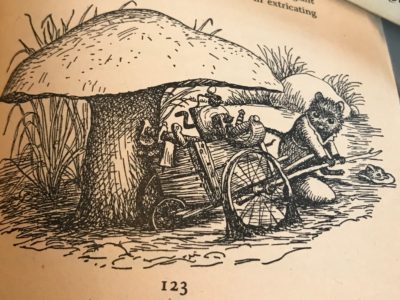
The picture on page 123 has this sense of foreboding, foreshadowing, especially if you read the words that come right before it. Bernard is there, and of course, being the reader, you would want him to be able to rush into the action and save Miss Bianca and Patience. But nooo, his wagon is stuck next to a giant mushroom, ‘completely occupied’ (and naïve to the situation, I must say) while Miss Bianca and Patience may as well be running for their lives. The image is ominous in a way that cannot be put into words, a feeling that somehow finds a way to seep into your mind as you hope for the best to happen, even as you realize that something bad is inevitably going to happen instead. Even worse, Bernard is drawn very cutely in this picture, with large and innocent eyes.

Miss Bianca: A Fantasy Picture Four

In the picture on page 130, Patience and Miss Bianca are running for their lives as they try to make it to the dovecote. The whole gist of this image is particularly suspenseful and dark, as Williams shaded in all of the background. The ladder is one of the things you notice quickly, as it is also one of the few things that are not shaded in. A light in times of darkness, if you will. The way that Patience’s hair and dress is drawn shows that it is moving wildly, with her arms in a position that shows that she is running very hard – as, who holds their hands almost parallel to the ground while they run or outstretched when they are going on a relaxing trip through the countryside? Not many people, I believe. Miss Bianca is also reaching out for the dovecote, even though she herself is unable to run, since she is tucked away in Patience’s pocket. This shows the longing that she has to be there.

Miss Bianca: A Fantasy Picture Five

In the picture on page 142, there is a gruesome sight of the Chief Ranger bellowing as he holds a hand to his chest with a foot just about to take the next step – and with a tiny sword imbedded in his neck. You can see how Bernard had scattered all of the weapons that he could not use all over the floor of the dovecote, and how he has flung out his right arm in a throwing position. I also believe that maybe, just maybe, the position that Williams drew Bernard’s arms in may have a double meaning, as it seems as if he is reaching out, upwards, to Miss Bianca as well. Miss Bianca seems to be calling out to Bernard, maybe even waving at him, with a hand behind her back, as always the polite lady. Perhaps, this picture has a double meaning, and can additionally show that no matter the situation, Miss Bianca and Bernard have a great love for each other. Again, the Chief Ranger looks very gruesome, with his stout body, few teeth, unkempt beard, and eyes bulging out of his sockets (at least in this moment). This image emphasizes even more that he is unruly and seems to be evil: the shadows under his eyes and around his swarthy neck are deep.

Miss Bianca: A Fantasy Picture Six

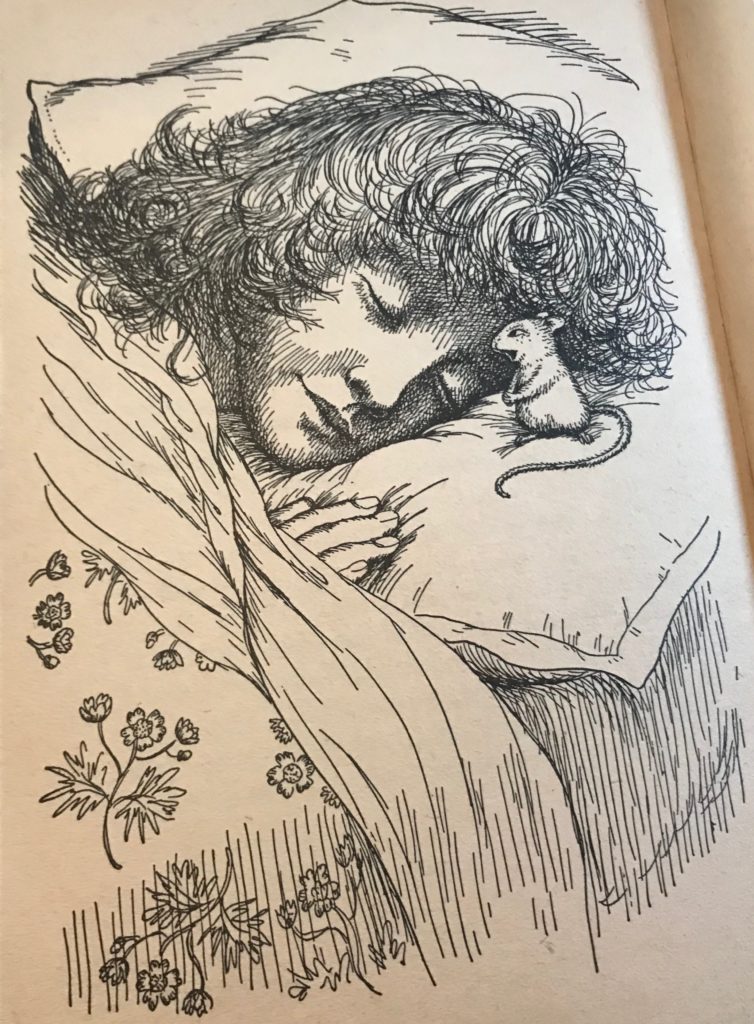
The picture on page 148 has a calm and peaceful setting, and both are relaxed – as Patience sleeps and Miss Bianca sings. Again, Miss Bianca has her arms clasped in front of her respectfully, even though Patience cannot see her. There is not much shading in this picture, only on Patience and Miss Bianca, and much of the image is the white of the paper. This gives more of a lighter feeling, unlike some of the more recent pictures, which had a suspenseful or dangerous air to them. When seeing this image, I imagine Miss Bianca to be a very nice singer, as she is singing with her mouth in a vowel shape and the skin around her eyes is a bit crinkled, or at least from looking at the way the eyes are drawn, it seems to be.

Miss Bianca: A Fantasy Picture Seven

In the picture on page 151, again, Miss Bianca is sitting in a ladylike position, with one leg beneath her daintily, and with a small arm steadying herself against one egg as Bernard helps to put her silver chain back in place around her neck. While Miss Bianca seems to be blissfully happy in this image, and maybe even distant from the way her eyes are drawn, Bernard’s large eyes are once again sullen as he sits with his side against Miss Bianca’s back. I wonder why Williams did not draw Bernard facing Miss Bianca’s back as he puts the silver chain around her neck – maybe there is a deeper meaning? (Note: Miss Bianca has a rather creepy expression in this image, as if she was forcing a smile and were to be extremely uncomfortable…) Miss Bianca seems to be placing her hand over her heart, however, and this could be interpreted as a sign that again, Miss Bianca and Bernard are very close. So, I suppose that what I feel is a rather creepy expression may also simply be Miss Bianca being extremely happy.


MICHAEL DONG

Mr Watt´s Literary Services


Michael wins the honorary Historical Medal for his 4th place!

History’s impact on John Bellairs

The House with a Clock in its Walls is a novel full of compelling historical references taken from the mind of author John Bellairs. The novel includes details of the murder of David Rizzio: this man was the private secretary of Mary Queen of Scots. A young Italian courtier, he was framed because of the jealousy of another man (the future husband of Mary Lord Darnley). Rizzio was murdered cruelly. He screamed for help to no avail, resulting in the “permanence of bloodstains” on the “hall floor in Holyrood” (John L. Stoddard, Lectures IX). Our protagonist, Lewis Barnavelt, reads history with interest and completely focused thoughts, obtaining strengths through his exercise of gaining knowledge. It’s his first night in his grand bedroom, and he soothes himself by opening a dusty collection of lectures by the famous American historian John L. Stoddard: David Rizzio was screaming with pain, as blood splattered out like plum juice. Rizzio was dragged away, his blood staining the red carpets as Queen Mary could only watch, held back by other men stopping her from saving him. Rizzio tried to reach out and cried for help, as he was wronged because of another man’s jealousy and anger. A famous death spread through the nobles: the death of David Rizzio, private secretary to Mary. Lord Henry Stuart Darnley (future husband of Mary) was believed to have helped the conspiracy and helped murder Rizzio. The murder served as a catalyst for the fall of Lord Darnley, which also led to the downfall of Mary.

On Halloween night, Uncle Jonathan presents Scenes of History to Lewis, asking him what he wants to view. Lewis chooses the failed Invasion of the Spanish Armada, and the Battle of Waterloo. When Lewis sees the face of the Duke, he empathizes with the Duke; originally he would think about destroying the Duke when reading about the battles, but now he pities the Duke. When Lewis watches the Spanish Armada, he is surprised into empathy, but also the beauty of magic. Lewis was sad for the Duke of Medina Sidonia’s plight, yet learned that it is okay, since it was only an illusion of magic, though the Duke was doomed.

Recently, a film adaptation (feature length) of House was made – many fans of Bellairs were excited, and intrigued to see it. Investigation into the historical references in the book will allow readers to understand our protagonist and the story in a deeper aspect; in addition, comparing the historical details in the movie and book will help readers and moviegoers understand the key differences between the movie and book. The book concerns a young orphan who is trying to simply fit into a new hometown, after a sad scene (his parents were killed in a car crash, all-too-common in the 1940s) in his life. Due to the uniqueness of his uncle, the young orphan strives to be similar to him and asks a lot about magic. Skepticism is one of Lewis’s chief features, revealing to the reader a special someone who Uncle Jonathan and Mrs. Zimmerman want to protect. For Lewis is desperate to find a feeling of home, as you can imagine.


When we first see Uncle Jonathan, we see a big man, happy and excited to see his nephew. Uncle Jonathan is sometimes unable to show his love but tries to give whatever he can to Lewis. Uncle Jonathan wants Lewis to feel like he was always part of the family, and shows Lewis many of the mysteries of magic. Lewis still feels sad at many points in time, but Uncle Jonathan’s gifts of humor and education go a long way. On Halloween night, Lewis, depressed about losing a friend, and plotting to snare Tarby back through an act of black magic, is amused by the Images from the Past trickery of his Uncle. Jonathan is able to transform Mrs. Zimmerman’s living room into a gallery, where Lewis can watch his favorite historical scenes play out: It was early morning, the English were ready, so were the French. The battle had begun, and Wellington was waiting, his troops were outnumbered, and the Prussian troops needed to arrive. Suddenly, a large group of soldiers could be spotted; the Prussians had arrived. Napoleon was surrounded and hastily tried to retreat, only to be trapped and captured. The Coalition’s capture marked the end of the great conqueror. Because Lewis is maligned by death he is mysteriously attracted to the unknowable. Lewis is a seemingly a weak character, sometimes relying on others because of his innate fears. Lewis is also a very knowledgeable individual. Both his skepticism and fears make Lewis a special individual who fixes problems differently. Instead of turning around to face the Hand of Glory, like a brave knight, Lewis turns to his own abilities. Lewis uses his knowledge of history in order to save himself and others. This weak-seeming yet skeptical personality saves him from situations.

The year was 1588, and the Spanish Armada was coming to wreak havoc on the country of England: Queen Elizabeth was in a panic, and called to her advisor, the all-around magical genius Dr. John Dee. Dee is prepared, and summons his weather magic to destroy the Spanish Armada. Incredibly, the invincible Spanish fleet is destroyed, and most of the work is credited to Lord Charles Howard and Sir Francis Drake, but many forget of the weird change in wind direction that prompted the Spanish to get delayed, leading to English victory.

Lewis looks on at the sad Duke, imagining the struggles that he had faced throughout the battles: Explosions rang out, each side of the battle yelling between blowing cannon shots to the other. The Spanish wished to conquer England, while the English wanted to destroy what many called the Invincible Armada. The English took advantage of the winds that delayed the Spanish invasion, raining down upon the Armada with long-distance artillery. Now the decisive battle had begun between both sides, but the Spanish ships were looking haggard, sinking or fleeing. The Duke of Medina Sidonia was in a panic, as he yelled “Retirada!” The Spanish pulled back. Who could have done this? Presumably, Dr. John Dee. There is another famous occurrence that happened. Dee was trying to kill Mary, Queen of Scots, but failed. Later, as mentioned earlier, her private secretary dies.  Could this have been instrumented in kind by Dr. John Dee?

What do all these events have in common? All are referenced in the same novel: The House with a Clock in its Walls, by John Bellairs. Bellairs was fascinated by magic and had a life dedicated to the liberal arts.

John Bellairs was born on January 17th, 1938. Bellairs earned degrees at the University of Notre Dame, and the University of Chicago. While in college, Bellairs found himself making a national impression. He appeared, representing Notre Dame on the March 15, 1959, telecast of Quiz Bowl. Against a powerful opponent, Georgetown, there was a tight atmosphere – competitors’ hands were on the buzzer for the bonus question, which was that any team member could earn one point for each line recited, from Geoffrey Chaucer’s The Canterbury Tales. Immediately, John buzzed in, with eloquence, reciting in fluent Middle English, and everyone gaped in surprise. Bellairs even continued to the Knight’s Tale but was stopped due to time.

After graduating from college, Bellairs was a professor of the liberal arts, teaching at Jesuit and Augustinian colleges, but yearned to be a professional writer. With his first successful book, A Face in the Frost, Bellairs gained more attention, and within a few years settled down to write novels. Bellairs eventually published 31 novels, including his three series for children starring Anthony Monday, Lewis Barnavelt, and Johnny Dixon.

Edward Gorey was born on February 22nd, 1925, in Chicago, Illinois. Gorey attended Harvard University and roomed with poet Frank O’Hara. Gorey illustrated multiple pieces, such as Bram Stoker’s Dracula, H. G. Well’s The War of the Worlds, and was thrust into the publishing world with his first book, an independent work, The Unstrung Harp.  Gorey’s drawings not only gave an accurate representation, but also a feeling that amplifies the story.

John Lawson Stoddard was an American writer, born April 24, 1850. He attended Yale University. Stoddard loved traveling the world and gave lectures on his experiences; the lectures were written and published as books, called John L. Stoddard’s Lectures, and grew popular. Stoddard published a book on Gibraltar, and started writing poetry as well as books on religious subjects. Stoddard had a range of religious experiences; he grew up Protestant, became agnostic for more than 30 years, and eventually converted to Roman Catholicism. In 1922, Stoddard published Rebuilding a Lost Faith, which is still in print. Stoddard supported Jews in their return to Israel. In Volume two of Stoddard’s Lectures, he said to the Jews “You are a people without a country; there is a country without a people. Be united. Fulfill the dreams of your old poets and patriarchs. Go back, go back to the land of Abraham”. Eventually, Stoddard decided to give his fortune to his hometown, and helped build new schools and homeless shelters for youth.

Lewis learns lots of history due to Stoddard’s lectures. Lewis is shown to learn from historical experiences. Upon arriving to Uncle Jonathan’s house, Lewis tries to grow accustomed to the environment around him. One of Lewis’s favorite hobbies is reading, with the addition of gobbling chocolate foods. On the bookshelves, Lewis sees a book on historical lectures on England and starts reading with a passion… with the occasional bite of chocolate mint. Lewis reads without reserve, ignoring the fact that the content (Rizzio’s death), is gruesome. The content fascinates Lewis, for we learn he is a knowledge vacuum. Not only does Lewis learn information from history, but he also learns about human emotions; this includes Lewis’s experiences with the Duke of Medina Sidonia. Lewis depends on his historical knowledge to his advantage as well, showing up in the critical moment and saving everyone because of his knowledge about the Hand of Glory.

The movie was not an accurate representation of the book in many different aspects. The movie had the same conflict and certain key moments that were experienced by Lewis, yet portrayed the story with different important details. Lewis’s relationship with his family is more prominent in the movie, and expanded to be a weakness, as he is tricked by Mrs. Izard who appears as his mother to confuse and beguile him. The mention of Lewis’s parents causes him to be emotionally unstable and unable to have a focused mind. Other smaller details seemed as if added, such as the size of, and how intricate the doomsday clock was. Mr. Izard’s being resurrected and his background and experiences (World War I flashbacks) changed the plot in the story. Another example would be the grave, which was the grave of Isaac, not Selenna. The movie depicted a more realistic tomb, flat and seeming like a vampire’s coffin, while the book had a giant, Greek-like building with two spectacled eyes coming out. The clock in the movie was much more intricate, seeming as if the entire walls were a clock… like a Hollywood movie. Unlike the movie, the book gave a true eerie type of feeling.

Lewis in the illustrations was chubby, while the actor in the movie was a fit child with no problems physically. Lewis almost never mentions his parents in the book, but Lewis thinks of his parents a lot during the course of the story. Emotionally, Lewis is accurate and the movie reflects it as well. Lewis is shy, yet brave in critical situations. Uncle Jonathan was somewhat similar to what we experience in the book. Funny, bossy, but at the same time caring, he was somewhat of a bright spot. Mrs. Zimmermann? Cast in a way that made her the most different from the book, she was given a new backstory to explain her reason to not use magic. I felt that her backstory in the movie changed her emotions at times. There was the whole subplot about Mrs. Z having lost her family, which was expanded to make her seem fragile, and that she had emotional baggage. But in the book, there is no mention of her family, and so this addition makes a new Mrs. Zimmermann.

The movie missed many of the historical details mentioned in the story, including one of my favorite scenes depicting the famous historical scenes in Mrs. Zimmerman’s house. The details about Louis’s suitcase felt a little too subtle, while they describe more about it in the book. We do not seem to see other representations of the occurrences happening on that year of 1948. I think that John Bellairs chose carefully 1948, bristling with so many different occurrences and events, such as the assassination of Gandhi, the creation of Nascar, the Communist takeover in Czechloslovakia, and the founding of [yep] North Korea. The representation of the year is kind of incorrect; I think the time period for the movie seemed too ahead, with bright colors and whatnot, instead of the representation of a postwar era with factories. Famous people such as John Dee and Edward Kelly were not mentioned either in the movie; instead, the book took a path about magic from the eyes of JK Rowling, not John Bellairs. Mrs. Zimmerman’s relationships are kind of complex and seem to be different, not the same in the story and the book. In the book, she lived in France once and was friends with famous artist Odilon Redon and Henri Matisse. In the movie, she again was mentioned to live in France, yet had a family, and thus lost her magic abilities because of the deaths of her family. The book never mentions her not being able to use her magic, instead, Mrs. Zimmermann said that she does not want to use it. Finally, one of the most important objects in the story, the hand of glory, is shown only in one scene in the movie, upon Lewis’s entrance. The hand is never shown again: it could be saved for the next book, which would not make sense.