Monthly- Archives: March 2025


NATHAN LUU


From Comfort to Despair: the Cozy Lairs of J.R.R. Tolkien
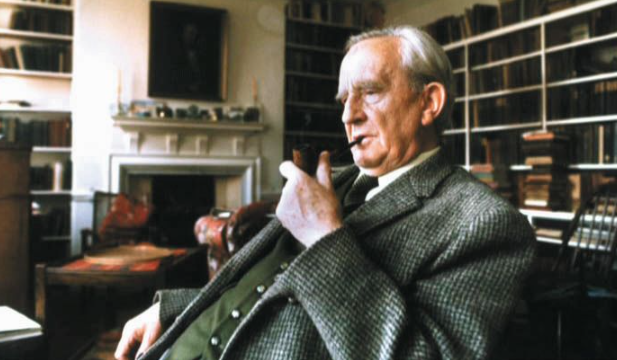
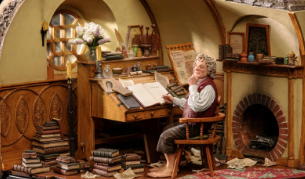
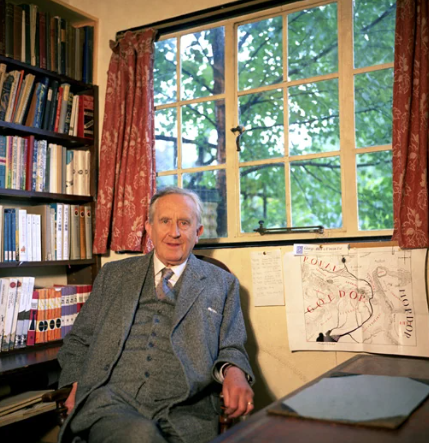
In reading The Hobbit, one would think Tolkien to be a man of great comfort, as comfort is celebrated by most of the characters. When individuals read this extraordinary book, they would most likely do so while in a comfortable position, enhancing the book’s entertainment value. This could range from reclining on a cozy waterbed to sitting up straight in a fur-like chair. As readers delve into the book, they can perceive the comfort reflected in Bilbo. However, what was Tolkien’s home like? We know he loved books, and he loved pipes – but do we have any information about his couches or his various dining areas (perhaps plush sofas near the window, or even a tidy little settee in a cozy nook)?
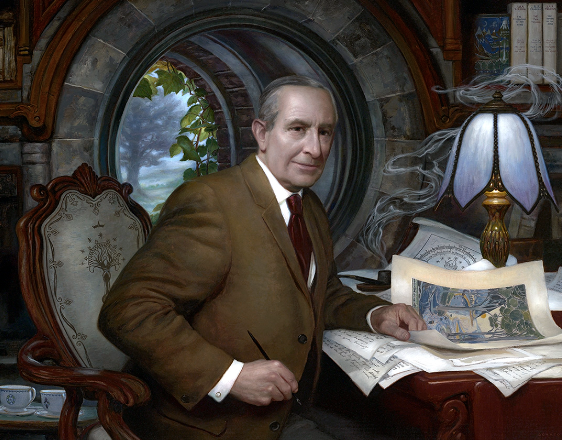
The answer isn’t immediately apparent from just reading the novel, but in delving into the book and exploring all its minute details of the estates of the mystical creatures, we arrive at a true sense of Tolkien’s adoration of comfort. 
***

In the heart of the forest, amidst towering trees, lies the troll’s lair. Here, three immensely huge trolls are sprawled around a large fire of beech logs, emitting a strong “toothsome” smell that even the dwarves, who were snooping around, could not ignore.
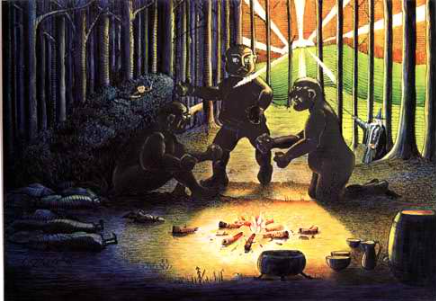
“They were toasting mutton on long spits of wood, and licking the gravy off their fingers.” Are you getting hungry yet? Imagine if you’ve been hiking all day! The trolls never leave their lair due to their vulnerability to the sunlight beams which is also the reason why the lair is built. So would the trolls ever leave their refuge for any reason? Now, unless you’ve read the book (which you should have already with a catharsis, because this essay is not for the uninitiated) you would be more than clueless to know that the company of thirteen hardy dwarves (with beards that demand nutrients) and one hairy-toed hobbit (a pipe-smoking, food-craving midget) are in need of rations. They need to chow, and chow soon! 

The hobbit and the crew, desperate for food, land near the troll’s lair. This, their only hope for food in the wretched forest attracts them, and also will give them (they hope) a full belly to rest for the rest of the night as long treacherous days are ahead of them. Bilbo’s ambition to pickpocket one of the trolls fails miserably and “William turned around at once and grabbed Bilbo by the neck.”  

As Tom, Bert, and William chat with each other, the dwarves are just mesmerized by the fire in between the three. After traveling for a while, they are frigid and would do anything for a little simmer of fire to hit their dwarvish skin. Also the aroma of the lavish food hits the dwarves and they can’t help but to look in awe at the fire. The “toasting mutton on a long spit of wood” is a sight that would make the dwarves’ tummies growl even more. I can also imagine the crackling of the fire causes the bone-tired dwarves and hobbit to yearn for a warm environment with which to relax, of course, after feasting.
The Misty Mountains are a mountain range with many steep valleys where one misstep could lead to your death. Throughout the valleys there were many loose rocks as they got “toss[ed] down into the darkness where they smashed among the trees far below”.
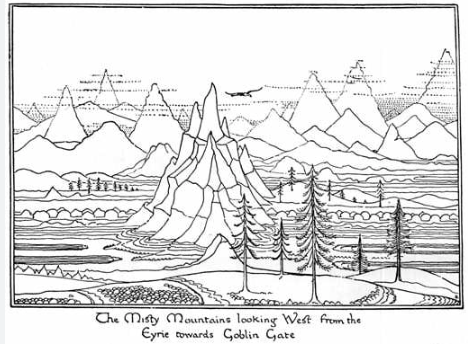
There are mysterious creatures “guffawing and shouting all over the mountainsides” – cloud men, throwing clouds at each other, a strange reference never mentioned in Tolkien again (he wrote The Hobbit in 1937 and the trilogy followed in the 1940s, and some of what he dreamed up in The Hobbit seems to lie in a world of its own). Within the heart of the Misty Mountains lies another lair, a complex one with passages crossing and tangling in various directions, almost labyrinth-like. This is also known as the goblin’s stronghold, where the goblins reside. We observe that the goblins can navigate the lair very well as they chase down the dwarves. Additionally, we see the goblins chasing the crew outside of the cave with a pack of wolves called wargs.

As the dwarves traverse throughout the goblins’ lair, they encounter many very worn out bridges which they get pummeled by goblins. The scent also could be smelt as rotten: I can’t imagine a human living more than 30 minutes without having the urge to throw up.

We can assume that once inside the lair, it can be very loud at times as hundreds of goblins are living next to each other where they relax and curse, in greasy smelly nooks, next to “passages […] crossed and tangled in all directions.”

Now, where is the Company? As I pick up the story, are they captured yet? NO! The dwarves, Gandalf and Bilbo, seeking a place to rest for the night, find a very tight crevasse, in which “there was just room to get the ponies through with a squeeze,” so one could say that the dwarves find a lair of their own while exploring the lair of the goblins. I must conclude that the goblins are willing to leave their lair to pursue the actions they desire. I find it impressive that though the Company just stops in for one night, the Goblins using their goblin senses, they can sense their upper room is infiltrated – these Gobs got Game!
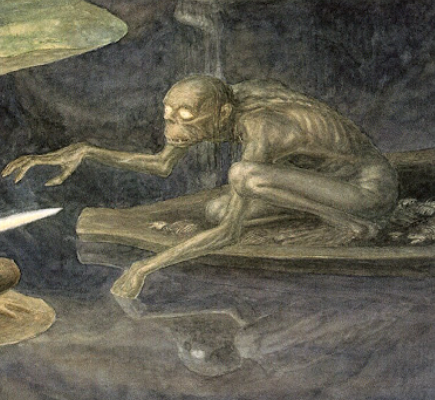
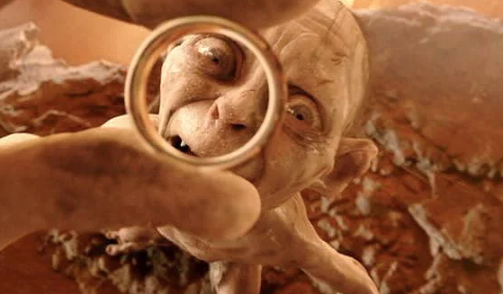
In the caves “deep down here by the dark waters”, in the depths of the Misty Mountains, lies Gollum. More specifically he “lived on a slimy island of rock in the middle of [a subterranean] lake” where he would inspect his prey just like a leopard ready to pounce. Everyone now and then though, he would row “about quite quietly on the lake; for the lake it was wide and deep and deadly cold”. For that, people wonder why. Is it because he is best in the absence of light? When he poses riddles, he will eat those who lose. When someone loses, their first instinct is to run, but they can’t escape in the dark. With Gollum’s absurdly strong eyesight, he can track them and eat them. “He liked meat too. Goblin he thought good, when he could get it… he just throttled them from behind. Sometimes he took a fancy for fish from the lake.” So we see that this skin-and-bone darkness dweller has a voracious appetite!
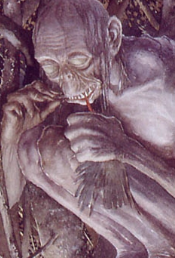
His prey: if they win, how will they make it out of the cave? They won’t (unless they’re Bilbo), so they get lost, and in the end, Gollum will eat them. Considering all of this, he decides to singularly live on a small deserted island on a small lake beneath the towering Misty Mountains.  

We all love to sleep in our lairs. With the emptiness of the cave, one must consider, how does he wake up in the pitch black? Well, he likely has a breaking point where he simply can’t stand the amount of sleep anymore. To answer the question, he simply wakes up when he reaches his breaking point of sleep. Another factor could be his malnourished body. How does he manage to sleep if he can’t even eat? How does he even eat? He could simply leave the cave to find food, but it’s not that simple. He’s been in the cave for over 400 years; he’s not getting out. We can dismiss that idea. Like I said before, he eats people whom he beats in riddle battles. How often do visitors come into the cave? There could be 5–6 weeks where he just won’t eat anything. Eating a body may fill up his stomach, but it won’t sustain him for a lifetime. Maybe with the inconsistency of his diet, he might have gotten used to the fact that he won’t eat for long periods of time.

Adding another factor to this, during the free time I mentioned, what would he do then? Well, as we’ve been discussing, he likes to have riddle battles. In the meantime, while waiting for his next victim, he probably plots for his next riddle battle by thinking of more riddles.  In the instance with Bilbo, “riddles were all he could think of. Asking them, and sometimes guessing them, had been the only game he had ever played with other funny creatures sitting in their holes in the long, long ago, before he lost all friends and was driven away, alone, and crept down, down, into the dark under the mountains.” But when he has no one to run riddles by, what could he possibly do? Did I forget to mention… THE RING!? This “precious” is what keeps him thriving in this horrendous scenery. This ring is what he is obsessing about constantly when having nothing to do. All he can think about is what he could do with this ring and all the power he could possess.
Moving on from the cave lies a bear beast behind “a belt of tall and very ancient oaks, and beyond these to a high thorn hedge.” There is also a large handmade oak cabin made by the the bear: with his “thick black beard and hair, and great bare arms and legs” you can believe he made this old cabin with his “large axe.”
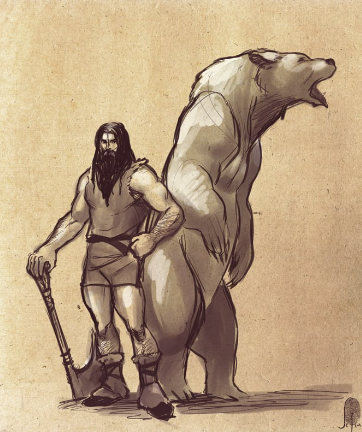
He is not one to be messed around with. It is none other than Beorn himself. If you were to do so though, you would be chopped into pieces. You can imagine him as some sort of buff murderer, as the woods are where they lie and he is constantly holding an ax.

We can see that Beorn is well organized mainly in his house, but why? Since company comes only once in a blue moon, he is home by himself daily, so he has all the time in the world. At that time, he most likely organizes his home. Some unique additions to this exquisite home would be the “rows and rows of hives with bell-shaped tops,” along with “unshaped logs: barns, stables, sheds and a long wooden house”, some side projects that he did in his free time. When they find Beorn, he is hard at work, gathering “many lopped branches” from the trees he had cut down and piling them near a tree trunk.  

Bilbo approaches Beorn’s house dreading the fact that “he is a bear, or that he can become a bear,” while asking various questions. Gandalf assures him that it’ll be all just fine and he is “very polite” and will introduce the crew “two by two”. The dwarves finally arrive at the big ‘ol log cabin. On Gandalf’s “call or whistle [they will] begin to come after-you will see the way I go-but only in pairs.” Soon Thorin and Dori came round the house by the garden path and stood bowing low” for none other than the great Beorn.
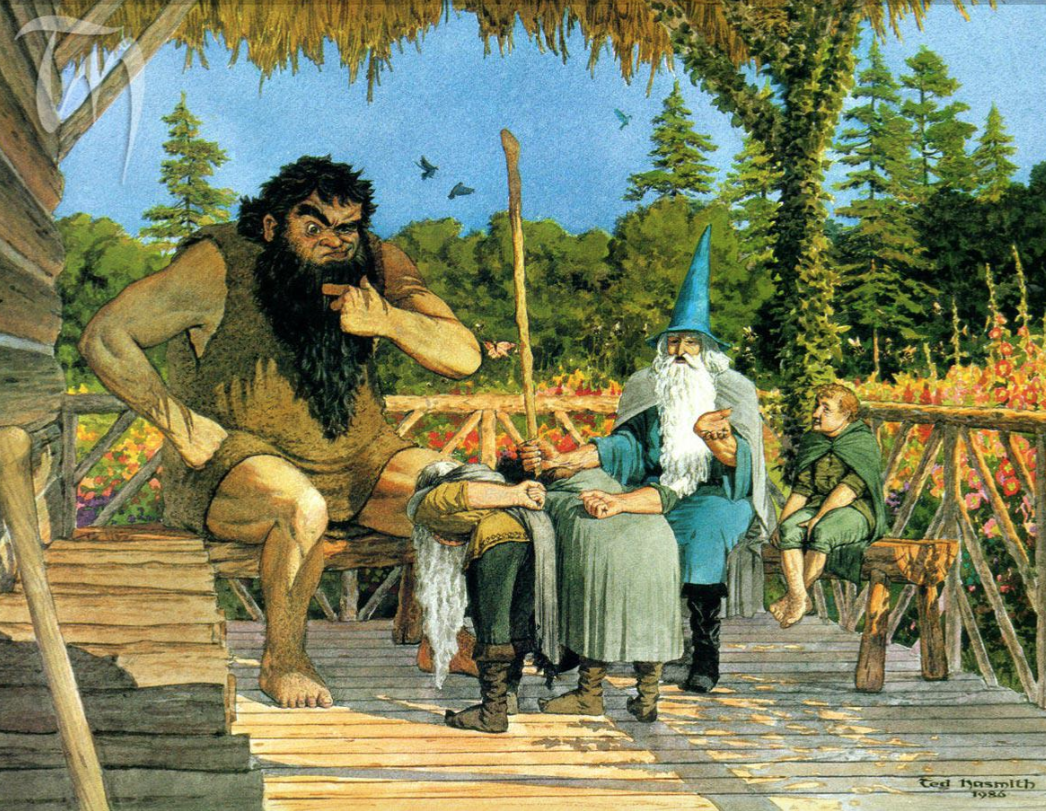
Ted Nasmith © 1985

Doesn’t this seem oddly familiar? Recall that, previously at nearly the beginning of the book, there was “KNOCK KNOCK” at Bilbo’s house by one of the company members. Dwarves would pile in, two by two, with the lead of Gandalf. At Beorn’s house dwarves pile in, two by two, with the lead of Gandalf. There is this parallel that Bilbo has with Beorn and it might just be a leap but does this bring deeper meaning behind Beorn? That maybe one day he would be leading the next company?

Near the house of the big bear is the puzzling Mirkwood where lies Attercop, home to spiders. Its “spider webs, one behind and over and tangled with another” give off this freaky Halloween feeling that gets put into the souls of the dwarves. You can even see the “fat spiders r[unning] along a rope till it came to a dozen bundles hanging in a row from a high branch.” Their “great tangled strands in the branches” make it impossible to move freely, creating a suffocating atmosphere. Just imagine yourself walking through the woods that you’ve never crossed before, and it’s nearly pitch black out. Then you see in the distance something you’ve never seen before, and this something is white so it stands out, spaghetti-like, and you see huge black-colored objects just moving along the spaghetti hanging from the trees.

And of course the Company (save our hero, the burglar Bilbo) ends up in the spaghetti. Caught, they are wrapped around in the spider’s silk, which makes them comfy. “The unhappy dwarves were dangling in the air with their toes just off the ground.” If the silk wasn’t comfortable, they would try their best to get out, but instead, they chose Bilbo to come save the day. I mean, even with the smell of the Attercop, the dwarves still chose to stay in the silk, signifying comfort. Just like you in the comfort of your chair reading this. Well, if it weren’t for Bilbo, they would have slowly gotten poisoned and perished in the grounds of Attercop.
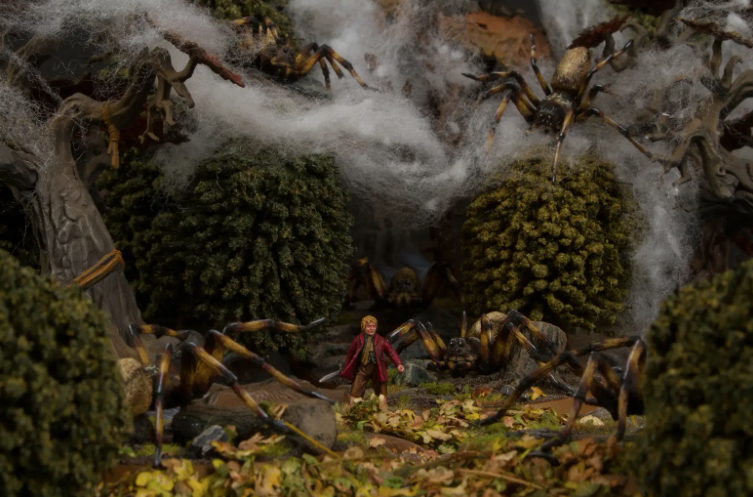
Art by “Garphy”

Another group of individuals that lie in the forest are the Wood Elves. Their lair gives off even more spooky vibes as “blaze[s] of lights began not far away—hundreds of torches and many fires must have been lit suddenly and by magic.” This entrance is literally straight out of a movie, in all ways (it’s not like the book is a movie, but we’ll just move on).
Just imagine walking in the forest late at night, and then you stumble upon a pathway and step on one of the stones. You’re met with an overwhelming number of torches that light up for no reason at all. I already know the first thing you’ll think of is Temple Run, and you’ll be running away from some sort of monkey or goblin, but in this case, wood elves.

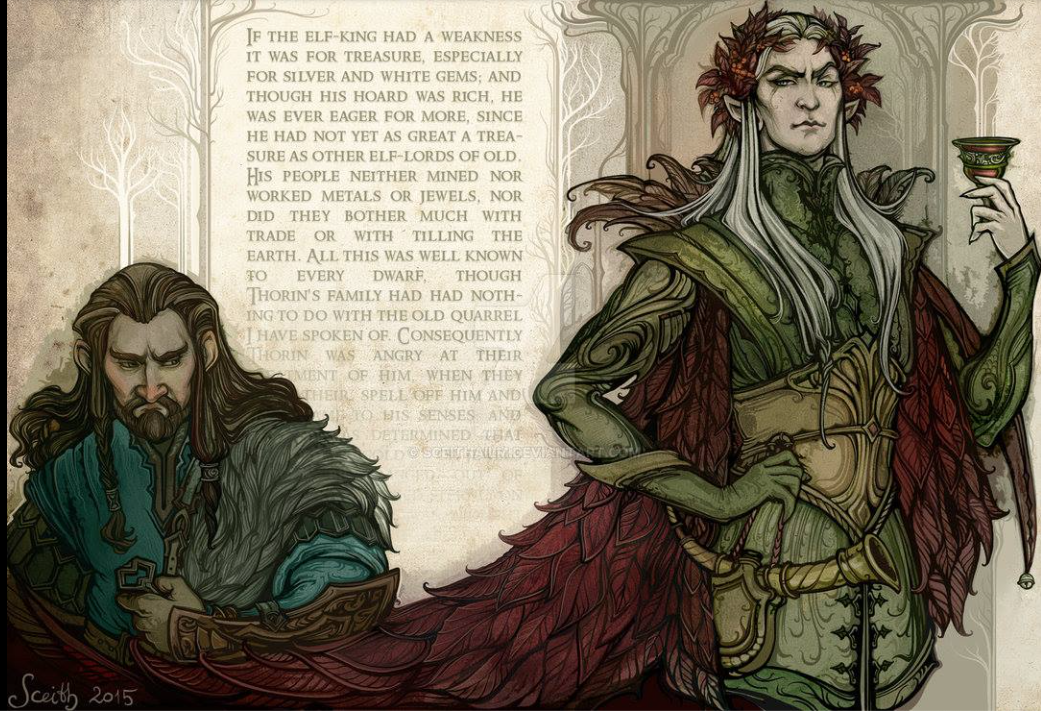
With the image of elves working for Santa or a fairy-like character, Tolkien gives them human-like features. The Wood Elves, though, don’t seem as pristine and refined—some are drinking a whole lot of wine, which suggests the empty barrels the dwarves depart in.

 “There was a great commotion as the elves began running to and fro, some hurrying to the king and others gathering the barrels and rolling them away.” They are seen worshiping a king, just like we humans used to do back in the day, with “a chair of carven wood upon which sat a great Elvenking”. That just gives the elves a more realistic sort of character than their playful character that people first think of.


The dwarves then get caught roaming around “my realm without leave,” and the Elvenking sternly tells them, “You have found your way into my halls, and you are not welcome.” Their consequence is being put in jail or prison.
Following the departure of Bilbo, we land in Laketown (formal name, Esgaroth). When first hearing this name, you think of a town in, under, or on water. Then you second-guess yourself and bring yourself back to reality and think it’s some random lakeside town in The Hobbit, but you’ll be wrong. This town literally lies on water.
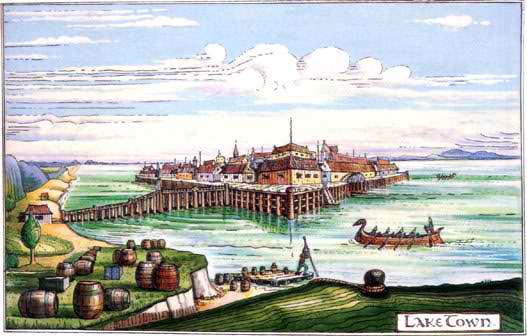
Originally by J.R.R. Tolkien, the color was added by H. E. Riddett and was made for The Hobbit Calendar 1976, and has been used in some illustrated editions of the book. Category:Images by J.R.R. Tolkien

More specifically, the old town was built on “wood [and] ran out to huge piles made of forest trees” though the town was not composed of “elves but of men”. The people of the town were petrified of the big red dragon, Smaug, as they were stationed right next to his lair.
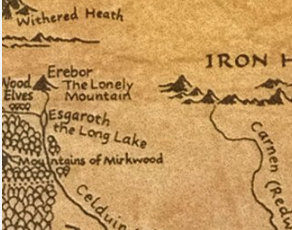

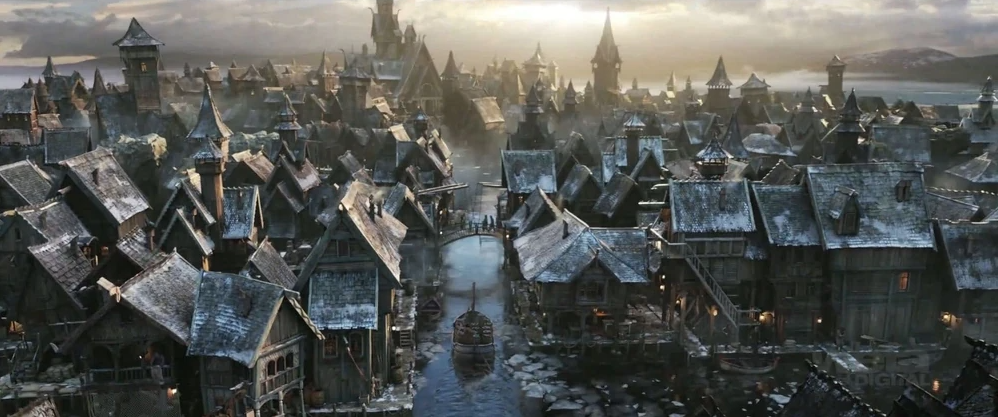
Soon after, the fellow dwarves and their de facto leader, Bilbo, stopped by the town. It was an enthusiastic arrival as “there was much shouting as well as the music of harps and fiddles mixed up with it”. Their “harps and flutes and fiddles were playing, and they sang many songs,” making it a truly grand welcome. The town even “doctored and fed and housed and pampered” Bilbo and his dwarves. They “brought him butter and honey and bread and cakes, and plenty of bacon and eggs,” ensuring they were well cared for. There was nothing wrong in the town; everything seemed great but… only if it lasted forever. Smaug awakened from his slumber due to the dwarves’ curiosity, and the town was then shredded down to ash. Smoke was all over the place, leaving the town inhabitable for years to come.
To get to Smaug’s Lair, the infamous stronghold, one must pass “gray and silent cliffs [leading] to the feet of Ravenhill”; along the circumference was a “lake, flowing swiftly and noisily; its bank was bare and rocky, tall and steep”. The “Front Gate stood wide open and the dark rock gaped like a mouth,” welcoming only death and destruction. You would imagine, for a dragon’s lair, a huge cave and fortress with Smaug laying on a throne. Now there is a little twist, for there is a huge cave, but instead of sitting on a throne, Smaug lays on piles and piles of gold that build up to towers. And if you open the door to the cave, you will see gold pouring out of the door and covering your feet. The place is where everyone feared, of course, everyone but Bilbo and his company. They were the bravest souls to take on this adventure.
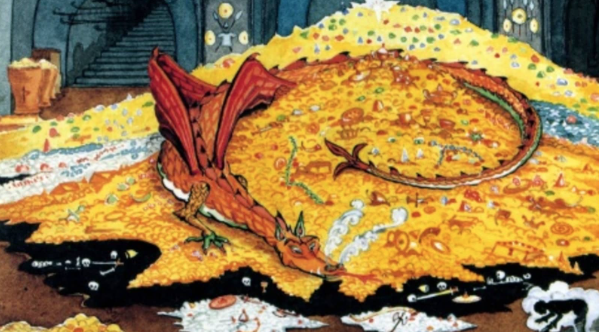
The lair was established in the Lonely Mountains and was only accessible during Durin’s Day. The inside contained “countless piles of precious things, gold wrought and unwrought, gems and jewels, and silver red-stained in the ruddy light.” The dragon is just silently laying there on these jewels taking his typical nap. Outside of the lair though, lay much nature, such as a “wide valley shadowed by the mountain’s arms” and the “gray ruins of ancient houses, towers and walls” surrounding the blood-curdling lair. The remains of “remnants of ancient dwarf-kingdoms” stood as a grim reminder of Smaug’s wrath. The steep cliffs surrounding the lair created “a narrow ledge over a sheer drop,” making escape nearly impossible.  

All of this is comfort, ranging from Smaug sitting on the piles of rock-solid gold to the silkiness of the Attercop’s webs, to the soft cushion of your chair reading this essay. It’s crystal clear that these different strongholds hold different creatures, to what they think comfort is to them, representing and shaping how that specific group acts and is formed, to the individual, entirely based on their environment. If it means living in a cave all by himself or living in a town above water, it doesn’t matter: as long as they’re comfortable in that area, it’ll be fine. Just like you enjoying your life in your luxurious house.


MELODY LONG

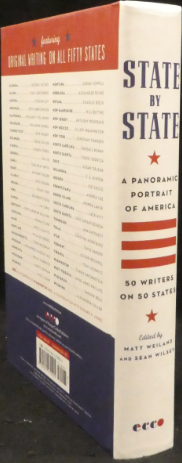
Melody has just begun Intro to Rhetoric and is succeeding with her quick analyses of various state essays. Having read the preface by Matt Weiland, she understands the purpose of the book, and we can see here that she is responding to the standard set out by Weiland with brief reviews.

Bechdel arranges her essay in a way that very much aligns with my expectations for State by State—mixing cultural and historical anecdotes about the state with the authors’ experience in a personal narrative. She opens with a bold anecdote about impulsively moving to Vermont to be with her girlfriend after only three months, only to later come to the realization that she had fallen in love with “the state, and not the person.” This initial rash decision contrasts with her slower, more introspective analysis of what exactly it is that she loves about Vermont. She speculates on several possibilities: the fact that “there’s always somewhere to go,” the insignificance she feels when standing on a summit, or even a genetic connection, as she recalls her grandfather herding goats in the Austrian Alps. 

Bechdel’s essay matches the goal that Weiland and Wilsey set for State by State: using personal moments to immerse the reader while tying them to broader cultural and historical contexts. Her seemingly unrelated reflections—such as her grandfather taking her to see The Sound of Music, which then leads her to describe Vermont as “absen[t] of Nazis, presen[t] of hills”—are all linked by a common idea: Vermont’s identity as a place of contradiction and independence. She critiques the state’s political landscape in a satirical tone, acknowledging the presence of right-wing Vermonters who discriminate against people like her, while also pointing out the left-wing “freak show” she belongs to, a category that includes “homosexuals, land conservationists, egalitarian school funding, [our] socialist congressman, and Ben & Jerry’s.” This humorous yet biting critique reinforces Vermont’s oxymoronic nature—both fiercely conservative and radically progressive.

Bechdel also dives into Vermont’s historical significance, emphasizing its role as the first state to abolish slavery and the impact of Ethan Allen, “Vermont’s founding hero,” who is claimed by both liberals and conservatives. On page 465, she satirically critiques Vermont’s obsession with independence through snarky references to the “independent bookstore,” the “independent hardware store,” and the “independent stationery store,” emphasizing the state’s deeply ingrained self-perception as a sovereign nation—something rooted in its history as an independent republic for fourteen years. She extends this commentary on page 466 with an observation about the “non-chain theatre” audience, describing them as “graying, erudite back-to-the-landers,” further illustrating Vermont’s distinct cultural character. 

            In terms of impact, Bechdel’s essay exceeded my expectations. The preface and introduction to State by State suggested that each essay would serve as a personally yet insightful view of a state, and Bechdel achieves this with humor, irony, and clear analysis. While I anticipated a blend of memoir and state commentary, I didn’t expect her approach to be so fluid and conversational—almost like following the natural progression of her thoughts rather than reading a structured essay. Comparing Vermont to Oregon, I felt that Oregon was way different from my expectations, a lot of jumping back and forth in time and pessimistic attitude which covered up more about the historical impacts of the state (I thought he might talk about the Oregon Trail, but I guess not).

Alaska

            Greenberg arranges his essay, Alaska, by capturing the state through a personal, yet fragmented reflection on their identity and isolation. Rather than offering a usual travelogue or historical overview, like Vermont, he arranges Alaska in short vignettes and anecdotes, mirroring the unpredictability of the Alaskan landscape, and maybe his own fragmented connection to it as well. 

            On page 21, Greenberg really delivers a sense of tension between wilderness and the self. “We stayed in a friend’s cabin, no plumbing, wood stove, outhouse…” where he compares the domestic routines with the rawness of nature, while quietly hinting at a deeper internal desolation. Each memory feels like a quiet confession, bringing the reader’s attention to how Alaska’s not just “USA’s own third world country” but really a space where people are stripped to their barest selves. Greenberg’s essay succeeds in the goal that Weiland and Wilsey set for State by State: using the tiny anecdotes to break down stereotypes and deliver a more intimate portrayal of Alaska. Rather than reinforcing the “final frontier” image of Alaska, Greenberg complicates it. He acknowledges the grandeur of the state but centers the essay on human vulnerability instead. What I was not expecting was his subtle, sparse storytelling, rather than something more scenic or bold in tone. Obviously, in a state like Alaska, it looks a lot different than the heart of New York City, so effective imagery is extremely helpful in terms of context for its landscape and culture. His sparse and disjointed storytelling makes the reader a little lost, often wondering where and when he has moved onto, and how it’s connected to the story he’s sharing.


MICHAEL LIN

Setting: A story’s support and meaning 

By Michael Lin

“Authors use setting to create meaning, just as painters use backgrounds and objects to render ideas.”

~Eudora Welty 

Often overlooked and brushed past, setting is the main supporting column of any great story. Without setting, the characters wouldn’t have a place to be at all, anywhere, or to do anything, and time would just not exist, which is exactly why all stories have settings to begin with, but Welty’s settings in particular always push the story forward in discrete yet meaningful ways. While the setting in Welty’s stories often lays in the background, it also creates meaning in the stories, just like how a painting’s background adds to the whole piece itself. Though sometimes taken for granted as just the backdrop to the plot, a firm grasp on setting can actually bring many elements together (such as internal versus external, a trap and then a release) in the analysts’ mind. 

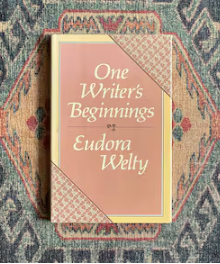
Born into a loving family and home on North Congress Street in Jackson, Mississippi, in 1909, Welty was brought into a setting that rivals her own works. Waking up to gongs of a grandfather clock that echoed “through the living room, dining room, kitchen, and pantry, and up the sounding board of the stairwell,” (One Writer’s Beginnings, 1).

Welty would soak in her environment, taking everything she listened to and saw to heart. At a very young age, she was quite time-minded and learned chronology immediately as a girl. Not only was she herself a sponge for information, but her parents were spouts that never stopped flowing. Welty’s father kept many gadgets and gizmos that gave Welty a sense of wonder: a kaleidoscope, barometer, gyroscope, and magnifying glass. Her mother, on the other hand, would not only read stories, but tell some of her own fascinating ones, such as how she survived through septicemia – a disease that even with today’s medicine can be lethal – by drinking champagne, or how she had kept “two polished buffalo nickels, embedded in white cotton” (OW’sB, 17) that were for her firstborn son who didn’t make it. In this pivotal moment that shocked her world as a child, Welty was simply playing around as a kid, fiddling with some “treasures of her [mother’s]” that she found in boxes. Welty finds the two nickels and rushes out to ask her mother if she could buy something with them, but Welty is immediately greeted with an extravagant “NO” from her mother. Welty inquires, and her mother eventually tells her how the two nickels were for her firstborn son who surprisingly died despite showing signs of being completely healthy. At this moment, Welty was bewildered – her world had been flipped upside down. 

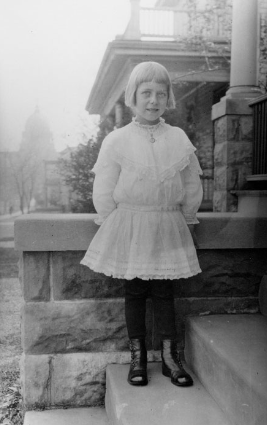
Eudora, about age 5. She said her mother made most of her clothes. Photo ©Eudora Welty, LLC; Eudora Welty Collection; Mississippi Department of Archives and History

How did realizing that she was in fact not the oldest shape her elder sister mentality? How did uncovering this tragic secret change her perspective on her home and parents? Welty discusses how discovering a secret can often lead to also discovering a hidden, darker secret that was not meant to be seen. Essentially, how did discovering this ghastly secret modify her views on her parents and home being a safe place where everything was how it seemed? 

The special way she grew up, absorbing everything around her, also made her think in her own special way too. From her childhood, Welty always pondered words themselves, and how they can connect to, or rise from, what they actually mean. For example, when she first saw a risen full moon, shining brightly, the connection between the 4 letters “m”, “o”, “o”, and “n”, connected to the big shining ball in the sky, with a similar shape to a plump Concord grape her Grandpa once gave to her. And it was at this moment “the word ‘moon’ came into her mouth as though fed to her out of a silver spoon” (OW’sB, 10). For myself and probably many others too, I just associate words with their meaning instantly if someone tells me what they mean; this deep, meaningful process where Welty simply connects the word moon with the glowing ball in the sky truly brings out how imaginative and creative she was from the start. However, Welty was under the impression that the sun and moon rose in their respective east and west sides, thinking that they “crossed over (when [she] wasn’t looking) and went down to the other side” (Welty 10). She held this erroneous view for quite some time, and it was only after literary critic Herschel Brickell pointed her misconception out to her, when she realized her mistake. He said, “Always be sure you get your moon in the right part of the sky.” Welty’s statement about setting is broad, but its true implications can be drawn from examining many of her stories under an individual close eye.  

In “Death of a Traveling Salesman” (1936), her first published story and what brought her into national attention, the main character R.J. Bowman finds himself in a place he’s never been to before. After a “long siege of influenza” (Welty, 1), Bowman prematurely rushes out of the hospital, and he attempts to drive to Beulah (“as he remembered, Beulah was fifty miles away from the last town”), a trip he had already made and knew how to get to, yet he ends up on a cow trail, by a hill he had never seen before. In fact, he just didn’t want to admit he was lost – that he’d just driven out on this unknown trail for miles, and… he even crashed his car, solidifying the inescapability of the setting. This setting Bowman finds himself in is really half interior, being Bowman’s own interpretation of his surroundings, and the surroundings themselves. For example, Bowman describes a woman who lived in the only house nearby as stupid, shapeless, and growing old, also describing how his heart fluttered as he talked to her; but Bowman wanted to embrace and hold her, due to his lack of an actual connection to a woman. However, near the end of the novel, and his life, it is revealed that this old woman and her Sonny were actually a happily married couple, and the dusty husk of woman that Bowman envisioned was pregnant, was about to have her baby, and in the right light was attractive on top of that! 

The setting actively influences how Bowman thinks and feels throughout the story, yet Welty reveals the real setting as being separate from Bowman’s misperceptions. It is rural farmland, with not many people, and he is helped by two who live in a cozy little shotgun house, but we never get to see that. All Bowman – and the reader – see is a desolate, unfriendly wasteland, the house having a “dark passage” (Welty, 3), it being cold and even silent with the woman right next to him talking. All of these aspects of the setting drive Bowman further and further along his deranged path. As the story drives on, the more Bowman soaks in the fact that he is alone, trapped with a creepy couple, the more anxious, skeptical, and fantastical he gets. Bowman starts imagining and theorizing about everything he sees, instead of actually looking at it. All in all, the setting and Bowman’s interior thoughts form a destructive cycle that drives him to death.

 In “Livvie” a 16-year-old young girl is married to Solomon, a much wiser older figure, already at the end of his glory days. From this moment on, Solomon only got older and older, eventually becoming bedridden, and Livvie’s youth only crumbled away. Livvie spends the majority of her youth alongside the deteriorating Solomon because she loves him, and the setting only furthers this feeling. Solomon’s house contained cozy furnishings, such as a “three-legged table with a pink marble top,” a “lamp with 3 gold feet,” or even a “jelly glass with pretty hen feathers in it,” (Welty, 208). No bleak and bland ordinary apartment or house would just have such intricate and unique items inside of it. Just these few items add to the sense of homeyness and the feeling that a true person is living in there with their specific quirks and feelings, just like the furniture’s own eccentricities. However, this loving home is never actually referred to as the couple’s or Livvie’s, even though they are married. By definition, marriage would split the property fifty-fifty, yet Livvie calls it “Solomon’s house,” (Welty, 209). Furthermore, Livvie never seemed to actually have any free will in the story, even if she was caring for Solomon out of love. She always had to clean, cook, and care for Solomon, and when a cosmetics lady arrived at the house, Livvie had no money to even buy the lipstick she wanted, even though the it “carried her away in the air through the spring,” (Welty 213). She could do nothing as Miss Baby Marie said her goodbyes, and she stayed in the isolated house watching Miss Baby Marie drive off. At this point, Livvie has been happy in her confined world; she has been joyfully tending to Solomon’s every need because of love, but now, Livvie has been introduced to something from the outside world that she wants. For the first time, Livvie desires something that she currently can’t have. The cosmetics provide a link to the outside world that Livvie had never had before, with Miss Baby Marie even saying that Livvie is “far from anywhere” (Welty 214), “anywhere” being a place with people and actual things happening, something that Livvie has likely never lived in and enjoyed to her fullest extent. Also, being that it is set in the spring, we are put into the mindset to think of Livvie’s future, the coming summer, fall, and how her life will change. In his final loving speech to Livvie, Solomon describes how he “spread sycamore leaves over the ground” (Welty, 217) for Livvie as, a newlywed, she’d be honored, preserving her life’s spring. He prayed, “God forgive Solomon for carrying away too young girl for wife and keeping her away from her people,” (Welty 218). In the end, the setting in “Livvie” first traps but then lets Livvie fly high into a new beautiful beginning.

In “The Wide Net”, William Wallace Jamieson discovers that his wife Hazel has gone missing. Returning at dawn, he reads a letter she left behind saying that she would drown herself because of his choice to go out drinking with his friend Virgil and one other, William immediately rushes out and calls for Virgil, who had “one foot inside the door” (Welty 153) of his house, ready to crash. They had just carried home the third man “flat between them”, so drunk from the previous night. To find Hazel, they seek out the Malones and the Doyles and go to Doc’s house, to borrow Doc’s huge fishing net to search for Hazel. Doc accompanies them, and the whole crew of them probes along the wide Pearl River, “glimmering, narrow, and soft,” (Welty 159), it bursting with joy. During their pursuit of Hazel’s drowned corpse, the group simply enjoys life, catching, cooking, and consuming fish. However, by the end of the merry day, William returns home empty handed, only to discover his wife was actually hiding in their house the entire time. 

Even after he’d discovered his beloved wife had possibly jumped into the river to end her life, Wallace still reminisces about when he first met Hazel and the setting around them. He was walking down a road when he spotted Hazel carrying a “frying-size” chicken given to her by her grandma. They walked and walked through the bountiful fields of blackberries and down to Dover. When they got to Hazel’s house, he stayed for dinner, eating the tender chicken, berries, sweet butter with an elegant tree design drawn on it and a neat pitcher of new milk that she “leap[ed]” up to get (Welty, 154). Dover is a town only four miles away, and now Hazel lives in William’s town; regardless, these communities are close, but what is more at stake here is … where’s Hazel? The young men then, don’t sleep, and roust up their friends and neighbors to “drag the river”. 

The setting in “The Wide Net” is just stunning. You have this group with a rather dark goal of finding William’s dead wife contrasted with a beautiful place. It is dawn; the sun glows and shines down on the flowing, gleaming Pearl River. There is nothing in the setting that would ever prevent William from enjoying nature and being alive. The story would have played out in a much more joyless fashion if William wasn’t allowed to catch a fish straight out of the river, roast it, and eat it, or just jump in the river, looking for Hazel. As he “div[es] to the bottom” William sulks into a “clear world of deepness” no longer tainted by the “muddy world,” (Welty, 162). He ponders and thinks about Hazel even more, and in this almost enlightened state of immersion with the setting, can’t become gloomy, can’t drown in agony. This is what is so amazing about the setting of “The Wide Net”: you have this rich, deep, clear space that our characters can simply immerse themselves in, feeling alive, being freed: William Wallace we all know is on the verge of fatherhood, but does he really know it? Perhaps diving into the depths for Hazel (whom no-one really senses is actually drowned) is in essence a rite of passage for William, a time of elation that comes of “great hopes and changes” that William “reach[ed] and turn[ed]” for, now realizing what he could have ruined.

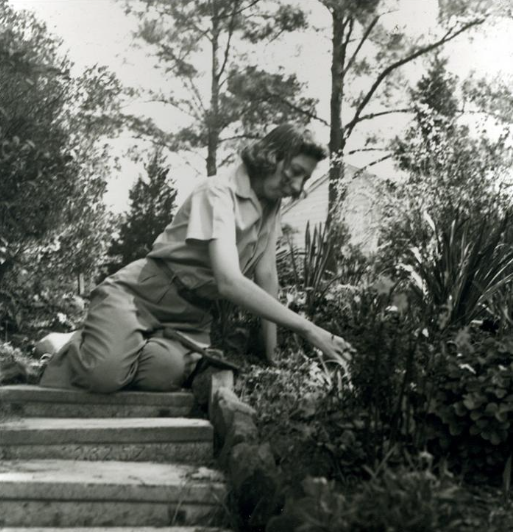
Setting is something that towers over other aspects in Welty’s warm and brilliant literature. The discrete, or individualized, moments of expanded setting are full of extractable meaning. Why don’t we do that now, as a way to pay respect to the fullness of an ingenious author like Welty?

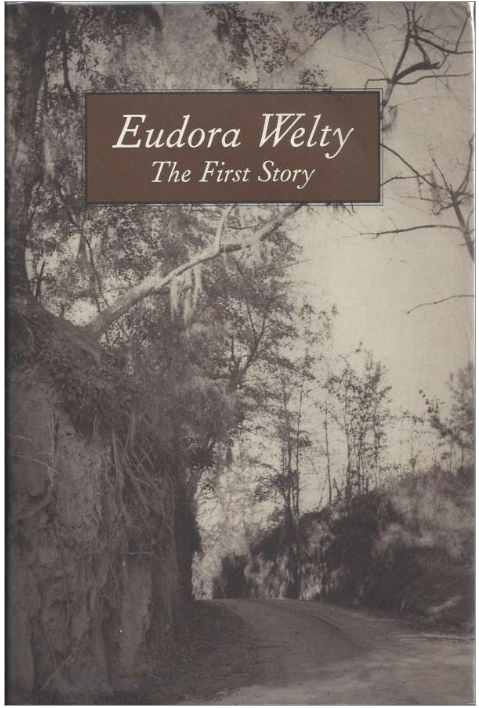
Welty’s first published story, “The Death of a Traveling Salesman” here in a commemorative edition to celebrate her 90th birthday.

In “Death”, the fact that this self-proclaimed memorized road that Bowman is driving on simply abruptly cuts into a ravine, being “the road’s end” (Welty 109) holds a lot of meaning in itself. I mean, this road that he is driving on could almost represent his life, with this sudden end being his death. As he keeps pushing, attempting to get his car back on the road by asking for help, all he can do is struggle in the face of his inescapable death. See how much the setting gave us there?

In “Livvie”, one thing that was not noted above was the “line of bare crape-myrtle trees with every branch of them ending in a colored bottle,” (Welty, 209). These bottles were meant to trap evil spirits. “Solomon had made the bottle trees with his own hands over the nine years, in labor amounting to about a tree a year.” (Welty 209). He did this to ward evil spirits away from Livvie, revealing his love even more. Solomon knew he die one day and wanted to preserve her life’s spring by dedicating himself to warding away spirits that would ruin her.

In “The Wide Net”, the crew had to deal with tons of local wildlife while searching along the river, finding a crocodile or even “The King of Snakes,” (Welty 164). By including such dangerous animals, Welty not only adds to the freedom of the setting, but also reveals the actual danger and reality of the situation. This isn’t some magical adventure of self-reflection for William, as he could have easily been killed by that snake if it didn’t choose to back off. Wallace has chosen to make this trek to search for his wife, even if he dies. He realized what may be lost and has made up his mind to do the most to atone for his mistakes.