AARON HUR
The acrobatic animals of the ocean
You know when you think of the most beautiful animals in the world, what do you think of? Well you think of dolphins of course! What makes dolphins so fascinating? Well, dolphins are brilliant animals, sleek and gorgeous, and like to put on a show. They’re like human beings caught in another body, because they’re so smart and love to play. It is hard to not love a dolphin, but never forget – these are wild animals.
Dolphins are small members of the whale order, Cetacea. Dolphins are amazing mammals that are known for their intelligence and playful abilities. They have excellent athleticism under good conditions, and can be trained to do insane tricks. Bottlenose dolphins, one of the most popular and smartest dolphins, have the third largest encephalization levels of any mammal on Earth (humans have the largest), and these close ratios with humans most likely contributes to their high intelligence overall and their emotional intelligence most significantly.
Do you ever confuse dolphins and porpoises? The term dolphin and porpoise sometimes are used to refer to any member of the group. Porpoises are kind of like dolphins, but are actually a different species altogether. Scientists prefer to say that porpoise is a common name for six species in the Phocoenidae family. Porpoises are more compact and are usually smaller than regular dolphins. Dolphins off the coast of Britain have been known to catch salmon and throw them into the air, re-catching them again in their ruby mouths. But did you know that dolphins also kill and maim their smaller cousins, the porpoises?
Most dolphin species don’t begin to breed until they are five to eight years old. The female dolphins produces one baby dolphin called a calf, the time between conception and birth being eight to eleven months. When the calf is born, the mother brings it to the surface for its first breath. The baby calf stays with their mothers for at least one or as long as two years, while continuing to nurse. Most dolphins give birth in the warm time of year. Something you may not know is that dolphins actually have hair on top of their head, but only for a short time after they are born. Another interesting fact is that they live relatively long, and some can live more than fifty years.
Dolphins are extremely athletic animals. The best can jump nearly 6 meters in the air! When dolphins sleep, they sleep with half of their brain awake, and keep one eye open, going to the surface to breathe every few minutes. Baby dolphins can stay underwater for only 2 minutes, so they stay close to the surface, while the mother and adult dolphins can stay under for up to 15. The young dolphin always stays close with their mother to stay safe from all the ferocious sharks at nighttime. The mother dolphin teaches their young advanced skills and ways to hunt with their pod.
Dolphins come in all different lengths and widths. The largest species in the dolphin family is the orca (also known as the killer whale),

can reach more than 32.5 feet. It can also weigh about 10 metric tons! That’s the biggest dolphin, so dolphins are much, much smaller. The bottlenose dolphins reach an average length of 8-10 feet and also weigh 300-650 pounds. Furthermore, the biggest river dolphin, the Amazon River dolphin, can be up to about 9 feet long, and 408 pounds. The smallest dolphin species is the Hector’s dolphin, which is about 4 feet and weighs only about 110 pounds.

Dolphins grab their prey with their teeth, which consists mostly of marine fish, shrimp and larger animals such as squids, jellyfish, and octopuses. The types of fish and other creatures dolphins eat depend on the species of dolphin, where the dolphins live and the wildlife that shares their habitats. The social behavior of the dolphins is complex and advanced in different ways. They use a complicated communication system underwater, of high pitched whistles and squeaks, some of which is beyond the range of human hearing. They also use echolocation, where their sounds reflect off of things and comes back to them. Then, they can tell how far away the object is.
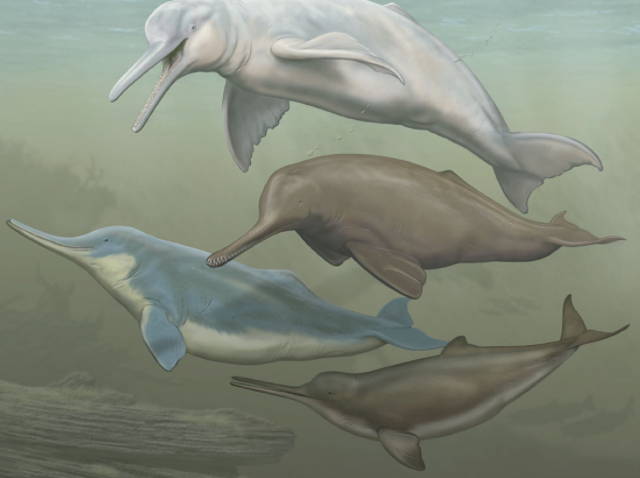
River dolphins are an interesting species of dolphins. They are sometimes pale blue or a color of white. One cool thing is that they’re very flexible and their vertebrae in their spine is free floating so they can easily do a 180 degrees turn. Pink river dolphins are the biggest out of the 5 species of river dolphins (also known as the Amazon River dolphin). They can live up to 30 years. These freshwater dolphins have small eyes and have poor eyesight so they have to rely on echolocation.
Amazon River dolphins or boto, live in the freshwaters in the Amazon or Orinoco Rivers in Bolivia, Brazil, Colombia, Ecuador, Guyana, Peru, and Venezuela. There are tens of thousands of these cetaceans, but they are at risk of becoming endangered from polluted bodies of water. Mercury contamination from mining activities is a very much a big threat to the river dolphins. Mercury enters dolphins through the food chain. Mercury is absorbed by animals such as catfish, carp, bass of various types, and other bottom feeders majorly affected by metals, who are in turn, gobbled up by dolphins.

The Amazon River dolphins’ diet is the most diverse among toothed whales. It has a lot of fish in it. Each day they eat 5.5% of their weight and that’s not a lot considering that pandas eat 40% of their body weight each day. Humans, by the way, consume roughly 2.5-3.5% of their body weight in food per day. This dolphin’s prey is between 5 and 80 centimeters, and the fish that they mostly eat are the Sciaenidae (drum fish or croaks), Cichlidae (like angel fish and sunfish), and Characidae (tropical reef dwelling small fish). Their diet has lots of diverse fish especially in the wet season when fish are spread out in flood areas becoming hard to catch. While in the dry season the prey density is greater, and they snack like crazy.

The Amazon River dolphin’s color is very interesting and changes based on its age. With grey on the top of their body as youths, a pink shade spreads around their sides to their back as they mature. When it becomes older it ends up close to white with a little of blue and grey. Amazon River dolphins have a modified hump in the middle of the torso, instead of a dorsal fin. Their big flippers are used to steer while they swim through shallow waters.

Irrawaddy dolphins are a very interesting type of dolphin. They’re very endangered, with only 92 remaining. They have a bulging forehead with a short beak, and 12-19 teeth on each side of their jaws. Irrawaddy dolphins vary in weight from 198-440 pounds. They can also be 5.9-9 feet long. The Irrawaddy dolphin is a sacred animal to both Khmer and Lao people (Thailand and Laos), and generates dolphin-watching ecotourism. Irrawaddy dolphins are sadly threatened mostly through bycatch and accidental captures.

Irrawaddy dolphins have drawn out pectoral fins they use to help them swim through the water swiftly. They have a cool shaped body that’s different from most dolphins, and they have a lackluster coloring of dark grey on top, and light grey on the bottom. The Irrawaddy dolphin has a unique look among dolphins. They lack the characteristic beak and aerodynamic head of most dolphins, instead having a bluff snout and a high, rounded forehead. Their dorsal fin is short, blunt and triangular and located about two-thirds down their back. Don’t you think they look just like Porsches, with the rounded head and the tail in the back?

Here are some cool facts about dolphins. Common dolphins have low foreheads and sharper, longer beaks. Also, bottlenose dolphins have an extra layer of blubber. Usually dolphins have triangular fins, but Hector’s dolphin actually has a rounded fin. The term Hector’s dolphins comes from a New Zealand scientist named Sir James Hector. Something you may not know is that dolphins actually don’t drink water. They get fresh water from the fish they eat. One other cool fact is that dolphins blow streaks of bubbles in the water to either show aggression or excitement. It is like shouting for humans.
Now, with any animal, there are a variety of types. From the fattest to the smallest, from the wisest to the silliest, dolphins, like humans, show a great range. Bottlenose dolphins are almost 13 feet long with more blubber to keep from the cold. They adapt with stubbier beaks and are fatter than most dolphins. Another cool fact is that Fiorland dolphins only touch each other to communicate rather than using clicks and whistles.
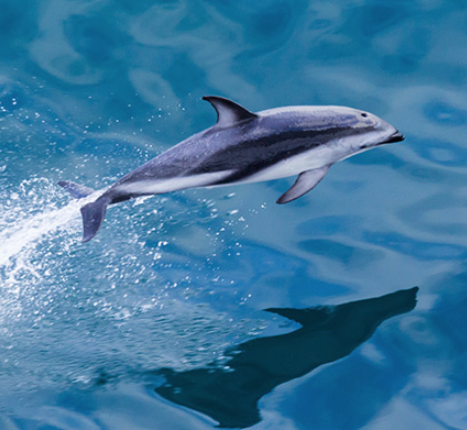
Dolphins live in large family groups. Dolphins, if you see them, will be mostly submerged into the blue or green salt water. These animals are like peak athletes – they are incredibly agile, fit, and like to show off. Sometimes, using the boat’s momentum and water displacement they propel themselves, like so many Olympians, into the salt-spray air. Some of these elite animals will develop oversized fins, which are better to slice through the air or the water, and better for speed, competitive edge, and general style. Did you know that dolphins have natural contact lenses? Well, their strong eyeballs need cleaning and refocusing from time to time. Dolphin eyes are specially designed to see above and below water, and they cannot see colors except for shades of gray, and blue-green spectrum.
Dolphins are tactile beasts. Dolphins create special whistles to communicate – have you heard it? As mentioned, dolphins are group animals – in that they use their group power to access massive amounts of food. Dolphins have many hunting techniques where the pod’s force as a group is brought to use. The young dolphins learn these things from their mother. One example of that is when a mother dolphin taught her calf her most advanced technique for getting food for their pod: the dolphin creates a circle around the prey, while their tail splashes up mud or sand to make a ring from the sea floor. Then the prey tries to splash out, but into the dolphins’ mouths they go. Dolphins use special whistles to communicate with their calves, and they can use that whistle if the calf is lost in a big group. The group hunts and teaches the young dolphins how to hunt. When dolphins are courting, they will touch each other if they are interested in the member of the opposite sex.
Dolphins are amazing, and are extremely unique animals as you can tell. They’re brilliant, talented animals with cool attributes, but sadly some of them are very endangered such as the Irrawaddy and Maui dolphins, with only 92 and 55 remaining, respectively.

Next time you go near water and see a dolphin swimming happily, you’ll know a lot more about them such as how they live, how much they are like humans, and how much they love to play… and why they are the acrobatic animals of the ocean.