Monthly- Archives: January 2023


MICHAEL LIN

Magic through a Professor’s eyes

John Bellairs (1938-1991) was a brilliant author of juvenile and adult literature who wrote many novels and series and parodies over the course of his shortened life. Bellairs created three series: the Anthony Monday series, which contained 4 books, the Lewis Barnavelt series, and the Johnny Dixon series, both of which contained twelve books. The latter two were also finished by the ghost writer Brad Strickland. The Curse of the Blue Figurine, the first in the Dixon series which explores an evil priest who utilizes dark magic to incur his wrath and lengthen his lifespan, The Mummy, the Will, and the Crypt, which contains the most puzzling magic, with an unfinished search for its source while also introducing Fergie, and The Spell of the Sorcerer’s Skull, which ropes in Father Higgins – Johnny’s benevolent local priest – to turn the tables on us, rescuing Professor Childermass instead, begin the series by exploring, among other things, how the Professor must learn how to adapt to magical situations.
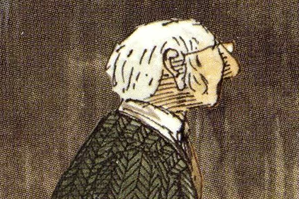
Bellairs creates very thorough and thought-out characters, and one of the chief characters who drives each novel (or seems to put on the brakes) is Professor Childermass. At first, the Professor just seems like an average grumpy old man that does nothing but complain. But he is far from that.

The Prof only displays himself as a pain in the neck to people he thinks are a nuisance in his life, but in this case, it is his car that is the nuisance. He is introduced as he makes his entrance into the Dixon home, hot and cursing. His car is stuck in the snow, and he’s ready to blow one of his own cylinders. “You know Henry,” the Professor snarls, “in a hundred years, people will think we’re out of our ever-loving minds to spend so much of our valuable time taking care of automobiles. Think of it! Everybody on this block owns a two-ton hunk of metal that he has to feed gas and oil – “. He barely even acknowledges Johnny, who has just moved in with his grandparents from Long Island, NY. But suddenly, the Prof stops when he sees Gods, Graves, and Scholars, by C. W. Ceram, The Mountains of Pharaoh, by Leonard Cottrell, and James Henry Breasted’s History of Egypt. Interrogating Johnny about whether he was assigned the books or not, Prof discovers a kindred soul – Johnny checked these out on his own volition! Commenting on Johnny’s books on page 15, the Professor speaks disparagingly about his nieces, in glowing approval of Johnny’s reading these books (and not even for an assignment): “I have just come from visiting my sister’s daughter, who lives in New Hampshire. She has two children your age, but they couldn’t read their way through a book of cigarette papers.” 
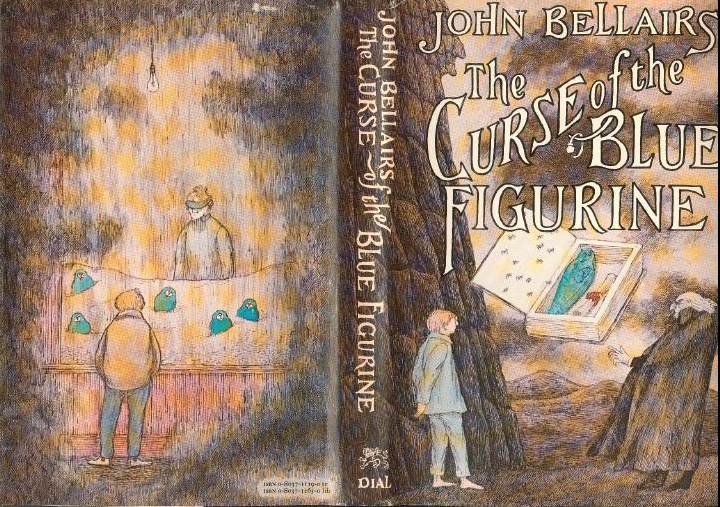
Now that the Prof has recognized Johnny as someone who is interesting, they go on chatting about questions Johnny is dying to know the answers to. This leads Johnny to start asking about ghosts – being the information lover he is – and this intrigues the Professor. The Professor “[eyes] Johnny curiously” (Bellairs, 16) and “a faint half-smile curl[s] the corners of his mouth” (Bellairs, 16). We can see the Professor is being hooked in by Johnny’s intense curiosity; this gives the Professor the idea of telling the story of Father Baart to keep him going. Father Baart had St. Michael’s Church built in the 1890s, and he also had the altarpiece designed by a mysterious artist. Johnny attends St. Michael’s both for school and church. Baart had a nasty mouth which he used to his heart’s content, making enemies with many people in the town of Duston Heights. The people wanted him out, but the bishop was too lazy to actually do anything. So, Father Baart kept on angering people, and after the mysterious artist left, some of his public enemies started dying from very accidental deaths. After these deaths, Father Baart vanished, leaving not a trace behind. Everything of his was untouched! But some rumors still fly at St. Michael’s Church about seeing him lurking out and about in the back of the church, ready to frighten any innocent soul. The Prof fires into explaining the local mystery.

Professor Childermass describes Father Baart: “He was short and wore a black cloak and he had a big head and a jutting chin and lots of grayish hair that he wore long. And an overhanging forehead, and a hawkish nose, and a deep-set, burning eyes. So if you’re ever in the church late at night well”… only to be cut off by Johnny’s grandpa trying to protect Johnny by saying, “Don’t scare the poor kid to death!” (Bellairs, 21). Gramps wishes for the well-being of Johnny, but also is intrigued by the story too. He follows up with, “It’s a shame that a man like that, a priest and all, should have gone over to the devil” (Bellairs 22). Since the Prof is charmed by Johnny’s interests, he goes to great lengths expressing the story to entice Johnny for the entire time. We can even see his grandparents being pulled in.

In this short outburst, we can clearly see that on the outside the Prof may seem like a toxic, grumpy guy, but when he is speaking with someone he finds interesting or worth talking to, the Prof really opens up. We can see this bond being formed between the two when Johnny discovers the figurine.

One of Johnny’s classmates at school named Eddie Tompke really hates Johnny. Eddie is really jealous of Johnny due to his smarts. You see, Eddie’s grades are in the gutter, and he takes his frustration out on Johnny. Being the smaller kid, Johnny was always afraid of being beat up by Tompke. So, on one fateful February day, Johnny is about to leave the church and spots Eddie talking to another kid right outside the door. Johnny obviously doesn’t want to run into Eddie again, so he goes back in, and performs a simple prayer, hoping that Eddie would be gone when he finished. But Eddie is still there. Frustrated, Johnny decides to have a look in the basement to bide his time. Bringing only a flashlight, he creeps down the creaky basement steps. Narrowing down to a bookcase, he grabs a random book. Once he picks the book up, spiders start to crawl all over the bookcase and a few get onto the book. Johnny hates spiders, and this anomaly almost causes him to throw up. But out of nowhere, the spiders disappear! Johnny is interested by this and attempts to grab the book that the spiders resided in originally, but fear takes hold of him, and he jerks his hand back three times in a row before he finally acquires the courage (or foolishness) to pick up the foreign object. Opening it, he discovers that the book is hollowed out, and inside resides a strange blue figurine and an ominous note left behind by Father Baart. The note reads: “Whoever removes these things from the church does so at his own peril. I abjure you by the living God not to endanger your immortal soul. Vengeance is mine; I will repay, saith the Lord. Remigius Baart.” Johnny is terrified. In the midst of trying to set things right by putting everything back, he hears a rustling noise, and is startled even more. In a panic, he runs back up the stairs, out of the basement, while still carrying the book with the figurine inside. So, with nowhere to go, he thinks of going to the Professor, but can’t go right away. Johnny hides the book in his room, and waits days until he can visit the Prof.

When Johnny visits the Professor’s house, Johnny catches him off guard in his so-called fuss closet. The Professor is forced to explain his fuss closet, explaining that “[he] has a rotten temper… So, [he] came up here –as [he] always [does] in such cases… and he fussed. [He] cursed and yelled and pounded the walls and the floor,” (Bellairs, 39). Normally, a random person walking inside of your home wouldn’t incline you to tell them a story about a closet, right? But the Professor is so fond of Johnny that he can’t help but welcome him in at any time even though he doesn’t even know why Johnny is there in the first place. The Professor’s reaction to the information Johnny shares with him about the figurine is telling, for it reveals how the Prof deals with the supernatural: the Professor immediately spouts “Good God! Are you serious? Do you really mean what you just said?” (Bellairs, 40). The immediate questioning of Johnny, one of his good friends, unveils how skeptical he is of anything supernatural. But Johnny, determined to find answers, nods and persuades the Professor into inspecting what he found.

A few weeks later, Johnny catches the Prof reenacting sea battles in his bathtub. Bellairs describes it so thoroughly even though the scene itself seems silly at best. Bellairs says Johnny, “… found the old man kneeling beside the tub. He was wearing a rubber waterproof apron, and the sleeves of his shirt were rolled up. The tub was half full of water, and in it floated a fleet of little wooden boats. They were galleys, with matchstick oars and little triangular sails. Little paper flags fluttered from the sterns of the ships. Half of the flags were red and gold and had coats of arms on them. The other half were green and had gold crescents,” (Bellairs, 61). But why describe it so much? In reality, these are just little tiny boats that are being fiddled with by the Professor. This scene is so out of the ordinary and weird. No one would expect a scene with a Professor playing with wooden ships in a bathtub, or would they? But Bellairs goes so far to really make it feel natural.

It feels natural because at this point, we still know the Professor as a sort of kooky crazy type of guy. As he is introduced, he is complaining about cars and asking for booze and fudge, which is absolutely not something a person with good etiquette and common sense would do. So, this scene with the Professor playing with boats furthers the idea that the Professor is this kooky crazy kind of guy, but it also hints at other parts of his persona. Childermass is “reenacting the Battle of Lepanto, which had taken place in 1571” (Bellairs, 61). But why this battle in particular? Why isn’t it just a plain `ol scene just for fun? Well, because Childermass is a professor of history, and in order for his students to have the best lecture on whatever historical topic they are covering, he reenacts them to freshen up and really understand it better. Although he may hate his students, he wants to be the best professor he can be for them. This care can be seen whenever he is with Johnny as well, because Johnny is someone who the Prof truly enjoys being with.

The Professor’s reactions to each type of magic presented are really interesting, because they are much different than any normal person’s reactions would be, and since the Professor is a professor, he is already influenced and lives by cold hard FACTS, so when you put someone like this in a situation where facts don’t apply anymore, they will have a much more amplified and distinct reaction. Now, the Professor does acknowledge the existence of magic, both black and white. In responding to Grandpa, he mentions medieval sorcerers that were priests – which means he acknowledges the existence of sorcerers in history – and even says “If you fool around with magic, there must be a terrible temptation to call upon the powers of hell” (Bellairs, 22).

So, the Professor is talking about magic to Johnny and his family, but this is a lot different than actually being in the frontlines of the supernatural. It’s a lot easier to say something than it is to truly believe in it. In each book, the Professor is constantly brought to a point of conflict where he must acknowledge the existence of the supernatural. The locus, or the location of the Professor’s acknowledgement of the supernatural, shows an interesting progression through the three novels. In these loci, he just doesn’t know how to actualize the magic in his mind, which produces many memorable reactions and ideas being presented from the Professor throughout the series.

The Professor directly harms Johnny by denying magic because he starves Johnny of any help. For example, on page 42, at the fuss closet, Johnny comes to vent his frustrations and fears about the figurine, thinking it has magical powers (which it does), but the Prof scoffs it off and unveils it to just be some souvenir. He exclaims “That’s a good one!” (Bellairs, 42) and, “Here, have a look! This is funny, it really is!” (Bellairs, 42). At this point, what Johnny has presented to him seems just like some joke. I mean, in the eyes of anyone sane, why would some random souvenir from Cairo, Illinois be imbued with magic power? Johnny even gets the figurine checked by Scholastic’s Hobbies, a toy magazine, to see if it has any value, and it didn’t. It was “manufactured by Mound City Novelties of St. Louis, Missouri” (Bellairs, 63). But ultimately, the Professor’s upfront denial of Johnny’s findings harms him. This reveals another side of the Professor, his weaker side.

After he discovers Johnny was actually being hurt all along because he didn’t accept the supernatural quicker, Prof bears an enormous load of guilt. This guilt is what causes him to have greater drive towards the end of the book to fend off Father Baart and save Johnny, because the Prof thinks all of it is his fault. These actions and reactions are hardly shown by the Professor to anyone, because his arrogant, rude side is dominant. But when push comes to shove, this emphasizes that the Professor is really not the braggadocious man we first see.

Johnny enters St. Michael’s church to pray and is approached by a kind old man named Mr. Beard. Mr. Beard really just seemed like a kind soul who wants to help Johnny, but this is all a ruse to cover his true intentions. Mr. Beard was actually Father Baart disguising himself, appearing only to Johnny (invisible to everyone else)! Mr. Beard gives Johnny a strange old ring to make Johnny feel better, because he can’t just deny an old man’s kindness, but this ring is actually an intense catalyst for Father Baart’s dark magic! Father Baart uses the ring to wring from Johnny his life force, control him, and send more powerful and evil magic into Johnny. The ring initially acts friendly, but we can clearly see it’s not, once Johnny encounters his greatest enemy, Eddie Tompke.

Johnny finds himself walking on the outskirts of town when he runs into Tompke once again. At this point, Johnny is furious, because he knows Eddie made an innocent kid steal Johnny’s sacred prayer book, and the ring intensifies this emotion. When Johnny is still unseen, “a force was rising up inside him, irresistible, it was this force that made him do what he did next” (Bellairs, 101). This can be thought of as the ring amplifying Johnny’s anger to have to spawn a vengeful situation… Ordinarily, poor old Johnny, polite and unassuming, would never jump out and start scolding someone, saying things like “I hope you fall down a manhole and break your other arm! You hear what I said, you rotten creep?” (Bellairs, 101). Even Johnny himself doesn’t believe that he’s just said that to him: it was as if “somebody else was using his body and his vocal chords” (Bellairs, 101). Johnny provokes Eddie and wakes the sleeping beast. As Eddie walks towards him, Johnny practically quivers to death. But suddenly, the ring activates and “Johnny felt a sharp pain in his ring finger, and it seemed to him that the yellow stone flashed. And then a strong wind began to blow,” (Bellairs 101). Then, the gust of air blasts rustles nearby bushes and blasts Eddie against a brick wall. This anomaly causes Johnny to then pace around for hours, terrified of what else the ring’s power could do.

Johnny, now moping to school and back, attracts the attention of his grandparents and the Prof. They meet together to discuss what to do, and the Professor mentions, “I haven’t seen him to talk to in about two weeks.” The grandparents agree, because they have no better ideas. “I came over here hoping that you two might enlighten me” (Bellairs 106). But none of the guardians knew what to do. So, the Professor proposes that he follow Johnny to the church and investigate why he is going there. “I’m good at tailing people. I was an intelligence officer during World War I. My code name was the Crab” (Bellairs, 107). The next night, the prof follows Johnny, but Johnny passes the church and heads across the Merrimac River to Hannah Duston’s Park. Johnny starts talking to someone, and all the Prof sees is Johnny having a conversation with the air! But still, the Professor doesn’t waver in his ideals. The Professor still doesn’t believe something supernatural is going on. He essentially sugarcoats to Johnny’s grandparents that he thinks Johnny has gone mad! The Prof proposes that Johnny should seek “mental help” (Bellairs, 124), and get “a real psychiatrist,” (Bellairs, 125). 

The Prof takes Johnny on a small vacation way up in New Hampshire to forget about all his worries, and another paranormal anomaly occurs that the Prof still refuses to believe. In their little rental home, Johnny finds a Bible with the words “Vengeance is mine; I will repay, saith the Lord,” (Bellairs, 150) underlined in red. Clearly, neither of them placed this Bible and underlined it, so Johnny’s first thought is that this was the doing of Father Baart, but the Professor just shrugs it off once again. He says, “Did you underline these words?” or “Oh, ghost my FOOT! I thought we were through with ghosts,” (Bellairs, 151). But this hurts Johnny’s feelings so the Professor apologizes immediately, but we can still see that the Prof’s first reaction is to doggedly refuse its existence. 

But finally, when the Professor wakes up to Johnny’s absence, the scale has finally tipped. He could shrug off words and strange actions, but a random disappearance in the middle of the night was so unlike Johnny that the Professor just couldn’t just deny it anymore. The Professor couldn’t let something atrocious happen to Johnny so “in an instant the Professor was on his feet. He was pulling on his pants, pulling them on over his pajama bottoms” (Bellairs 158). The Prof tracks Johnny’s footprints, scaling steep cliffs, narrow ledges, and harsh trails all through a pitch black thunder storm. He finds a black shadowy figure looming over Johnny, and the figure threatens the Prof. But, immediately, the Professor comes to action, yelling “My mother met you once when you were alive! And she said you were the rottenest, meanest creature that ever crawled on the face of the earth!” (Bellairs 165). The Prof also grabs Johnny and starts a fire to fight back against Father Baart. We can see that as soon as the Professor accepts the fact that something paranormal is going on, he acts quickly like an apex predator. It is because of the Professor’s quick actions and thoughts that allow Johnny to finally seal Father Baart and his curse. Without him, the wooden box would have never been uncovered, which was what allowed Johnny to survive and bring back the Professor!
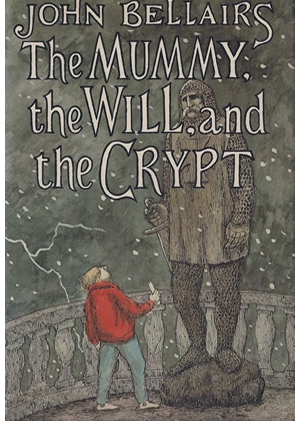
In The Mummy, the Will, and the Crypt, the sequel, or the 2nd in the 12-part series, the Professor’s input on the story differs immensely from Curse, but in the end, he still is able to rescue Johnny, although in a much different way. For example, the Professor doesn’t even realize what is going on until he realizes Johnny is missing!

Johnny and the Prof find themselves visiting a museum and finding information about H. Bagwell Glomus, a rich owner of a healthy cereal company. Mr. Glomus has not left behind a will, but instead some disparate clues that were showcased in the museum. Johnny decides to give it a go, and the Prof toys with Johnny a bit, saying “Well? Have you figured out where Mr. Glomus’s will is? You’ve had oodles of time,” (Bellairs, 11). Although Johnny doesn’t have a clue on where to start, the will of Mr. Glomus starts to intrigue him. In this second novel, Johnny’s grandma is diagnosed with cancer, and the treatment is expensive. Concerned for her life, Johnny goes to drastic measures, and he searches for the Glomus’ will to earn a $10,000 cash prize.

Johnny’s friend Fergie from camp becomes a main character, due to the story mainly being set at a sleepaway camp. Although, in the beginning, the Professor still does try to direct Johnny away from finding the will of the Glomuses, saying “I’ve had enough of chewing over the affairs of the Glomus family. It’s time for us to pay up and hit the road… Arrgh!” (Bellairs, 13). It may not be obvious, but the Professor is directing Johnny away from the supernatural without even knowing it, for searching for the will is what causes Johnny to be put in a perilous situation later in the book. But he isn’t doing this intentionally because his guilt from Curse would obviously kick in. So, the Professor doesn’t have as many interactions with the supernatural as in Curse. In fact, he only has one interaction with the supernatural throughout the story. When the Prof discovers that Johnny is chasing after the will again, he runs into Mrs. Woodley, who is the keeper of the inn Johnny stayed at in his search.

At camp, and still obsessing about the will due to his Grandma’s sickness and the financial award, Johnny wants to call the Professor to report some findings. He decides to go into town to make a phone call even though the rules of camp allow for no phone contact. But Johnny wheedles his counselors to allow it. So Johnny steps into a quaint inn owned by a woman named Mrs. Woodley. He waits patiently and is eventually able to get the Prof on the horn. After checking in on his grandma, Johnny says “I found out something about Mr. Glomus’s will!” (Bellairs, 50). Furious, the Professor lashes back by saying “John, you are supposed to be enjoying yourself! You are supposed to be tramping about on woodland paths among the autumnal splendor of the White Mountains! What on EARTH are you doing thinking about dear old Mr. Glomus’s will?” (Bellairs, 51). The Professor clearly wants nothing to do with such petty ideas and immediately shuts Johnny down, as always. But, as soon as Johnny hangs up from the call about the Glomus will, he spots Mrs. Woodley, standing like a stick, creepily staring at him. He also notices a rather gloomy-faced young man giving him the evil eye.

After Johnny returns from camp, grandma is still sick. Johnny is still worried because he fears being abandoned again (recall that his mother is dead and his father, a fighter pilot is MIA in Korea). Johnny goes off on a tangent away from his normal school life, thinking that if Grandma dies, then Grandpa will be too sad to do anything, and the Professor won’t want to adopt him either, so he is extremely anxious as the days go by. One cold day in November, Johnny returns to an empty home and a note, saying that the Grampuses went to the hospital for a normal checkup. But Johnny, drowning in anxiety, does not believe this one bit. He decides to form his own plan to save Grandma: he’ll take money from their saved up stash, take a train north to New Hampshire, stay at Mrs. Woodley’s inn, and investigate for the will and get the prize money. On the day he was going to leave, he found an undertaker’s business card on their doorstep, and he almost broke down. But unexpectedly. filled with courage from fear, he immediately left his own note and starts his escapade to find the will. 

Johnny’s grandparents and the Prof immediately discover Johnny’s absence, and the Prof chases after Johnny. In this, we see again his military spy skills in action (this is mentioned in Curse, calling himself The Crab); we see this side of him when he discovers Johnny has disappeared. When he finds out, he immediately goes over to the Fergusons and gives Fergie “the good old-fashioned third degree” which is a long and harsh interrogation officers in the military often do. When Johnny is hurt, we can see the Professor’s mood intensify. After the interrogation, when he drives the car with Fergie, he drives super crazily, “he was a terror on wheels… He jammed the accelerator down, and the needle flicked past ninety” (Bellairs, 120). This dangerous driving causes Fergie to grip down and get slammed around the car, proving the Prof’s extreme will and grit that is carried over from his military life. 

The Prof and Fergie discover themselves at Mrs. Woodley’s inn and they ask her if she has seen Johnny. Woodley immediately tells them no, but the Professor doesn’t believe her. Looking around, the Prof finds Johnny’s “waterproof matchbox” (Bellairs, 128) that leads him to realize that Mrs. Woodley did see Johnny and is lying to them the whole time. He rashly “reached out and picked up a small china dog, wheeled around, and threw it into the fireplace” (Bellairs, 129). After this, he starts yelling at Mrs. Woodley, revealing her vengeful side. But, foaming at the mouth, she screamed and screeched at Fergie and the Prof in a hardly human voice.  All the Professor has to say is “I never imagined…I mean, who could possibly have guessed…?” (Bellairs, 130). He has essentially already accepted that something supernatural was up, right then and there. Instead of taking the whole story to deny and finally accept the supernatural, here he just blatantly accepts it as soon as it happens! After this, he finds Johnny knocked out in the crumbling church where the will resides and rescues him before the building collapses, so, in a way, the Professor does technically save Johnny from the supernatural again, but by rescuing Johnny out of a perilous situation instead. In the end, the Professor’s military training likely provided him with the will and resolve needed to perform this insane chain of actions to arrive in just the nick of time to rescue unconscious Johnny and save him from getting crushed.

In The Spell of the Sorcerer’s Skull, the 3rd book in the 12-part series, the Professor is the one who is victimized by the magic. This not only changes his role in the story, but also opens up room for other change. For example, we are introduced to a hero, albeit an already fond friend of Johnny’s, Father Higgins.

 In Fitzwilliam, New Hampshire, on a cold February night, a snowstorm was brewing, and so was the Professor’s temper. Johnny and the Professor stay at Fitzwilliam Inn on their winter vacation trip, not a pleasant one. The Professor, in his temper, shouts “Winter paradise indeed! I’d like to give a piece of my mind to the boneheads who settled up in this godforsaken wilderness! AND to the cheapo types who run the state and don’t provide enough money to clear the roads or sand them in the wintertime!” (Bellairs, 4). Responding to this, Johnny comforts the Professor, saying “Please, Professor! Don’t be angry, please don’t! Everything’ll be all right!” (Bellairs, 4). Already on these first few pages, we can see a slight role shift between the two. Johnny is now the one comforting and placating the Professor instead of receiving admonition from him. Once they arrived at the Inn, the owner, Mr. Spofford asks the Prof for his last name, because he was unable to read it in the guest book.

 Mr. Spofford, the owner, once hearing the Professor’s name, reacts strongly. “Mr. Spofford looked shocked. His hand flew to his mouth, and there was an uncomfortable silence in the room. The Professor presses him, giving some treasured family history, and asks him “So may I ask why my name has given you such a turn?” (Bellairs, 9). 

Mr. Spofford splutters: “Oh, it ain’t nothin’ against… against you personally. Or… or your family name. It’s only jist that, well, we got this clock here that we show to visitors sometimes, n’ it’s s’posed to be haunted, an’… well, it’s called the Childermass clock.”

As a side note, Bellairs employs a liberal use of coincidences. For instance, in Mummy, you’ve learned that it is only the proximity of the sleepaway camp to the Glomus Estate that allows the plot to continue to thicken. That’s a coincidence. Johnny and Fergie are at a camp, hundreds of miles from both the Glomus mueseum and the Duston Heights – sheer coincidence. And in Figurine another coincidence is almost impossible to believe: On the trip that the Prof treats Johnny on to relieve his worries, the mountain nearby just so happens to be the burial site of Father Baart’s ashes, St. Michael’s church, hundreds of miles away. So when they are getting all snug in their cabin, it just so happens that Baart’s ghost is able to waltz in and hypnotize Johnny and take him to the burial site. 

In Skull, we find out that the reason for the Fitzwilliam Inn possessing the clock is that, “it got left on the front porch here, one night durin’ a snowstorm.” Quite a coincidence. Nevertheless, we read on. The Professor’s reacting to this family heirloom is still quite revealing. He knows it is of a strange room where his uncle mysteriously died in a horrific position, but completely disregards the fact that it could possibly be magical. You would think that the Professor would try to be more skeptical to prevent danger, but no, he still hasn’t. Even when he gets the “oddest sensation” from touching a mini skull – which is always a creepy object – he doesn’t make anything of it. 

Later in the book, while Johnny was doing his homework with Fergie, he notices a Jack-o-lantern on the Professor’s upstairs window. The Professor already isn’t really the type of guy to put decorations up for any holiday, so seeing a Jack-o-lantern on his windowsill during March was quite the shock to the two friends. The next morning, Johnny confronts the Professor about the strange actions, and asks “I just wanta know how come you made a jack-o-lantern when it’s only March” (Bellairs 31). The Professor immediately retorts by telling Johnny “either this is some kind of bizarre joke that you’re trying out on me, or you need to get a pair of glasses!” (Bellairs 31). Once again, the Professor glosses over suspicious and potentially dangerous remarks from Johnny, similar to the figurine in Curse or findings about the Glomus will in Crypt. However, unlike the other two books in the series, the Professor is affected by the magic, ultimately biting him in the back for not learning to be more cautious in the situations he has been placed in.

In order to save the Professor from his mistakes, Johnny teams up with Fergie and Higgins and they begin a journey to find his whereabouts. They eventually rescue the Prof, and to his own amazement, he doesn’t even know what happened! Although in the first two novels, the Prof was able to admit to the magic in just the nick of time, in Skull, he never even realizes that magic is affecting him, even after randomly waking up on an island in front of Johnny. The Professor was only able to realize after Johnny explained every detail to him. 

All in all, Professor Childermass adheres to who he always was: a grumpy old man with a flaming hot temper, knowledgeable to the world yet still naive, and a truly caring figure just hiding behind his shell of ferocity. From the first novel when he admits to the supernatural at the last second (at Johnnie’s disappearance), to the last where he is ultimately drained by magic (losing all memory and being entirely taken hostage), this old grumpy caring ciggie-loving coot never changes!

Student feedback by Natalie Liu:

Professor Childermass may appear mean and ignorant on the outside, but beneath his tough exterior is a deeply kind and passionate soul who genuinely cares for curious children. The Prof is spotted reenacting a particular scene of history in his bathtub: “Childermass is a professor of history, and in order for his students to have the best lecture on whatever historical topic they are covering, he reenacts them to freshen up and really understand it better.” This again reveals how much care and dedication Prof takes into account when teaching something he is interested in. I like how Johnny, in particular, draws out a soft and vulnerable side of Prof, the side that feeds Johnny’s curiosity, and is quietly protective of him when he seeks his guidance. After Johnny’s first magical encounter, he seeks Prof for help, but he denies that there was any supernatural existence, diminishing what Johnny had truly experienced that very day. Prof laughs, “Here, have a look! This is funny, it really is!” (Bellairs, 42). At this point, what Johnny has presented to him seems just like some joke.” Prof is historically knowledgeable about magic and emotionally fond of Johnny. As a historian, he understands that sorcerers and dark practices existed in the past. However, when magic enters his real, personal life, especially when it involves someone close to him, Prof is skeptical in his response to Johnny’s claim. Everything Johnny describes suggests that it is clearly more than a simple coincidence, but Prof’s reliance on logic and rational explanations prevents him from admitting that the world may not operate solely on facts and reasoning. The professor’s inner conflict between knowledge and belief stumbles him and reveals the more human, weaker side of him; he is not heartless nor is he foolish, he is just a rational man confronted with an experience beyond logic that challenges his identity. 


ZAFAR MAJID

The Ravenous Rats

This story won Zafar HONORABLE MENTION in the Scholastic Awards!

The shining sun glared down on the small town of Deaba, Louisiana. Everywhere the light shone, there was peace, happiness, and serenity. But in the darkness, there was no harmony, no rules, and no laws. Behind the KFC was a gray, greasy alleyway where little light shone through. The alleyway housed a dumpster stained with liquid and trash from tin cans to puddles of vinegar. Ishmeal poked his head into the top-most trash bag that reached the lid, looking for something to eat. “Oi! Cuz! I think I found something.” His tail swayed back and forth until it whipped up straight, motionless. Ishmeal then held up a half-eaten chicken bone. Hunter, waiting on the greasy pavement and working on a wrapper, cocked his head. His mouth started salivating just by looking at the juicy chicken bone. His taste buds could almost sense the drumstick on his tongue.

“Bring it down then. We don’t have all day.” Ishmeal gripped the chicken leg in his forepaws and with the grace of a piece of cheese he jumped down to the pavement; however, without his front paw, he couldn’t stabilize himself at the crossbeam and he smacked the ground, face flat. Ishmeal was knocked out. It was at this moment that the chicken rolled away from his grip. Hunter saw his moment, he pounced on it. Once Hunter pierced through the crunchy outside his taste buds burst! His mouth danced with joy as the grease ran down his throat, coating his GI tract. Hunter lost all sense of reality and was eating so fast that he was now eating the chicken bone. Soon enough there was no evidence left of the drumstick. Ishmeal slowly opened his paw and then a crusty eye.“Hunter! Where’s my portion? You didn’t even find it.”

“Well, you were on the ground and you didn’t say you wanted any so I finished it. By the way, it was delicious.” Hunter licked his fingers and smacked his lips. Ishmeal was staring at him. Angry. Suddenly, he jumped onto Hunter. He opened up his jaws and bit a big chunk of Hunter’s shoulder off. Hunter began to howl in pain and he tried to push Ishmael off of his body. Red hot blood flowed down Hunter, making him look like a ball of dirty maroon yarn. Ishmeal kept scratching Hunter with his razor-like claws and then, without warning, the KFC back door opened. They froze. A man with a big white bag walked over to the dumpster and smooshed the bag in. Then the man paused, cocked his head, and turned around.  He looked down, made eye contact with Hunter and Ishmael and froze.  His eyes seemed to grow three fold and he screamed in fear, scampering back into KFC:. “AAAAAACCCKKKKKKKKK! RAAAATS!” 

Ishmeal and Hunter looked at each other. They both began to run, but Hunter stepped on a glue trap.

“Wait Ishmeal! Help me! I can’t run! My leg is stuck!”

“Yeah ri-” He stopped. Another man, this time a big burly man with a broom who had heard the scream, crashed through the oily screen door. Ishmeal dashed as fast as he could, hoping he could make it to the trap in time to save his cousin. The man started to raise the broom. Ishmeal grabbed Hunter’s paws and started to pull.

“You’re saving me. Why?”

“Questions later, saving now!” Ishmeal jerked Hunter’s leg. Suddenly it popped loose, leaving two forlorn (and greasy) toes. They began to run. The man whacked his broom down, soon realizing he missed. He tried again. This time when he whacked, he nailed Hunter.

“Ow!” 
“Hunter, are you okay?”  
“No I am not! He got my leg and I lost two toes! He shall pay for his sins.” 

Ishmeal hoisted Hunter up onto his back and looked up and saw the entrance to their hideout in front of the local pawnshop. The entrance was hidden under a couple of elderberry leaves. Ishmeal sprinted to the hole, huffing as sweat dripped down his chest. Hunter’s blood was soaked into his fur. Ishmeal’s arms began to grow weaker and weaker. Their Hidey Hole was just a couple inches away. Ishmeal threw himself to the entrance. He crashed through the leaves, ripping them in half. He landed safely thanks to the fact that Hunter had broken his fall. “What the heck, Ishmeal, you almost killed me!” Hunter’s face was raw with pain and his beady eyes were filled with anger.
“I’m sorry but I wanted you to be safe to heal.”
“Well you should have thought that before using me as a cushion!” Hunter’s face turned red hot. He was in so much pain that the white of his little knuckles started to show through. 
“Well you are safe now. Just be grateful. ” Ishmeal walked over to their beds made out of straw and weeds. He patted his cousin’s bed, gesturing for Hunter to sleep. “You look tired.” Hunter looked over at Ishmael with his pale face. The blood on Hunter’s leg had started to dry up a bit but the dark circles under Hunter’s eyes had grown and he did not look well.  His head slowly started to sway back and forth.  
“Yes of course I need sleep!” snapped Hunter. “I can already feel the pain moving its way to new parts of my body.” Hunter hobbled over to Ishmeal, one leg straight, the other twisted in a strange way. Hunter sat down on the bed slowly, gently making himself comfortable. Ishmeal helped him as he did so. 
“There you go, nice and comfy now.” 
“I see colors and stars and…” Hunter’s eyelids finally closed. The white of his eyes showed a bit, making him look particularly frightening as he slept. Ismeal was not used to things being so quiet in the pawnshop hideout. He had gotten used to Hunter’s constant complaints and banter. Ishmeal found himself alone in a dark hole with no one to talk to: just himself in the vast space of nothingness. He found his way to a corner in the room and he began to curl himself in a ball. His stomach began to grumble but he shrugged it off, trying not to think too much about food and how hungry he was. Ishmeal watched as the world upon him began to fade away.

***
            Hunter sat up straight, scanning the room filled with the horrible stench of mice. Ishmeal kicked the broken chair leg across the floor. “The mice are back!? We slept through their infiltration! They trashed our hole. There is hay from the bed everywhere and the bed is broken!” Hunter looked up at Ishmeal.
            “The question is not about who, but why. Have we assaulted them in some way, or have we disturbed the peace by doing something?” Hunter winced in pain holding his leg. “Ish, it is not getting better.”
“Here. Why don’t I-” Ishmeal paced back and forth trying to find something. “Ah, here it is.” Ishmeal pulled out a crutch made of sticks and rags from his mound of hay. “I made this last night. I thought that you might need it after that whole event.” Ishmeal sat on the bed and lifted Hunter’s leg. 
    Hunter hissed. 
Ishmeal backed his hands away. “Okay! Okay I get it. Your leg hurts. And maybe your shoulder hurts as well from my bite.” Hunter eased himself and allowed Ishmeal to put his hands on his leg.  
“Ow! Ow! Please stop! It hurts so much! Ah!” 
“Hunter, fight through the pain. Just hate on the mice and let it boil it up inside you.” Hunter suddenly stopped panting and closed his eyes and breathed. He breathed in and breathed out, hating on the mice for having the audacity to come into their sweet Hidey Hole. Finally he opened his eyes. 
“Alright, ready.” Hunter squeezed his face down tight and clenched his fangs. But it was already over! Ishmeal took his paws off of Hunter’s leg as gingerly as possible, then he stood up.
“Now that was not so hard was it?” Hunter gave Ishmeal a tight slap. 
“What the moldy gouda was that for!?”
“You deserved it for making me suffer for that long.” 
“Fine. Anyway, now that you’re back on your feet we need to find out how to track down those mice.”
“Easy. The steps to finding them are right at the entrance of our search.” Hunter motioned over to some red steps leading into a tunnel.
***

            After trekking for about an hour they came across a brightly lit path. This path was filled with trees that soared sky high and wild bushes that were close to the ground. The  sun loomed right over them, indicating that it was noon. The two rats stopped, one covered in dried blood and the other in sweat. Hunter moved his leg around, not feeling much pain anymore.
Hunter’s nose perked up. “I think I found something. Follow me.” He made a dash for the pipe and picked up a label and examined it. Ishmeal came panting behind.
            “How much longer?”
            “Not much. Look.” He showed the label to Ishmeal and he was confused. “What the heck does this even mean?”
            “Sniff it.” Ishmeal shrugged and sniffed a bit of the label. “See, the awful stench of the mice has been tagged onto this label leaving it as a clue. And look at the label, what does that say?”
            “SheaznE?”
            “What? Have you not been taught to read?”
            “Nope and I don’t intend on it.”
            “Never mind that it says “cheese”. Now why would they have left a cheese wrapper?” 
    “Because they are MICE.”
“No but this one has a specific smell to it. It is almost like it burns my nose right off.”
“Well what else does it say on the wrapper?” Hunter pulled the paper closer to his eyes and squinted. 
“It reads: Jean Fromage Cheese Shop. Well, as far as I know, the cheese shop is just a couple more blocks away. Well come on, we have nothing to lose.”
“Yay.”
            The walk to the cheese shop felt endless. Hunter’s legs were aching and his bones felt brittle. Ishmeal’s soles had become so worn out you could see the bone protruding from under his foot. 
            “Hunter. Can’t we just take a little break? My skin is so thin right now that I can see my ribs.” Ishmeal pinched the little bit of skin left on his body. 
            “No, the cheese shop is just around the corner.”


            “Mmm. Cheeeese.” Ishmeal’s stomach began to rumble louder and louder. “I can’t stop thinking about it now. Mmm, that delicious brie just melting in my mouth soothing my taste buds. Yet there is always a hint of saltiness in it. But it is still sweet as it glides down your throat.” Ishmeal stopped in his tracks and he started to rub his belly and close his eyes. Hunter turned around looking at Ishmeal. 
            “Shut up, you’re making me hungry.” Hunter, before the journey, had looked as plump as a cushion, but he was stick thin now. “Here you know what, we can stop at this trash can and find some loot here.” Hunter put his hands down making a platform for Ishmeal to stand on. As Ishmeal stepped on Hunter was baffled. “Jeez, are you on a diet? If so it’s working.”
“Yeah, yeah. Laugh it up right now, you’re no different.” Ishmeal dug his razor-like claws into the trash can. Suddenly his bottom claw slipped. SSSSCCCRRRREEECH. Hunter winced.
“What in the Roquefort was that!! Stop fooling around.” Ishmeal nodded and started to dig his claws into the trash can. Slowly he made it to the top of the can.
“Okay trash can. Let’s see whatcha got.” Ishmeal started to dig into the pile and soon he found something that made him perk his tail up. “Ho, ho, ho!
“What is it!”
“Hunt, you are not going to believe what I found!”
“Alright yes I will not believe it, but what is it, show me!” Ishmeal’s dirty little paws showed over the lip of the trash can revealing what looked to be a slice of pizza. Ishmeal brought it closer to himself. He inspected the golden cheese on the pizza, the pieces of pepperoni, and the bright red sauce. Ishmeal took a bite, his eyes lit up, his taste buds danced.  The pepperoni, the cheese, and the sauce mixed together made a melody worthy of Beethoven himself. When Ishmeal took a bite of the crust he knew he had experienced true happiness. The bread tasted fresh and straight out of the oven.


“Oh Hunter, it’s magnificent. Here, try some.” He threw a piece down for Hunter to try. Hunter took a bite and said nothing.
“Yes. Yes. Toss it to me!” Hunter put the pizza on the pavement. Ishmeal put the hot dog on the pizza. 
    “Hey Hunter. Do you think that smells weird? I mean just take a look.” Ishmeal pointed to the white moss-looking substance on the hot dog. 
    “Nah.” Hunter shoved the pizza in his face and took a bite. “Mm. It tastes like – .” Suddenly his stomach rumbled like a foghorn. Hunter took a look at his stomach. “It must be because I’m still hungry.” He put the pizza down and sat on the pavement. “Hey Ish, you want to try some?”
    “Why not?” Ishmeal picked up the pizza from the hot dog and took a human-sized bite. “Wow! That tastes like… hurk… nothing like I’ve tasted.” Suddenly Ishmeal’s stomach started to rumble too. Ishmeal’s eyes opened up wide. “Whew, this pizza really takes a lot out of you.” 
    “Yeah. Whew. Okay let’s get moving.” Hunter lifted himself from the dry pavement. “Where is the cheese shop?”
    “Well how am I supposed to know? I couldn’t read a sign if my life depended on it. Owwhh.” Ishmeal grabbed his stomach and clenched it tight. “This is horrible. How did this happen?”
    “Oh suck it up and be a buck. Now let’s go that way.” Hunter pointed in front of him.
     Hunter looked up to find that there was a green sign above their heads with white lettering. 
“It says the Jean Fromage Shop. Huh. Wait! Jean Fromage! That’s it! Let’s look inside.”
“Alright I am ready.”
“Achoo!” 
“Are you okay?”
“Yeah, I’m fine. Just a little pain. But really I’m fine. Whew. Okay. Let’s go.”
***
The cheese shop was accessed by a hole in the gutter which led to an opening behind the door. Ishmeal and Hunter basked in the glory of cheese: from Swiss to Tomme de Savoie,

they stared as the rows stretched on forever, covering the walls with

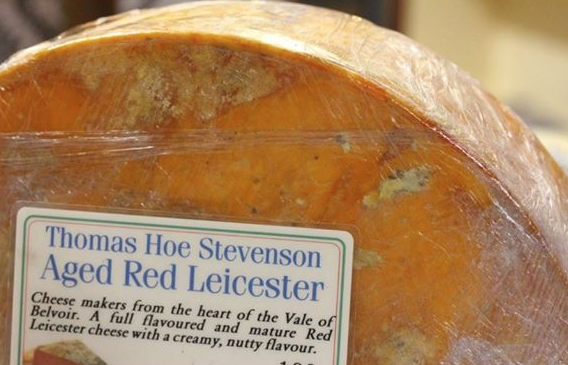
wheels of Camembert and Leicester Red

and even blocks of Manchego

lined up in front of the concession stand. Ishmeal sniffed the air. “Smells fresh.” Hunter punched a hole into a wax wheel and took a chunk of Vacherian into his mouth.


“Mmm. This cheese. It just melts and is… oddly sweet.” He started to go in for more when he saw something that looked out of place. “Hey. Can you see a bit of an opening near that wall?”
“Yeah.” Ishmeal walked closer to the wall. He touched the wooden panel with his paw and he pushed it. Suddenly the panel sprung open. “Hey lookie here.”
“OOOH! What do we have here?” Hunter walked over to the panel with Ishmeal. In the doorway they saw a tiny mouse almost a quarter of their size. Hunter slowly walked over to the mouse. “Don’t worry little buddy. This won’t hurt too much.” Hunter lunged for the mouse barely scraping it. He looked up only to find that the mouse was gone. “Fudgy gouda! It got away.”
“Well come on. We don’t have a second to lose.” Ishmeal started to run over to Hunter picking him up, when suddenly a light turned on. They saw hundreds of mice standing there like a big wall. Ishmeal and Hunter just stood there, astonished and frightened. Hunter began to speak up. 
“Hi.” He then straightened his posture and puffed out his chest. He then said with authority, “Which one of you broke into our hidey hole!” There was no response from any of the mice. All of them had dead stares in their eyes. 
“Hunter. We should run now rather than later. I thought those mice would be puny. They are bigger than a gallon sized wheel of gouda.”
“No, I want to talk to them. Now speak up!” One mouse looked down at Hunter and stared at him, not even blinking once. Hunter began to gulp. But then he grabbed his stomach.
    “Hunter stop faking this. Seriously. Hunter. Hunter?” Ishmeal started to sweat, “Hunter what’s wron- AHH!” Ishmeal clenched his stomach tight. It felt like there was an animal inside of his body twisting and turning it around. Both Hunter and Ishmeal fell to the ground howling in pain. The mold from the hot dog had started to kick in and cook their insides. Suddenly there was a booming voice coming from behind the wall of mice.
“Make way!” All the mice forming the wall moved to one side making a hallway for a shriveled old mouse to make his way through. Behind him were mice in white uniforms and caps with red crosses. They were rolling stretchers past the old mouse running to get Hunter and Ishmeal to safety. Once Hunter and Ishmeal were on the stretchers they were rolled into the hallway. 
As they were being rolled to the unknown place Ishmeal turned his head to Hunter. “At least we had one last adventure.” 
“Yeah. To one. Last. Adventure.”  
He watched as Hunter’s eyes drifted away. Ishmeal began to weep. He grabbed his cousin’s paw and it gripped tightly, not letting go. As he shed his last tear he looked at Hunter’s still corpse for one last time, and expired himself.


TAYLEN LI

The Fabrication – A Curse in Disguise

1 year ago
Today was a special day. Not for her, but for her son. It was her son’s tenth birthday. She had been extremely fidgety the whole day and she couldn’t wait for her work shift to end.  The moment the clock hit six, she turned off her laptop and grabbed her bags. As she ran down the stairway, a sudden pain hit her. It was like a powerful force was stinging her. She knew exactly what was happening. The disease. She sat down on the stairs and took deep breaths. She continuously rubbed at the urticating spot. The pain did not stop. It was in her chest. She began to panic and yelled for help. Nobody came. After massaging her chest and crying out for some moments, she tried to get up. Gripping the handrail of the stairway, she heaved her legs up. She began to feel weak and the excruciating feeling would not go away. It was hopeless.  She considered the elevator but she remembered something: her son’s present. The thought of her son made her twitch in irritation. She had to hurry – there was not enough time. Not enough time. She used all her strength to run up the stairs and back to her office room. The backpack that she had bought for her son was sitting on her desk. The backpack would signify all of the hardship that her son had brought her. It would be one last jab at her excuse of a son.  A cold sweat emerged at the top of her forehead as she grabbed a pen on her desk and began writing on a small slip of paper. The pain began to worsen. There was not much time left.

Dear Stuart, you are the worst thing to ever happen to me. Why did you have to be a boy? Every year for my birthday I wished for a sweet daughter. Instead, I got you. You! You are a disgrace, a lost cause, a pest. If you had been a girl my life could have been saved. I could be healthier and recovered by now. If you had been a girl I would not have lost hope in myself. You are a cursed child and I can finally leave you. Besides that, I hope you live the rest of your life happily and become the person you want to be! Love, Mom.

She continued for a few more minutes, and when she finished writing, she placed the note in one of the concealed pockets of the backpack. Then, she taped the “Happy Birthday” card that she had bought days before on the top of the bag. It was done. She closed her eyes and sat down on the leather office chair. It felt good to finally be free. Her consciousness began to drift away. The thump of her head onto the desk was the last sound that was heard in that room.

Stuart Hobkins was always the awkward one at school – maybe it was because of his pink backpack that his late mother gave him for his tenth birthday. The bag was covered in My Little Pony cartoons and splashes of pink and purple, and every day when Stuart arrived at school he walked in shame through the halls, his cheeks blending in with the backpack. Some days, Stuart would think about discarding the bag because of the embarrassment, but he didn’t because he couldn’t afford a new one. At school, Jake Martin and his goons would tease Stuart during recess, and Stuart was forced to chase them around for his backpack.

Fred Boggleton was Stuart’s only friend. He had dandruff littering his hair, freckles, and a strange fear of mallards. Boggleton also wore the same fake mustache to school every day. Perhaps that was why they sat at their lunch table alone.


Today Stuart had packed his favorite lunch: a peanut butter and mayonnaise sandwich with pickle slices. The stench of the sandwich was horrifically malodorous, so he’d packed it in several wraps of tin foil. Stuart carefully took his lunch out of the cursed backpack. He scanned the cafeteria, looking for Fred. He was near the end of the lunch line. Stuart took a small nibble out of his sandwich. Some pickle juice dripped out of the sandwich and onto his lap. Stuart quickly grabbed his napkin and wiped it off, but then mayonnaise began to fall out of the sandwich and onto his lap. He set the sandwich down and got up to get more napkins. That was a mistake. As Stuart got up, the strap of his backpack tangled his foot and he lost balance. Stuart tripped and fell into Jake Martin who was walking across the aisle. A startled Jake Martin furiously shoved Stuart off of him and onto the floor. Slowly, Martin’s group of goons began to surround Stuart. One of them was holding Stuart’s pink backpack.


“Ay Jake,” the fool with the backpack called out. “I found the little chump’s toy.” Jake cackled at the sight of the backpack. He grabbed Stuart’s bag out of the hands of his minion and began squirting mayonnaise and ketchup into it.
“Hey! Stop!” yelled poor Stuart who was pinned on the ground by a rather stout boy. Martin’s gang continued to fill up Stuart’s backpack with food. The cafeteria soon reeked of tuna, egg salad, cheese, mustard, chili tacos, and milk. The backpack was turning into a weapon of mass nostril destruction. Finally, Stuart broke free from the lout’s grasp and without thinking, tackled Jake Martin! Unfortunately, Martin was holding a tray full of steaming hot chicken noodle soup. Jake fell backward onto the table behind them and landed in a cup of yogurt while the soup spilled onto a couple of other kids at that table. Oh no.
“WHAT IS WRONG WITH YOU!” roared Jake. He was inches away from Stuart, his face bright red and his breath hot. Mango Chobani was splattered around Jake’s face, but most of it was covering his furrowed brows.
“I… I’m sorry,” whimpered Stuart, who was slowly turning into a tomato. Everyone was staring at Stuart and Jake. The cafeteria was almost completely silent. There was only the dripping of soup and occasional snickering.
“You are so dead,” uttered Jake. Now, a crowd of people began to form.
“Stuart!” someone in the crowd cried out.
It was Boggleton. He was holding a rectangular pizza from the school cafeteria. Stuart’s mouth opened, shaping into the form of an “O” and he frantically shook his head. But it was too late. Boggleton’s pizza soared across the lunchroom like a homing missile searching for its prey. Then it located its target: Jake’s face. By now, everyone had regained composure and were foraging for weapons. Stuart spotted Boggleton running from Jake Martin. Stuart narrowly dodged a bottle of chocolate milk and a chicken wing before reaching Boggleton.
“FOOD FIGHT!” the group cried in unison. Moments after the war cry, all hell broke loose. Jake Martin advanced on Stuart and Boggleton. He brandished a bottle of milk and jumped at Boggleton. Luckily, Stuart located a nearby tube of hot sauce and sprayed it on Jake, blinding him and making him withdraw temporarily. Meanwhile, the other students began to form two sides. Stuart and Boggleton took refuge behind one of the tables on the right side of the cafeteria. Burgers and fruit were flying across the battlefield. Suddenly, something splattered on Stuart and Fred. Stuart was soaked in warm milk. Boggleton exploded in anger and immediately began to throw everything that he could find. A wet and sour-smelling Stuart soon joined him. With Boggleton’s boost of energy, their side soon took the edge.

It was in the heat of the battle when the teachers finally arrived. Soon afterward, all of the students were forced out of the cafeteria and lunch ended. In the midst of the food fight, the concoction in Stuart’s backpack had spilled into an air vent. The entire school now smelled like a rotting corpse. Due to this, the principal was forced to end school early that day and the students were sent home.


Later that day, when Stuart was walking home with Boggleton, he realized something. It was all the backpack’s fault. His backpack was the reason there was a food fight in the first place, his backpack was the reason Jake Martin was now determined to throttle them, and his backpack was the reason that half of the grade just got suspended.


“It’s all because of this piece of junk!” snapped Stuart. He proceeded to hurl his bag on the sidewalk.
“Why do you have it anyway?” said Boggleton.
“My mom bought me it.”
“Well… then you should just buy a new one.”
“I-I don’t have enough money. I can’t afford it.”
“I can buy you a new one.”
“Really?” Stuart gasped.  
“Yeah sure.” Boggleton had an impish smile. “Come on, let’s get rid of your backpack.” The two ran to Boggleton’s house, which was just a couple minutes away from school. Boggleton grabbed a pair of scissors from his backpack and began to cut Stuart’s bag. First, he snipped off the straps. Pink and purple fabric littered the pavement of the Boggleton driveway. After slicing the straps off, Boggleton snatched a lighter from a shelf in the garage. He bestowed it upon Stuart.
“You do the honors,” he said.
“Okay.” Stuart took a deep breath and flicked the lighter on. A tiny flame emerged. The fire began to burn the outside of the backpack, and the cotton and cloth smoldered to ashes. A short while later the bag was almost entirely incinerated. The air reeked of smoke. The remaining part of the bag was covered in soot and embers. Any trace of pink or purple was no longer distinguishable. Stuart used the lighter once more to finish it off. The backpack was covered in flames again. While Stuart was watching the flames, Boggleton noticed something fall out of one of the open pouches on the ignited bag. It was a slip of paper.
“Stuart? What’s that?”  
“What?” Stuart noticed the paper on the ground. “I don’t know. It’s probably just some trash.”
Out of curiosity, Stuart picked up the slip. It had not been burnt; the pouches were closed when they lit the backpack aflame. The paper was a bit crumbled, but not completely. Stuart saw writing on it. It was written with black pen and the handwriting seemed very scribbled, yet familiar. The pen was faint and the soot from the fire obscured nearly all of the writing. The only part of the note that was not burnt and somewhat visible was the last section, at the bottom of the note. It said: I hope you live the rest of your life happily and become the person you want to be! Love, Mom. At first, Stuart was confused by the note but after reading it a couple more times he slowly realized what it was. It was supposed to be a part of the birthday card from his tenth birthday. The rest of the birthday card was burnt so Stuart assumed that the whole note had just been praise from his mother. He was baffled initially because his mother had always been hard to identify; Stuart could never understand what was on her mind and what she was feeling. Stuart’s mother had always been grumpy and typically didn’t applaud Stuart but sometimes she would behave as if she was longing for something. Most of the time though, his mother seemed bitter. Stuart thought this was because of the sickness that she developed months before his tenth birthday or because she was unsatisfied with him as a child, but when he thought about it, she’d always been that way. But now he knew that his mother had wanted him to be successful and happy.
“What’s it say?” asked Boggleton.
“Oh, um… it was just a price tag,” said Stuart as he crumbled up the note. After the two cleaned up the mess they had made, they headed to the store to buy Stuart a new backpack. But the whole time Stuart was thinking about his mother. It was the note: it had made him feel proud and loved.
If only he knew the truth.


ZAYD MAHMOOD

Many said that Caesar was a general but that was not all, as in the War Correspondent doc it states… He was one of the best reporters as well. The document then zips along with the first war correspondents William Howard Russell, hired by Edwin Lawrence Godkin of the London Times. Russell’s actions were so heroic and brave that a mere human could not do so without shivering in fear. Then there’s the Bayeux Tapestry’s stitchings depicting a battle that took place, The Battle of Hastings in 1066, where the Anglo-Saxons and the Normans went to war. Now most correspondents might coward away but not that of Thutmose lll commander of the Egyptians, and his trusty scribe Tjaneni, who kept a journal detailing the engagement as he stuck with him everywhere the Pharoah went (1400 BC). Tjaneni was also the boss proto war correspondent as he was as original as a Trojan horse. But my favorite correspondent by far was Robert Capa: “Perhaps the best known of all World War II combat photographers, the Hungarian-born Capa had made a name for himself well before climbing into a landing craft with men of Company E in the early morning hours of D-Day” (the War Correspondent doc). He took seven stellar photos of D-Day and… many other battles, leaving me awestruck at how he survived for so long (he met his Maker on the battlefield in East Asia, sadly a few years later). In my opinion he is a true hero, not one of the fake heroes like let’s say, Justin ‘the Biebs’ Bieber.

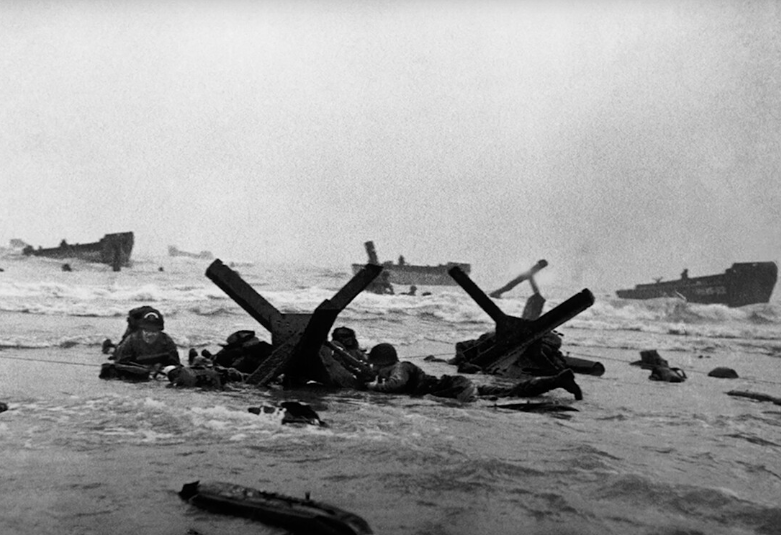
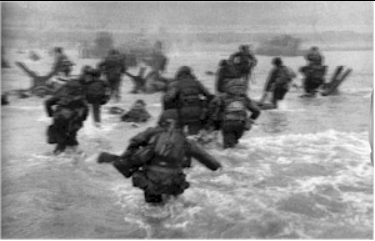
Robert Capa, one of the 7 images from D-Day

Mark Kellogg, a Western free-lance newspaper reporter, set out to tell us what happened on the morning of June 26, 1876, on a hill at Little Bighorn in Montana. “By the time this reaches you we will have met and fought the red devils with what result remains to be seen.’” He seems to me like a very dastardly man of some sort as he is very against the Red Devils which is messed up that he even calls them that. I know I am jumping around a lot so I will just focus back on one of my favorite depictions in this story: D-DAY! Well, I should put an exclamation point as it is an amazing topic. It was 1944, WWll, and Allies are going to invade Normandy, France to rid the land of the Nazis, and I thought that we would never get to see this amazing historical moment of grit and passion. Then all of a sudden BANG! in comes Capa to take some pics of this amazing historical moment and the pictures are absolutely stunning. 

The war correspondent had rules and standards to achieve, of course: “The birth and maturation of the unarmed professional war correspondent had four midwives: Democracy, Time, Scale, and Speed”. Without these fundamentals, and most importantly, “… democracy, nurtured by nearly universal suffrage and popular education, meant governments had more and more to justify the blood, tears, toil and sweat of going to war”. The war correspondent has to be able to communicate to someone with not only authority but with a citizen’s obligation to the truth. Time (not thyme) is everything for war correspondents. Personally, I am terrible with time management. But not these people – they can do things like showing up right on the dot and not have a single worry for being late. Scale is pretty explanatory. The bigger the battle, the more correspondents. Again, the first legit war correspondent (paid to write in war theatre) was Billy Russell, the first to be hired exclusively for this position (by Lawrence Godkin of the London Times). Can you remember that? And finally, Speed. A correspondent must be quick to get information and to relay it back, and because of the modern era, we had telegraph, then telephone, then TV etc.

The reason for all of this jumping around and talking about these things are because these things highlight the attributes and the unique qualities that war correspondents have brought to us. If not for them, then the information and our even lives might not have been here today. For isn’t the non-fighting population largely responsible for ending wars? Forget about only the military general’s saying haughtily, I was on the very front lines. As the war correspondent, in my opinion is the most dangerous and the most nerve-wracking job even known as they are very literally in the front lines. They have faced more dangers in a day than we could do in our lifetime so I really think that they are the true heroes of wartime not someone who boasts about being on the front lines. They can do anything from reporting like William Howard Russell to attacking as well like Julius Caesar. Capa could have died on that battlefield while taking those pictures of D-Day. Do you have what it takes to be a war correspondent? Btw, he did die at age 40, while reporting from the French Indo-China War. Rest in Peace.


JUNE QIN

Vandalia: The Fiction and Truth of West Virginia

Stretching from the Atlantic to the Pacific, from the snowy peaks of Alaska’s Brooks Range in the Arctic Circle to Florida’s swampy Everglades in the Gulf of Mexico, the United States of America is as diverse topographically as it is culturally. Each state of the U.S. may as well be its own country made up of its own jargon, customs, state song, and origin story. Take, for example, the landlocked, rugged state of North Dakota and the tropical islands of Hawaii. From their locations, climates, and people’s lifestyles, how could they be more different? Even the name “United States of America” juxtaposes the ideals of state independence and national unity which is further developed in our government’s system: a federal republic. 

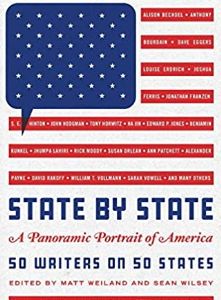
In the early 2000s, Matt Weiland and Sean Wilsey set out to compile a collection of fifty authors on fifty essays. Upon returning to the States after living abroad for four years, Weiland “was hitting the Americana hard”; he wanted to “experience again some simple American virtues: the essential looseness of American lives, the vitality and variety of American vistas, the cut and jib of American talk.” From this stemmed the questions: what makes Americans Americans? Yet also, what differentiates Americans in one state from another? And zooming in even further, how can we capture “the richness of lives we don’t know,” the nuances in each American? 

Weiland compares State by State to “a road trip in book form,” something that is “personal, eccentric, and partial” rather than comprehensive, exhaustive, and formulaic, for that was already attempted by the WPA American Guide series. In the 1930s during the Great Depression, the Federal Writers’ Project employed over 6,000 American writers to create tour guides of more than 500 pages each of every state. While Weiland and Wilsey sent the WPA guides of their assigned state to each of the contributors as inspiration, they hoped to receive personal stories, one of each state. We seem to know little about “America and the lives lived here,” our knowledge coming only from personal experience, history taught in school, maps seen in atlases, and American media consumed. The fifty states together constitute America’s identity, so perhaps the best way to know more about our country and its people is to learn “each state’s particularities and idiosyncrasies, their beauty marks and moles.” Those distinctions also appear in the state’s people: where you’re from largely defines your character and differentiates you as an American from someone in another state.

Wilsey experienced the road trip firsthand in the fall of 2002. He set out to drive from west Texas to New York City with his friend Michael Meredith and his dog named Charlie Chaplin. Perhaps the most surprising part of this excursion was that they were traveling in a pickup truck from 1960 (the same year Steinbeck took his trip which became Travels with Charley) that went, at most, 45 miles per hour. However, the slowness was what Wilsey longed for. Not only did the 9/11 plane crashes happen twenty blocks from his apartment, but also in the months before that, several of his loved ones passed away. This road trip would give him the time and space to grieve those losses. 

San Antonio was one of the cities that Wilsey, Charlie, and Michael Meredith stopped in. They met a man named Don Harris who delivered to them a monologue about the city. 

“San Antonio has always seemed to me to be a city out of a Borges story, particularly one with

knife fighters, political thugs, and Hispanic-Irish gangsters, like Death and the Compass. The

past here is so intense that it’s also the present, and nothing ever really disappears. The city’s

always existed with wild Indians, soldiers, priests, vaqueros, pachucos, socialites, aristocrats,

writers, and working people, in a constant mix. Conrad’s favorite writer, R. B. Cunninghame

Graham, the Scottish lord—the real king of Scotland some say—spent several years in San

Antonio, attempting to become a cattle baron, going broke, and then, out of desperation,

beginning his writing career with an account of a hanging in Cotulla for the San Antonio

Express. Stephen Crane wandered around with the Chili Queens in the same plaza where the

Comanches would ride into town and receive tribute – pay or the town would be burnt and

looted. Till recently it was represented by Congressman Henry B. Gonzalez, the boxer

congressman – who flattened another congressman with a single punch, and tried to impeach the

first Bush.”

He goes on for quite a bit more…

Don Harris’s disquisition on San Antonio perhaps serves as an appetizer to the fifty state essays that follow Wilsey’s introduction; he offers his personal perspective on the city which, although it may differ from San Antonio’s other residents, is more valuable than a vague, superficial list of facts and statistics.

Wilsey’s road trip perhaps didn’t turn out to be the most pleasant, luxuriating, and easeful getaway that he had thought of. Meredith needed to arrive in New York City in six days which was impossible. Their friendship was fragile; they “tiptoed around each other like heartbreaking new friends,” here Wilsey quoting Jack Kerouac describing his and his driving companion Neal Cassady’s relationship in his travelog On the Road. Death seemed to hover over Wilsey throughout the trip, as Charlie dug up a dead animal in Kingsport, Tennessee the night that Wilsey and Meredith decided to part ways in order for Meredith to arrive on time. Just as Weiland alluded to, Wilsey’s road trip experience somewhat parallels a reader’s journey through State by State: the initial excitement and relief of immersing into a new state and leaving one’s familiar home, the surprise and intrigue whilst enjoying the story, and the careful, critical eye that’s always alert.

West Virginia is located in the pocket between Pennsylvania, Ohio, Kentucky, Virginia, and Maryland. It is the only state with two panhandles that jut out of its main body. American journalist John Gunther suggested that West Virginia’s geographic outline resembled a squid, but I think it’s shaped like a frog leaping towards Tennessee. The Appalachian Mountains run through the entire state, thereby earning it its nickname, the “Mountain State.” From the 1670s, colonial Virginia (when Virginia and West Virginia were one state) viewed these tall, rugged mountains as a valuable buffer protecting it from the French and Indians. However, this geographical barrier seemed to gradually isolate western Virginians from the rest of Virginia. Eastern and western Virginia were not only divided between slaveholding and non-slaveholding, but the Virginian state government also refused to build necessary “internal improvements—turnpikes, canals, and railroads” in west Virginia. For a variety of reasons, on June 20th, 1863, West Virginia became its own state. 

Jayne Anne Phillips was born in West Virginia on July 19, 1952, grew up in West Virginia, and graduated from West Virginia University in 1974 with a Bachelor of Arts. She then went on a cross-country trip to California, an experience which influenced her writing. Later, she graduated from Iowa Writers’ Workshop, taught at universities such as Harvard and Boston University, and founded the Master of Fine Arts in Creative Writing Program at Rutgers University–Newark. In 1976, Phillips published Sweethearts, her first collection of short stories, but it was her third collection Black Tickets (1979) that brought her national recognition as a writer, earning her the Sue Kaufman Prize for First Fiction. Nadine Gordimer, who won the Pulitzer Prize in Literature, called her “the best short story writer since Eudora Welty.” After Black Tickets, Phillips wrote her first novel Machine Dreams (1984), following up with Shelter (1994) and her most recent novel Quiet Dell (2013).

Phillips’ debut novel, Machine Dreams, follows the Hampson family’s experiences from the Great Depression through the Vietnam War. The novel begins with Jeans Hampson’s vivid memories: “I was three years old. I saw my hands on the phone box, and my shoes, and the scratchy brown fabric of the dress I was wearing.” She tells stories from her childhood until her adulthood in the form of a letter to her daughter Danner. Then, Phillips alternates perspectives between each family member, staying in first person, painting the power struggle between Jeans and Mitch in their marriage, the extraordinary bond between siblings Danner and Billy, and finally the breaking down of Danner as she struggles to keep her family intact. 

Phillips’ second novel, Shelter, is set in a West Virginian girl’s camp where sisters Lenny and Alma undergo a rite-of-passage. Writing in the third person this time, she creates a barrier between the reader and the characters, distancing the reader from the characters’ thoughts, unlike in Machine Dream. Furthermore, she immerses the reader into the camp culture and its surroundings, conveying the camp’s isolation and eeriness. 

Quiet Dell, her latest novel, is based on a true story of Harry Powers’s murder of a widow and her three children in the title town of West Virginia. Similar to the exposition of Machine Dreams, this novel starts with Annabel recounting childhood memories with her sister Grethe, father, and grandmother in their hometown in Illinois. The family tells their last year alive, how they were lured to Quiet Dell. Then, Emily Thornhill, a Chicago reporter, picks up the story, determined to ensure that Powers is convicted. Phillips grasps her creative authority to bring justice to the widows and children murdered by Powers.

Phillips’ essay contains so much: West Virginia’s origins, family legends, and Buckhannon’s football games, but it is her authentic yen for contemplating fiction and truth and her transparency in revealing herself as a fiction writer, despite her task, that ties the piece together. She begins the essay by painting the lush landscape that hosts an abundance of life: a paradise full of birds swooping through the verdant forests, bears, deer, and bison roaming the mountains, and schools of fish swimming in the rivers. The land was home to “miles of towering evergreens, mountain glades that suggested northern tundra, acres of rhododendron, and the ancient box huckleberry.” Phillips emphasizes how the Native Americans preserved its wilderness and beauty, using it “only for hunting and attendant ceremonies and rituals.” Then, the Europeans arrived, creating the colony of Virginia. They had sought western sea routes to Asia but instead discovered the rivers snaking through leafy hills: the New River Gorge and the rushing waters of the Kanawha at the Great Kanawha Falls.

Though more colonies formed, wild western Virginia remained at the frontier of European colonies, attracting ambitious and tenacious settlers. Phillips tells the story of Morgan Morgan who was originally thought to be the first settler of western Virginia and “recognized no Crown.” Phillips refers to its inhabitants as either “oppressors or [those who] fled oppression,” people seeking the freedom to either control others or their own lives. This included two hundred Germans who were kicked out of Pennsylvania. In 1762, one of Lord Fairfax’s nephews became the first magistrate in charge in the town of Romney; however, Phillips claims that “government was fiction” in western Virginia. 

During the French and Indian War, a group of Shawnee raided Draper’s Meadow, a Virginian outpost with a population of around twenty, killing or capturing most of the residents except William Ingles who sought refuge in the woods. On the other hand, his wife Mary was captured and taken to Ohio where she learned skills such as making salt. She ultimately escaped and trekked more than eight hundred miles back to Draper’s Meadow, exhibiting extreme tenacity. Today, Draper’s Meadow, now known as Blacksburg, belongs to the state of Virginia, located near its southwestern border with West Virginia. Phillips’ inclusion of this anecdote despite the town’s modern location indicates West Virginia’s transcendence of boundaries; rather than a state or colony closed off by man-made ley lines and natural obstacles, West Virginia prevails as a region influenced by its neighbors. 

Phillips reveals the nooks and crannies of West Virginian history, disclosing the shocking might-have-been about West Virginia: it was almost established before the Revolutionary War!

“Lord Dunmore’s War left them [early Colonials] a mobilized force and cleared the way for the Revolution, sweeping away Benjamin Franklin’s already approved proposal that western Virginia be declared a fourteenth colony. The colony was to be called Vandalia. Vandalia: a name for a paradise, a word Cervantes used to denote an imaginary place in his mythical Don Quixote.Had revolution held off another year, western Virginia’s secession from Virginia eight decades later need never have happened; Vandalians might have forged a more viable world in the mountains and forests, a world not so easily bought and sold.” 

Phillips conveys the semi-tragic nature of West Virginia’s statehood, as she emphasizes “the name [Vandalia] and the paradise were forgotten.” What if the colony of Vandalia had been created? Perhaps West Virginians have a nag in their hearts that they don’t fit in with the others. Phillips elaborates on their isolation in colonial Virginia: instead of Vandalians (who were never formed), “frontiersmen fought the Revolution from sixty isolated forts in the mountains… they helped win the war but lost the peace: political skirmishes between eastern and western Virginia began in earnest.” One can really see how Phillips, a native West Virginian, is suffused with melancholy about not being separated from the Old Dominion from 1775. 

This reminds me of Benjamin Franklin’s reflection on his failed Albany Plan of Union (1754) when he was on his deathbed in 1790. The Albany Plan of Union was a plan to unify the British colonies of America under a centralized government long before brewings of the American Revolution even began. Had the plan succeeded, perhaps the separation of the American colonies from Great Britain need not have happened, saving them many resources and hardship. With a centralized government, Franklin realized that the colonies could have erected a militia to fight in the French and Indian War. Then, Britain wouldn’t have sent military personnel to the colonies nor taxed the colonies after the war to pay off debt. The Proclamation of 1763, Stamp Act, Boston Massacre, Tea Act, and finally the Intolerable Acts likely would have never existed, nor would the colonists’ resentment of the British empire that grew from them. The American colonies could have coexisted in the British empire in Franklin’s plan. 

Phillips further portrays the divide between western and eastern Virginia, especially in their values. To western Virginians, “Geography was morality: There were no plantations in the mountains, no acres of fields. Farmers and woodsmen in the still wild western territory sustained themselves, growing what they ate, trapping, hunting.” But what led to their independence and self-sustainment? Was it the wildness of the land? Or eastern Virginia’s neglect of its western counterpart? For their own hard work, western Virginians were taxed more because owning livestock costed more than owning a slave, on which eastern Virginia’s economy depended. When West Virginians advocated for more funds for public development, Virginia constructed a lunatic asylum named the Trans-Allegheny Lunatic Asylum, “for indigents and outcasts, for the odd and insane and homeless.” As the first publicly funded institution built in West Virginia, Virginians seemed to condescend to West Virginians right out of the gate, shunting their own crazies out to the “only state mental institution west of the Alleghenies.”

When it comes to the Civil War, the state of West Virginia is, well, one could say, ground zero. Formed as a state during the war, the state is symbolic of the preservation of the Union. Only one month after Virginia seceded from the Union on April 17, 1861, the Pro-Union Virginians chose to remain with the Union and created the Restored Government of Virginia. Although West Virginia obtained statehood in 1863, it was not only the location for seven battles, but as both the Union and Confederacy fought over its ownership throughout the war, “some towns changed hands fifty times.” Virginia and West Virginia continued to face conflicts. After the war, Congress and the Restored Government of Virginia required West Virginia to pay fourteen million dollars of Virginia’s debt. This was an insult to West Virginia’s independence founded on the very blood spilt in the Civil War. In response, West Virginia passed the Test Act, disallowing fifteen thousand Confederate veterans the right to vote which in turn bolstered Union veterans’ egos. 

West Virginia wasn’t given much time to celebrate its independence, as “the capitalists moved in,” and the actual land and wealth of the new state was “shipped… to the northern cities”. Even as recently as the 1980s through early 2000s, West Virginia continues to suffer from exploitation of its natural resources. Coal companies encroached on the Appalachians and “simply blast[ed] off” mountaintops, dumping all of the debris into the rivers below, “destroying watersheds and the checks and balances” of the surrounding ecosystem. The harmony between the flora and fauna and the people was disturbed; the once sacred hunting grounds, the formidable peaks that protected colonists were disfigured by mere man-made explosives. In addition to the abuse of the land, Phillips includes the mistreatment of West Virginians. The out-of-state companies “brought in their own men,” and the revenue flowed into the economies of those states, not that the money could ever compensate for the damage imposed on the Appalachians. Still happening today, after their business is finished, the companies “‘restore’ the tops of the mountains to level, moon-like landscapes, seeded with grass and little trees, and move on,” demeaning the grand peaks and lofty trunks that once stood. Housing a diverse ecosystem comparable to the Amazon rainforest, West Virginia, Phillips laments, “is no longer paradise.”

After presenting a rich portrait of West Virginia’s history, Phillips has not only established herself as a proud citizen of her home state but also passed the knowledge onto us readers. Yet is its history representative of West Virginia today? What does Phillips try to convey about West Virginia through this essay? Answers can be found in her commentary on story and fiction, integrated into the discussion of her family history. Phillips remarks that “if all stories are fiction, fiction can be true,” a rather unconventional and philosophical comment amidst the narration of her family legends and the depiction of the history of the land that became West Virginia, as well as its formation in the 1860s. She puts to us: if a story is fiction, then it must be made-up to some extent; if fiction can be true, then what is non-fiction? Phillips adds that fiction can be true, not necessarily in its content, “but in some transformed version of feeling.” Prior to this remark, she reveals two stories: 1) her father was neglected by his parents who left him to his aunts when he was a baby to take care of him, which inevitably incited 2) rumors and gossip amongst the townspeople, themselves stories, fact or fiction, depending upon the teller. While neither her family’s nor the townspeople’s version of the story may be entirely true, the telling of both versions has certainly shaped each of their perspectives on Phillips’ family. 

The intertwining of fiction and truth continues throughout the essay as Phillips recalls her mother’s reasoning for preventing her sons from playing football. In high school, her mother had fallen in love with a classmate, William Goodwin. The “youngest of five brothers”, Phillips calls him “an adult child” possibly because his father died from a heart attack when William was 12. All the other brothers became doctors and administered special care to their mother, but “she, too, died”. The author’s mother and William were together for two years until on the way home from a date, William complained of chest pain, which the doctor diagnosed it as heartburn. Still worried, Phillips’ mother phoned one of William’s doctor brothers who said, “Tell him to keep still until I get there,” but he got out of bed, “to wash his face”. He “died in the bathroom of the rooming house,” from a heart attack. Phillips’ mother was asked to plan his funeral. This event marked the author’s mother so much that she possessed an unflagging fear of her loved ones dying from heart attacks. At least twenty years later, Phillips’ mother carries this experience with her, referencing it or unconsciously reacting to it with her now growing sons. “She said she’d seen a boy die on the field once, hit too hard. The story may have been fiction. She’d seen a boy die: That was true. Or she’d seen it in her mind, over and over, the boy on the bathroom floor, in the rooming house.” Here, Phillips distinguishes between the fiction and truth of her mother’s logic: while she hadn’t seen a boy die on the field, she had seen a boy, namely her lover, William, die. However, her fictional story that she had seen a boy die on the football field transformed her sons’ realities as, in accordance with their mother’s wish, they didn’t play football in high school.


Phillips’ commentary on truth and fiction harkens back to the idea of Vandalia, a name for paradise, well-suited to describe the would-have-been fourteenth colony. It not only represents the possibility of western Virginians seceding from main Virginia before the American Revolution but more importantly West Virginia’s identity. Although Vandalia never materialized, Phillips remarks that “if there is a memory of paradise, paradise can exist,in some other place or country dimensionally reminiscent of our own”; Vandalia is not lost but forever stored inside the memory of West Virginians and their descendants. It doesn’t matter that West Virginians today weren’t alive to experience the near-formation of Vandalia because “story conquers all distance,” including time and physical separation. Phillips illustrates West Virginians’ eternal bond to the land and each other. Regardless of whether they stay in West Virginia or leave, “they share the feel and smell and mind’s eye image of a narrow road in summer, a dirt road or a paved one, bordered by woods and fragrant weeds, overhung with trees, twisting deeper.” All of them “stand in the middle” of West Virginia’s story; they are West Virginians forever.