
Monthly- Archives: September 2017


ANTHONY CHEN

Mr Watt´s Literary Services

GOLDEN EAGLES ARE EPIC

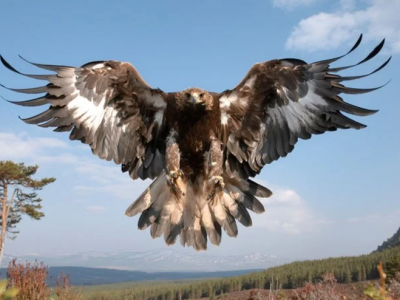
Do you know what the national animal of Mexico is? Why it’s the golden eagle! The genus name is aquila chrysaetos meaning “eagle, golden eagle”. The golden eagle is a close relative of the American bald eagle. Recognized by its broader wings and smaller head, the golden eagle has high yelping calls, and with its dark brown and golden plumage, this raptor is known to be a symbol of fear and reverence, and holds mystical powers in the eyes of the Native Americans. Although the golden eagle is spoken of in legends, many people still don’t know too much about this bird of prey. This is because the golden eagle prefers to live in places with little human activity. Golden eagles also have large territories where they conduct their activities, and they have many physical and mental abilities which make them far superior to other raptors.

The golden eagle is a very peculiar raptor, because its activities have rarely been documented. These birds are found mostly in western North America, past the Rocky Mountains, and can be found in habitats from the arctic regions to the desert. Their territories stretch to sixty square miles, and squirrel-sized mammals, to foxes and young ungulates (hoofed animals), are what they eat; the golden eagle swoops down on its unsuspecting prey, talons grabbing, lifting into the sky. Even though golden eagles can live in a variety of habitats, they prefer wide-open places.  
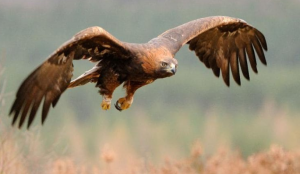
If a rival eagle flies too close to another eagle’s territory, the home eagle will defend his territory through the use of acrobatics to send a message that tells the intruding one: “This is my territory.” Golden eagles are monogamous, building large nests that grow bigger and bigger every season. This often results in the mated pair adding new layers and materials such as moss, grass, weeds, and local vegetation. Golden eagle nests average five to six feet wide and 2’ in height. Golden eagles often build their nests on cliff ledges, but seldom in lofty trees as most raptors do; while both provide commanding views, one could argue that the golden eagle prefers the solid berth of the stones and their disassociation from other tall objects. In the nest, the female will lay 1-4 eggs. These eggs are white, marked with brown. After 41-45 days of incubation, tiny eaglets hatch from the eggs. However, only one or two of them will survive until the fledgling stage. The surviving eaglet or eaglets will have their first flight, 60 to 70 days after hatching.

The golden eagle uses many different techniques to hunt, soaring over its land, and scanning the ground for animals, or flying low over the ground to hunt. Another form of hunting that golden eagles use is perch hunting. This is when the eagle is perched on a branch and scans the area underneath him for prey. Upon seeing prey, the golden eagle swoops down and attacks it by diving with talons outstretched. Golden eagles, like many birds of prey use their talons to catch prey. However, unlike its endangered fish-eating relative the bald eagle, the golden eagle’s legs are feathered all the way down to the talons. Some may argue that golden eagles have feathered feet because of what they eat, as if eating hairy animals puts hair on a birds’ legs. Well, the bald eagle and other sea eagles have bare legs, perhaps because they eat fish, and don’t want to get waterlogged.

Golden eagles have a 6.7 to seven foot-long wingspan, quite large for a raptor. They use their wings to perform flight patterns in the air to defend territory and to court. Often in courtship, two golden eagles can be seen circling each other, rather than engaged in the vigorous swoops and climbs used while defending territory. These flight patterns are always used to send a message whether it is: “I like you” or “You Shall Not Pass!”

Many people also wonder why the female golden eagle is larger than the male. This difference in size is through reverse sexual dimorphism, which is the difference in appearance between males and females of the same species. In most species, the male is larger, or more decorated, than the female, which can be seen in peacocks where the male has a more elaborate decoration than the female. However, female golden eagles are larger than males, thus showing us an example of reverse sexual dimorphism. The female golden eagle often weighs 40% more than a male and has a 10% larger wingspan than males.

There have been many theories about reverse sexual dimorphism in birds of prey, especially in eagles, hawks, and owls. One such theory on why the male is smaller than the female is: the smaller the male, the faster it can hunt and forage. This is mainly based on the fact that female raptors often stay protecting and incubating the nest, while males go out to hunt and feed the female as she incubates. Another theory is that reverse sexual dimorphism is an adaptation, and the larger female eats/takes down larger prey compared to the male. This adaptation is to expand the variety of food the pair eats; which would greatly help in times of scarce food because it wouldn’t matter what prey they caught.

Many other raptor species also have reverse sexual dimorphism. Hawks, owls, falcons, and other subspecies all have a larger female than a male. However, there are a few exceptions like the burrowing owl (athene cunicularia), where the male is slightly larger than the female. The difference in size between male and female also varies from species. Scientists have speculated that it has to do with their diets. Birds that hunt large prey, like the golden eagle, have more sexual dimorphism compared to birds that prey on smaller insects and birds. So, more aggressive bird species have more sexual dimorphism. Eleanora’s Falcon shows very little sexual dimorphism compared to other bird species like the golden eagle, because it preys on small birds that often don’t fight back. The golden eagle on the other hand, often preys on larger prey like squirrels and foxes. Foxes tend to be more aggressive, and there is a large predator to prey ratio when hunted by the golden eagle. Now, is it because the males are already geared for being adept killers, but the females need a booster, so to speak, to get down and dirty with clawing apart prey?

The golden eagle has had a significant role in many cultures, past and present. The Native Americans perform rituals with golden eagle feathers, and used to wear the feathers into battle. In Europe and Asia, ancient kings used to hunt with eagles. The golden eagle was also highly revered in ancient Greek and Roman cultures. They believed that the eagle was a messenger of the gods, and it was a symbol of Zeus/Jupiter. The golden eagle was also the model for the ‘aquila’ a symbol of Rome, and army campsites were placed near their nests if spotted. Nowadays, the golden eagle is the national bird in seven countries and used in the coat of arms or other symbols as well. Hunting with eagles is now mainly practiced in Central Asia. Aquila Chrysaetos is now the national symbol of five countries: Albania, Germany, Austria, Mexico, and Kazakhstan.

The golden eagle has also been misused by certain parties and countries. The Third Reich, for example, selected the golden eagle to be part of their “The Reichsadler,” a Nazi symbol with a golden eagle perched upon the Nazi swastika. Arguing against adopting the Golden Eagle as the National Bird of Scotland, the deputy leader of the Tories in Scotland complained that, “the symbol was the last thing that victims saw as they were herded into Nazi death camps.” However, why should the bird be condemned to this bloody, painful symbolism? “It’s hailed as an icon of wild Scotland, used on company logos, place names and ancient burial sites, and now a new campaign is aiming to see the golden eagle named as the country’s national bird.” This is language from a petition submitted to the Scottish Parliament in 2014.
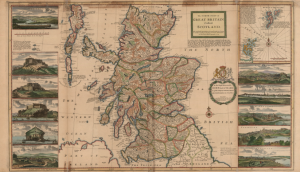
“There are currently just 431 pairs of Golden Eagles in the whole of Scotland. Owing to centuries of persecution, this most charismatic of birds has been almost entirely confined to the more remote areas of the country, such as the mountains and glens of the west coast and on the western isles, with numbers held at artificially low levels and many territories vacant.”

“RSPB Scotland, backed by wildlife cameraman Gordon Buchanan, has submitted a petition urging ministers to formally designate the species as a national symbol, placing it alongside the lion rampant, saltire and Scottish thistle and emblems of the country.”

Through these depictions, the golden eagle’s reputation as a fierce predator has been exploited for negative purposes, unlike the more reverent symbolism in ancient Greek, Roman, and North American culture. The golden eagle is a bird recognized by its predatory abilities, and ferocity. They reside in very remote places in this world, and are revered by many cultures, past and present. So the next time you are out traveling the world, try and notice eagle symbolism around the area; if you see any, lift your gaze to the skies or the nearest rocky cliff.


JAMIE PAN

Mr Watt´s Literary Services

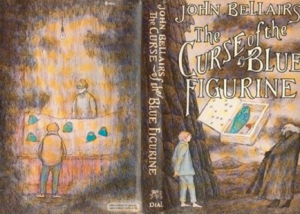
Exploring Forms of Magic in John Bellairs

John Bellairs was a very famous author who wrote amazing books. He lived from 1938-1991, and was born in Marshall, Michigan. He was the first of three children. He went to public school most of his life, developing a passion for English literature. Besides writing, he enjoyed reading ghost stories, and novels by the well-known 19th century fiction masters Charles Dickens who wrote Oliver Twist and Henry James. He also enjoyed work from 20th century historian C.V. Wedgwood, because of her vibrant and realistic depictions of famous battles (she would spend time in all sorts of weather at the battlefields themselves to get a full experience of it prior to writing) and Will Durant, who brought together many varying sources (some esoteric) in his approach to writing history.  C.V. Wedgwood, and Will Durant had the same interests as John Bellairs. In fact, most of his inspiration came from them, including the books he wrote.

Bellairs went to the University of Chicago and University of Notre Dame to earn his master’s degree. He was named to Notre Dame’s College Bowl team, and appeared on the G.E. Quiz Bowl, nationally televised, which was hosted by Allen Ludden, Betty White’s husband. He surprised everyone by reciting lines from Chaucer’s prologue to The Canterbury Tales, in fluent Middle English. He graduated Summa Cum Laude, proving a very hard-working academic.  He was not only a student at the University of Notre Dame (a Catholic research university) and University of Chicago, he was also a teacher at Merrimack College (a Boston Catholic, Augustinian private college), Emmanuel College (a Catholic women’s college), and Shimer College (a Great Books college). The University of Chicago (a top-ten private research university) and the University of Notre Dame are two amazing schools; fifty-seven years ago, still as great as they are today. Today, the University of Chicago is ranked number three, while the University of Notre Dame is number fifteen.

He developed his true passion for English while at university, and after teaching at the colleges, he began writing books. His first book was St. Fidgeta and Other Parodies, which was written in 1966. The original St. Fidgeta article appeared in The Critic, a Chicago-based Catholic magazine.

After writing St. Fidgeta and Other Parodies, he continued to write and wrote more than a dozen award-winning novels. Bellairs began to find his style in The Pedant and the Shuffly: this book not only features a wide variety of magic, it features some of John Bellairs’ unexpected humor and a medieval tone. For a while, this book was hard to find and went out of print. Fortunately, it’s back on the shelves today. The Face in the Frost, another one of Bellairs’ top novels, was a breakout hit. Lin Carter, a high fantasy critic, who died only a few years before Bellairs, called it one of the best fantasy novels since The Lord of the Rings. Besides that, it was also described as an “authentic fantasy by a writer who knows what wizardry is all about” (Ursula K. Le Guin). Famous author John Clute calls it a “unique classic” in The Encyclopedia of Fantasy as well. This book was a combination of humor and darker elements, which is what made it such a popular and well-known book.  Two of his novels were translated into at least five different languages. Additionally, he was nominated for Edgar Allan Poe Award for Best Juvenile Division. His two books, The House with a Clock in its Walls and The Treasure of Alpheus Winterborn, were made into TV shows. Next to writing, he enjoyed bad poems, especially nonsense, doggerel, and light verse. He also enjoyed architecture.

He wrote novels which included the Lewis Barnavelt Series, based on magic, featuring Lewis Barnavelt, his Uncle Jonathan, Mrs. Zimmermann, and Rose Rita, comprising twelve books. In addition to the Barnavelt series, he wrote a Johnny Dixon series consisting of 12 books, and an Anthony Monday series consisting of four.

In 1991, he died of cardiovascular disease, tragically young, at age 54. Some say that his addiction to alcohol could’ve been the reason why he died at such a young age. John Bellairs left two unfinished books at his death, and Brad Strickland finished them: The Ghost in the Mirror and The Doom of the Haunted Opera. In other words, after Bellairs passed away, Strickland continued to come up with entire new novels, completing the series himself. It seems that Strickland’s career was boosted by his association and collaboration with Bellairs. Though Bellairs has seemed to drift into obscurity in the last 20 years, Hollywood has recently made the decision to create a movie based on his book The House with a Clock in its Walls, starring Jack Black.

John Bellairs wrote about good and bad magic, including necromancy, which is a type of magic relating to bringing the dead back to life. He wrote about benevolent, or harmless magic, like time travel, or conjuring up the past. Both types of magic took place in the first book of the Lewis Barnavelt series, The House with the Clock in its Walls. The book begins with Lewis traveling to New Zebedee as his parents have recently died in an auto crash, which is what brought him to his crazy warlock Uncle Jonathan, and an absolutely mysteriously magical household. The Izards previously owned the house. Both Mr. and Mrs. Izard, whom you shall learn about on Halloween night, are dead. When Lewis enters the house for the first time with his cardboard suitcase in hand, he sees an elderly woman with her ear pressed against the wall, listening to an eerie ticking.

The Figure in the Shadows, the following book, is about amulet magic, which allows the wielder the ability to control someone completely, using an enchanted object. The Letter, the Witch and the Ring, is based on ring magic, similar to amulet magic, but more powerful because the wielder of the ring can change her subjects into animals. This book features Rose Rita as the hero, a no-nonsense tomboy who cracks through a binding and malignant spell, which endangers the life of her elderly friend.

In the first book, on Halloween night, Lewis was glum because his buddy Tarby had been avoiding him; Tarby’d been shocked by Uncle Jonathan’s powers a week or two prior and was avoiding Lewis, so instead of trick-or-treating, during the evening, he chose to read his favorite author, the American travel writer, John L. Stoddard. Later, Lewis closed the book and went to find Uncle Jonathan at Mrs. Zimmermann’s house, and saw him lighting up the fire. Mrs. Zimmermann is a witch who lives next door. However, she has more magical powers than Uncle Jonathan himself, who dabbles mostly in enchanting household objects (and he has a mansion to play in), causing chessmen to speak in Olde English, and the stained glass windows to show scenic views. In fact, the previous week, he had eclipsed the moon in the backyard, but Tarby had been uncomfortable. So, Uncle Jonathan wanted to have a special display of good magic for his nephew; he got up and walked over to the fireplace, and the electric candles began to flicker, and so did the bulb in the chandelier. Immediately, the taste and smell of salt was tickling Lewis’ nostrils, and his tongue. Before he knew it, he was standing in Scotland. “‘We are standing on John O’Groats,’ said Jonathan. ‘It is the northernmost point in Scotland. The year is 1588, and out there is the Armada, or what is left of it. You’ll need the telescope to see them’”(73). The sight was amazing, and it was a real-life turn-back-in-time moment for Lewis and Uncle Jonathan, and Lewis was able to experience an event buried in the past.

Despite the wonderful learning experiences provided to him by his benign yet hairy uncle, he wasn’t satisfied. Later that Halloween night, Lewis met Tarby to perform an act of… necromancy. He had been reading one of Uncle Jonathan’s books, which inspired him to show off knowledge to Tarby, to befriend him again. Dreading going to the cemetery, he still yanked himself out of bed and escaped the house to perform the evil spell. That night was very strange – unexpected for both. “He drew a big circle and then a smaller one within it… now he started to chant in a high-pitched nervous voice” (85-87). That’s how the act of necromancy was created. Lewis continued the process of waking up the dead. It was dark, and the tomb became blacker than the night, and there was an oozing space between the doors, and out came Mrs. Izard. Lewis ended up running for his life and scratching himself.

Strange things happen over the next few weeks, and the clock keeps ticking in the walls. At one point, a car-chase: with a pair of silvery eyeglasses shining through the windshield, an unknown person tails them at high speeds, dangerously advancing on their older and much larger car. Mrs. Zimmermann, Uncle Jonathan and Lewis might as well be running from a mobster the way they career through the county roads. “The burning white holes danced in the mirror as before… dead roadside stalks bent in its wind, and overhanging branches whipped along the metal roof” (99).

Lewis is a very dynamic yet oddly static character. He’s an autodidact, picking up material fast, raiding Uncle Jonathan’s magic library, so that his uncle has to take his more serious and dangerous books and put them under lock and key. However, he’s socially weak, and can’t handle unexpected situations very well. For example, in The Figure in the Shadows, when Woody, a bully, stole his Sherlock Holmes hat, he complained and cried for a while. He couldn’t find a way to steal the hat back, because he was so weak, and didn’t have many skills to protect himself. He doesn’t have the ability to fight back and go and take his hat from Woody. Lewis is also a very irresponsible and careless character. He doesn’t know what he is getting himself into when he performs his act of necromancy after reading Uncle Jonathan’s books. He ended up facing an extremely tiring adventure, and almost dies.

In The Letter, the Witch, and the Ring, Rose Rita becomes the main character. Lewis is planning to go to camp, so he can learn to be like other boys, and Rose Rita thinks she’ll have nothing else to do other than spend her summer with Mrs. Zimmermann, and the fact that Lewis will be learning to do things like swim, and start fires in the dark, causes her a slight depression.

In The Figure and the Shadows, amulet magic takes over the way Lewis acts, but in The Letter, the Witch and the Ring, an old enemy of Mrs. Zimmermann happens to poison her with an enchanted memento, which causes Mrs. Zimmermann great physical suffering. Although Rose Rita is resourceful in times of danger (in fact, in “The Figure in the Shadows” she saves the day by rushing to the edge of a well, with an enchanted piece of chalk) this mission puts a lot of pressure on her, because Mrs. Zimmermann’s life is in danger.

Rose Rita’s mom tries to convince her that summer could still be fun without Lewis by her side and she was right, because Mrs. Zimmermann invites Rose Rita to go on a trip after receiving a strange letter. A few days before they left, the latter confessed that she had recently been deprived of one of her powers to animate an umbrella. The new one, given to her by Uncle Jonathan, is ineffective. ” … well, I’m afraid I’m back in the bush leagues. I can’t do anything.”

Mrs. Zimmermann received a letter from her cousin Oley before planning the trip. The original reason for the trip was to go to the farm and have her sign a few papers, but there were more things left in the letter that caught Mrs. Zimmermann off guard. Oley also discussed a “magic ring”, which she downplays. She says she always knew that he was a little out of his mind, but she still decided to go see what all this “mumbo-jumbo” was about.

This letter tricked Mrs. Zimmermann and Rose Rita. “What a weird letter!…I’m sorry to disappoint you about the magic ring, but Oley was right when he said he was a little funny in the head… So I’m going up there to have a look at the farm and sign a few papers” (14-17). Mrs. Zimmermann and Rose Rita decide to go up to the farm shortly after receiving the letter. After arriving, Mrs. Zimmermann gets a strange deadly disease and loses all her energy. Thank god she had Rose Rita!

Rose Rita’s toughness helped her throughout the book and Mrs. Zimmermann’s life is thereby saved. She was Mrs. Zimmermann’s companion for safety. Even though Rose Rita faced a lot of fearsome tasks in order to save Mrs. Zimmermann, she never gave up. Without Rose Rita in this book, Mrs. Zimmermann would have died. Rose Rita drove Mrs. Zimmermann to the hospital even though she’d never been behind the wheel. She was brave, tough, and never gave up. “Mrs. Zimmermann spent the next three days in the hospital at Ironwood”(71).

Good magic can cause either a positive effect or no effect on something or someone, while bad magic can hurt someone physically and mentally. Normally, bad magic goes against natural law and what is meant to happen. Rose Rita and Mrs. Zimmermann were meant to have an enjoyable trip into the Upper Peninsula of Michigan. Gert Bigger, the evildoer, changed all that. The person starting bad magic is normally trying to gain something, hurting others in the process, or directly. The ring magic is an example of bad magic. Mrs. Zimmermann was controlled by Bigger, physically and mentally. This enemy intentionally meant to hurt Mrs. Zimmermann and is an evil witch.

John Bellairs may be considered an obscure writer, but his creativity and writing style is not-to-miss. His humorous and mysterious style brightens up the plot of his books, and there is so much to learn besides excellent vocabulary, and examples of figurative language: you learn about the black arts, which I sincerely doubt you know much about; you will also encounter John L. Stoddard, Dr. John Dee, and other fascinating characters from history. The magical traditions i that you collect while reading Bellairs books is not only interesting, but absorbing. And once you finish reading the Lewis Barnavelt Series, there is so much more to wonder about. John Bellairs’ books are highly recommended, and anyone who glimpses a row of his title should definitely pick them up and dive into the … World of Bellairs.


JONATHAN LIM

Mr Watt´s Literary Services

Ta-Ka-Me-Ray

At a small, cozy house near the woods there lived a boy and his family. The boy’s name was Jefferson Smith III, but he preferred to be called Jeff. Jeff had brown ruffled hair, freckles and a big smile; he was 9 years old and he had a hunger for adventure. Jeff lived with his ma and pa and his brother—he loved them even when his brother, Jack, was really annoying, and his family loved him back. His ma was 41 years old and Jeff got his smile from her. She had black hair (some white, thanks to Jeff and Jack) and was kind, loving and she liked to bake cookies. His pa was 43 and Jeff got his freckles and hair from him – pa also had a huge sense of humor which ma sometimes didn’t approve of. His brother’s name was Jack and he was 5 years old. He had black hair just like ma and had a (weird) sense of humor. Jack and his family lived in a peach two-bedroom ranch! It seemed like a peaceful house but inside it was filled with pictures of dragons. Jeff happily called this place home, and disliked going to school and leaving his home. But, once he was at school, he loved it there and all the subjects, yet math was his favorite. He also took band and played the trumpet.

Cream Puff Life

Still he loved coming home from school and when he entered the house he would see pictures of himself fighting dragons, fighting wizards, sitting on a pile of golden butter cakes, spooning cream puffs (with golden cream) into his beautiful mouth. He had drawn all of these and would love to draw more but the hallway could not fit any more pictures.

However, today none of this amused Jeff, as he wanted an adventure. So he went around the house to see if anyone wanted to play Dungeons and Dragons, a game where you roll to do your action and fight, but nobody wanted to the play. So Jeff went outside to play with his huge dragon: a stuffed animal, Mr. Flamer had short wings and big disc-like eyes, and was about a foot taller than Jeff. He’d gotten Mr. Flamer two years back, when he turned 7.

Today was a beautiful sunny spring day and Mr. Flamer was ready to rumble. Jeff grabbed his wooden stick and charged at the big smiling dragon like there was no tomorrow. His stick was an enchanted poison blade, which did infinite damage, the battle was long and hard but Jeff pulled it off and got the gold coins (which were a bunch of rocks) that the dragon kept in his cave. Jeff returned to his imaginary village victoriously, and was the hero.

When he was playing with Mr. Flamer, he heard very quiet words being chanted, “Ta Ka Me Ray.” Jeff wondered what that was and followed the sound of the words into the forest. “Ta Ka Me Ray, Ta Ka Me Ray, Ta Ka Me Ray.” The words slowly got louder and louder and Jeff soon found the source of the sound. It was a necklace with a piece of wood, which had been carved into the shape of animals: a bear, a squirrel and a wolf.

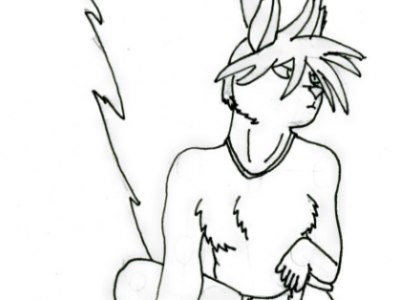
Jeff considered how the hero has an amazing 6 pack and passes a test. Jeff quickly prayed, hoping that he would live, and then said, “Ta Ka Me Ray. Ta Ka Me Ray.” POOF!!! When Jeff opened his eyes he saw fur on his arms, then on his legs, then everywhere! He was a bear! He was so surprised he started running (probably away from himself) but ended up tripping over a log and falling down. By the time he got up he heard his mom calling, “Dinner in 20 minutes.”

Jeff as Bear

Jeff was very hungry and started walking back but then he realized he was a bear and that he couldn’t go back. He smacked himself in the face to see if he was dreaming, but the bear claw barely missed his eye and the pad punched his nose. When his eyes stopped tearing, he saw a pack of hungry wolves silently surrounding him.

Jeff was so scared that he backed up away from the pack and tripped over a stump – the wolves saw this as an opportunity and they attacked. Poor Jeff ran for his life, but while he was running he realized something, for if “Ta Ka Me Ray,” changed him into a bear, maybe he could change back with the same words. “Ta Ka Me Ray”, he shouted.

POOF!!! He was a squirrel and he was being chased by some very confused wolves, who were running a little awkwardly, looking toward the alpha male who commanded them with a snarl to keep on chasing. Jeff recalled failing gym class and feeling his squirrel bones begin to ache, quickly ran up a tree for a break. He couldn’t believe how easy it was to rise 40 feet vertically, without even thinking.

Wolf Terror

Then Jeff tried to sit and slipped, but his claws saved him, and when he clawed his way to a sitting position, he looked at his body and tried moving his legs and arms, they felt the same. Still surprised at the ease with which he climbed to 40 feet, he looked at his paws and smelled them; the odor was gross, like an old man’s foot. He then looked around his furry body and it wasn’t a pretty picture, with matted fur in greasy lumps – he really wanted to be a regular boy again.

All of a sudden Jeff heard a “Boo!” Jeff was so surprised he jumped and touched the sky. He looked behind and saw a baby squirrel laughing very hard. The baby squirrel had big round eyes and a fluffy red tail. She said “Hi, my name is Corny, what’s yours?” Jeff was still in shock but managed to say, “J-J- Jeff.” “Coo-coo-coo-cool!” Jeff stared hard at the little squirrel, obviously his junior, and sniffed. He had better things to do than to be laughed at by a runt who couldn’t even formulate a word. He had to get out of here, he thought, and his attention went back to the wolves, who had disappeared from the base of the tree. After a half hour of ignoring Corny and waiting to spot a wolf, Jeff, rested by now, pointed his head down the tree, but unlike he’d do as a boy, swinging his feet down, lowering his body, Jeff found that his squirrel instincts had him going headfirst! His claws bit into the trunk, and he marveled at the lightness of his body – in fact, the tree stretched out below him like a knobbly roadway, and he began laughing to himself at the freedom he felt as he raced down towards the ground. Maybe it wasn’t such a pain to be a squirrel after all! As he reached the base, the roadway seemed to lift out, and he found himself turning his world right-side up as his claws bit into the earth. Jeff began running around like a little hatchback, tail up, paws drumming the earth like mad, up and over bushes. He felt like he was flying, and when he glanced up to see if Corny was admiring his actions from above, he was greeted with two yellow moons. It was the alpha-wolf! The rest of the wolves had sprung out of their hiding spots. He screamed as he felt hot drool slide down his shoulder, but then he heard a “Hi-yah!”

Out of nowhere, a huge Corny came out and started beating up the wolves, and this was a completely different side of Corny.

Corny the Bionic Squirrel

It was like a tornado of fury. Corny’s fists were flying into wolves’ faces making their teeth fly, she was like Hulk; unfortunately Jeff didn’t have any popcorn to eat while watching. Soon all the wolves had given up. They were whimpering like little dogs and ran away. “Yay, I beat up all the bad guys!” shouted Corny. “You think you’re the only one with Ta-Ka-Me-Ray powers?” snickered Corny. “I have my own pretty necklace of bones, and I use it to grow five times my size and gain huge muscles!” Corny even had a new voice: a lower voice, filled with brawny power. “No one hurts my new friend J-J-Jeff!” she roared, causing the last wolf to puke and then faint.

A puking wolf at the sight of Corny

After Corny stopped panting and went from Hulk size to normal size they started walking, looking for someone to help Jeff. After a while Jeff started to get hungry so he began looking for food. Jeff had once watched a survival show about how to survive in the woods, but he didn’t have a bow and arrow to shoot some deer for dinner. Then he looked at his necklace and realized that he had turned into 2/3 of the pictures on the necklace. There was a bear and a squirrel: the other one was a wolf. Suddenly Jeff knew what to do, and he said, “Ta Ka Me Ray!” POOF!!! He was a wolf and his instinct to hunt kicked in. His friend Corny looked really delicious, but Jeff knew it was wrong to eat a friend. So Jeff decided to look for some dinner. After a while he spotted a deer eating some grass which made his tummy rumble. He slowly crept towards the deer and he got in position. As fast as lightning, he launched off of his hind legs and pounced onto the deer. It was safe to say that soon, Jeff’s stomach was full. After his delicious meal he went to bed on the ground. The next morning Jeff and Corny woke up and Corny got to ride on Jeff because he got tired of her complaining.

After a while the “Corntastic” duo (which was what Corny named them) stumbled upon a little cottage. Jeff tried his best to knock with his paws but the door was too hard. Corny tried to knock on the door with her head but with no success. Jeff, frustrated, started howling. After a while they heard “All right, all right, I’m coming, I’m coming.” As the door opened, they saw an old man with a brown, knobbly, twisted wand in his hand which made Corny say, “It’s a magic guy!” Jeff tried to talk, but all that came out was “woof.” Then the wizard chanted a spell and slowly Jeff’s woofs turned into actual words! “Woof, woof …you help me?” “What is your problem?” asked the wizard. Jeff told the magical wizard everything from finding the necklace to being chased by wolves. The wizard did not say a thing while Jeff explained. Then Jeff asked the wizard his most important question, “Woofers, woofly, woo… Woo – wow can I turn back into a human?” The wizard calmly replied, “You are the chosen one, the protector of the woods. To turn back into a human you need to chant the spell backwards.” Jeff howled in glee. “Arrroooooo! Aaaa-thank you mister. I just have… Woof, woof, wone more request: can you bring me back to my home?” Right after Jeff finished his sentence, Corny shouted “Mr. Magic Guy, can I have a cookie?”

Dreamy Wizard

As soon as Corny finished her sentence, Jeff and Corny were teleported back to Jeff’s house. He then said the spell backwards, “Yar Em Ak Ar.” POOF!!! He was a human again! He put Corny into a hole in a tree with her cookie. Then he walked into the house where Jeff’s parents rammed into him with love saying, “We were so worried. We missed you!” When Jeff finally pried away from his parents after an hour of hugging, he went to his bedroom and he put his necklace on his bedside table and went to sleep dreaming of bears, wolves and squirrels.