Monthly- Archives: January 2013


SARAH XU

Mr Watt´s Literary Services

The Battle of Zama

On October 19th, 202 B.C., the plains of Zama (the present-day Saqiyat Sidi Yusuf, Tunisia) were teeming with soldiers as they prepared for the deciding battle which would mark the end of the long Second Punic War. The two grim enemies, Hannibal, from Carthage (modern day Tunisia, north Africa) and Scipio, from Rome, stared at each other’s armies, analyzing every extra soldier. Hannibal had, Scipio noted, eighty imposing, impatiently fidgeting, and half-trained elephants. Scipio shuddered as he imagined his soldiers trampled, crushed to death, under the 10,000-pound weight. Putting the elephant’s enormity out of his mind, Scipio bent and twisted his neck, trying to see the footmen behind the towering elephants: from what he could glean, Hannibal had about 35,000-40,000 footmen and 3,000 cavalry, a reasonably good amount. Scipio smiled inwardly (it was never a good idea to show your feelings before a battle) seeing that Hannibal’s first line of men were frightened recruits that had likely just been picked up along the way. Scipio’s soldiers had bulging muscles, hard, chiseled features, and fierce, determined eyes. Scipio felt a twinge of fright, though, about what must be skilled, decorated veterans at the back. Although Scipio couldn’t see the third line of soldiers, he was relatively sure Hannibal had put them in the traditional three lines, with the skilled at the back and the inexperienced at the front.

Scipio himself had the same formation, with what the Romans named hastati, principes, and triarii, in order. The triarii were the skilled, wealthy men, the ones at the back everyone depended on. The principes were the middle class, reasonable in skill and wealth. The hastati were poor and unskilled, put at the front because they were worth risking, however, their long javelins, called pilums by the Romans, could go clean through the enemy. Instead of forming the traditional checkerboard lines, though, Scipio had left vacant spaces between the soldiers. He looked back, and was satisfied at seeing the silver gleam of the swords and shields abruptly changing into the light green of frost-covered grass. These spaces weren’t completely empty: there were spry, light-footed skirmishers, known as velites by the Romans, bows at the ready, dotted throughout the columns, who were, like Scipio, scorning Hannibal’s puny cavalry. Scipio’s cavalry were strong, agile, and had massive numbers compared to Hannibal’s. On that good note, Scipio, satisfied, sat back on his horse and told himself relatively confidently that he had a slight advantage. But then his thoughts were interrupted at Hannibal’s resounding battle cry, and Scipio, along with everyone, sprang into action.

The fate of the two most powerful empires of the time balanced on this renowned Battle of Zama. One side would win, and extend into one of the largest empires of all time. One side would fall, shrivel up under the light of the winning empire, and eventually die. These two prodigious adversaries were Carthage and Rome. Carthage, a sprawling African empire, was the trading center of the world; thousands of people flocked to the beautiful sun-browned country to chat and barter and laugh in the huge marketplaces. Rome, a vast empire centered in what is now Italy, was splendid and beautiful in its white columns and smooth arches. Rome was a blossoming flower, and yet Carthage was in full bloom, a beautiful white lily that towered over Rome.

The person who took credit for Carthage’s domination was Hannibal, Carthage’s victorious leader. Hannibal had been raised by his illustrious father, Hamilcar, to be a great general, beginning his military career thirty-five years before the Battle of Zama, at the tender age of ten. When Hamilcar died, Hannibal had been ready. He had then taken his first solo step out of Carthage, proceeding to conquer every Roman land he’d stepped into. Over the next twenty-five years, Hannibal swelled Carthage’s already huge territory into an enormous one, and shriveled Rome’s reach. All the mighty generals of Rome were now buried in battlefields, leaving nobody left to rule Rome’s military. However, a young noble Roman, Scipio, had seized his chance and declared himself leader. Scipio: “who was he?” murmured the Romans. And soon, from countless rumors, they found out. Scipio, aha! He was a young, intelligent Roman who could turn out to be Rome’s formidable messiah, or yet another inexperienced, vanquished general.

Hannibal was known across the continents for his almost spotless battle record. What made it twice as amazing was that Hannibal never won by a huge army but always by an ingenious strategy. And the second-most famous battle in the Second Punic War, the Battle of Cannae, is a great example. The strategy of the Battle of Cannae would tip the scale in the Battle of Zama, but in whose favor?

The Battle of Cannae took place 14 years prior, in 216 B.C. By this time, the Roman senate had had enough of defeated armies and dead generals. To prepare for this battle, the senate had recruited thousands of men and built up a huge, towering army to rival Hannibal’s.  Hannibal, at this battle, wasn’t worried. He had his brain, a couple of soldiers, and that was all he needed. He arranged his soldiers in a wide semi-circle, (the outward part facing the Romans), with the cavalry and some other foot soldiers in the front of this semi-circle. The Romans had scorned this seemingly pointless strategy and had laughed as the soldiers retreat rapidly, not knowing those soldiers had been told to do so. And when they finally realized, it was too late. Hannibal’s soldiers bounced back from facing outward to an inner-facing semi-circle, their cavalry moved in front of the Romans, and the Romans were enveloped. Surrounded by all sides, the Romans, helpless, defeated and shamed, were destroyed.

It was fourteen years later, and Scipio was fresh, new, perhaps inexperienced, a young confident man taking the dead generals’ charges. Hannibal was experienced, wise, perhaps tired; he had already lost an eye. These two were enemies from birth. There’s a legend that Hannibal’s father made his son take an oath to always be an enemy of Rome. And isn’t it said, “Keep your friends close and enemies closer”? It is extremely likely that every Roman military man studied Hannibal’s tactics. Scipio did so himself, studying many of Hannibal’s victorious battles, including the Battle of Cannae. And later, he was able to claim not just studying, but mimicking one of those battles. Hannibal, because of his fame, whether he liked it or not, was a teacher to his enemy.

The preparations for the Battle of Zama had been frustrating, but Scipio was careful to hide this frustration as he trained his troops. Syphax, a Numidian king with a formidable army, wasn’t going to be his ally when the time came to fight Hannibal. The reason was a beautiful, Carthaginian woman, Sophonsiba, who easily persuaded her new husband to help Hannibal instead of Scipio. Luckily, though, Scipio secured the help of another Numidian king, Syphax’s rival, Masinissa. But because Syphax had destroyed most of Masinissa’s land and people, Massinissa could only contribute about 1,000 cavalry, who were on their way.

Meanwhile, Hannibal was worried. Yes, he’d gotten some of Syphax’s cavalry, but it wasn’t enough. If one of his brothers, Mago, could safely come over (which Mago was in the process of doing), Hannibal would have enough soldiers. But it was dangerous in wartime. Hannibal had already asked his other brother, Hasdrubal, to contribute, and Hasdrubal and his army had marched over. But Scipio had intercepted Hasdrubal, and he and most of his army had lost their lives. Mago’s forces were traveling on ship, Hannibal’s army on foot, to join armies. But, when they met, Hannibal learned that Mago’s army had lost many soldiers, including Mago himself, from a skirmish at sea with the Romans. These were Hannibal’s brothers, two experienced generals, now dead, unable to help Hannibal in a battle where he might end up dead himself. But there were still some reinforcements, about 12,000 men that joined Hannibal’s army. These were Ligurian and Celtic mercenaries, picked up along the journey from Carthage.

Hannibal caught wind of Masinissa becoming an ally of Scipio. He knew that Masinissa was coming to help Scipio in the looming battle. He quickened the army’s pace; they would have the advantage if they battled against Scipio before the reinforcements arrived. But Hannibal was too late: Masinissa had arrived with his skilled cavalry. Hannibal was forced to admit Scipio had a slight advantage.

Legends tell that, just before the battle, Hannibal and Scipio met for the first and only time, most likely out of curiosity. This was probably the only time they met, Scipio’s wrinkle-free face cold and stony, secretly admiring Hannibal whose strategies he could recite by heart. Hannibal’s face was as stony and cold as Scipio’s, but he admired the young, brilliant energy in the young general’s face. Despite the hidden admiration, though, there was an unmistakable tension in the air, an almost tangible fear and rivalry. They were enemies, after all.

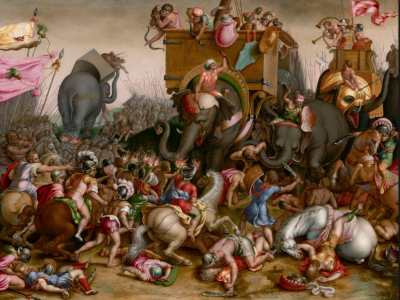
Far away from the mountains, people felt the vibrations from the hundreds of army elephants, who, on cue, had responded to Hannibal’s cry in this Battle of Zama. The elephants stampeded forward, each vibration making every footman flinch. But as soon as the elephants took one step toward the Roman army, Scipio’s trumpeters raised thousands of trumpets and blasted a great, big, ugly, out-of-tune sound and the elephants, susceptible to noise, became paralyzed. Scipio needed to do only one more thing to get them to move out of the way. At a thunderous cry, the skirmisher’s light arrows started to pierce the elephants and they went berserk. Some galumphed crazily into the left side of their own flanks, causing that side to go into complete disarray. Others took the wise course and ran through the purposely-put gaps between Scipio’s soldiers, and were then free. Some elephants, though, did thrust themselves into Scipio’s army. Taking advantage of the confusion caused by the elephants, the Roman cavalry on the left flank galloped forward, chasing the army faster and faster away from the battlefield.

Knowing his cavalry was now too far away to save, Hannibal called his footmen forward, who started shouting valiantly to each other, to quench every scintilla of fear. They were able to fight and march their way through Scipio’s lines without too much difficulty, and the armies continued fighting. All the Roman soldiers felt a tangible, frightening fear of the humiliation, or worse, death, from losing the battle, but then new energy coursed through Roman veins, and they fought with brilliant zealousness through the first line. They marched on to the second line, slightly confident, slightly wary. Hannibal had to act quickly to thwart the Romans’ possible easy breakage through his lines. He ordered the second line to extend outward with the first line’s survivors, to keep the rows in formation. The second line, thinking that the remnants of the first line were running away, started attacking their own fellow soldiers!

Secretly laughing, Scipio’s army danced past. But the Romans were now tired and sweaty, with double cramps and tangled hair. Hannibal still had a reasonable chance of winning. Knowing that if Masinissa’s (Scipio’s ally, the Numidian king) cavalry came back before Hannibal could defeat the Romans, that Rome would definitely win, Hannibal ordered his third line to march and fight. The exhausted Romans had to fight off the best of Hannibal’s army.

Now it was Scipio’s turn to act quickly. In the split second before the armies clashed, Scipio ordered his line to extend, in response to Hannibal doing the same. Now, both sides formed opposing long lines. The two enemies marched forward again, shouting to keep their energy up, and then suddenly stopped mid-step. Time stopped, the whistling wind stopped, the shouts and the cries stopped, the clashing swords stopped, everything stopped… everything except the sound of thousands of galloping hooves whose sound filled up the whole valley. Emotions escalated and plunged at this huge sound, zigzagging through the confused, dumbstruck soldiers. Masinissa’s cavalry, though, had only one emotion, a need really, a need to gallop on faster and faster until they could reach the battlefield and destroy. Finally, sweaty and determined, Masinissa’s cavalry swooped over the hill. The cavalry’s dark shadow was cast over the thousands of soldiers. Masinissa paused for a moment, staring at the thousands looking up at him. Masinissa snapped out of his reverie, and his army charged down the hill, ramming into the back of Hannibal’s soldiers. The Carthaginians helplessly turned in circles, fighting with the cavalry in back and with Scipio’s foot soldiers in front. But it was impossible to do those two things at once. Surrounded by all sides, the Carthaginians, helpless, defeated, shamed, knew they had lost. The enemy was closing in, the soldiers were dropping like flies. Hannibal’s face fell in his one and only defeat, and he galloped off, tears stinging in his shocked, despairing eye.

Enveloped, trapped, and then destroyed: this happened twice in the Second Punic War, in its most important battles. In the first enveloping battle, the Battle of Cannae, two Roman generals fought Hannibal, and Hannibal won, using an enveloping strategy. In the second enveloping battle, the Battle of Zama, the victor was Scipio, the Roman. This battle ended the war. Scipio, using Hannibal’s enveloping strategy, won.


JASON LI

Mr Watt´s Literary Services

 Intelligence without ambition is like a bird without wings. – Salvador Dali 

Every man is said to have his peculiar ambition. Whether it be true or not, I can say for one that I have no other so great as that of being truly esteemed of my fellow men, by rendering myself worthy of their esteem. – Abraham Lincoln 

You can’t get anything done without wanting to get it done. Humanity can be separated into classes, not based on wealth or talent, but based upon the characteristics of ambition and motivation. Salvador Dali, an influential Spanish surrealist painter, only accomplished his master works out of ambition, despite the initial lack of outside interest and success. Early in his life, he suffered failures such as losing his mother at an early age, being expelled from his university, and being accused of being a fascist. Dali’s successes include paintings such as Galatea of the SpheresThe Persistence of Memory, and Crucifixion.  He defines ambition, and not intellect or skill, as the sole factor leading to eventual success. Humans are motivated internally and externally, and while everyone’s goal is different, whether it be earning the respect of others or material wealth, these ambitions define our species to be different from animals in that we as people strive to build something in life. Abraham Lincoln, our greatest president, had only the humble goal of proving himself worthy and respected to his contemporaries, “by rendering [himself] worthy of their esteem”. Lincoln as a man was motivated by his sense of morality to achieve great things politically so as to ensure the dignity of his fellow man and the unity of his nation. Through his achievements, he will be forever known in this country as a hero.

While I believe that Dali is right in that nothing comes to the man or woman who doesn’t strive towards their goals, I also think that ambition is only one ingredient in the recipe for success. Dali’s quote suggests that intelligence without ambition is like a bird without wings, so it can follow that ambition without intelligence is wings without a bird. Even with ambition, there is a certain amount of skill, talent, upbringing, disposition, and luck involved before one can truly fly: one’s upbringing may represent the hollow bones of a bird while one’s innate talents could represent feathers.

Lincoln adopts a generally held idea that each and every person has a dream to follow. Upon a cursory glance, Lincoln’s goal, ‘to achieve the esteem of his fellow man’, appears mild, but the way that he achieved this esteem defied any and all expectations. His successes, including preserving the Union during the Civil War, and freeing the slaves, exemplify that. While Dali implies that since ambition is necessary for success and that success is rare, Lincoln brings up the idea that ambition is held by all, leading to a partial contradiction in ideas: President Lincoln believed that every man has ambition, while Dali, by implying that ambition is the key to success, insinuates that ambition is not a commonly held trait inherent in human nature. I disagree with the notion that every man has ambition, or motivation, in life, given the tendency among people for complacency in the modern world. In Lincoln’s era, life was much harder than it is now, mortality rates higher, and virtues more enforced.

The notion that ambition is the key to success appears in the novel Ender’s Game by Orson Scott Card. In it, a rising politician named Peter remarks to his sister, “For every Einstein, there are a thousand people just as smart as him, who never reach their full potential.” Peter implies that the desire and determination to achieve one’s goals are far more important than mere IQ, that although both intellect and ambition are necessary to accomplish one’s objectives, ambition is by far the rarer and therefore more important quality.

Another idea stems from my own experiences. My mother takes a position that intellect and raw talent do not matter, and don’t even exist. She proposes that what society regards as skill is merely the result of enrichment through education, tutors, classes, et cetera. Then, she cites motivation and drive as the key to academic success, bringing up my other peers, and dividing them into the categories of those who have the drive to succeed, and those who don’t and are heading towards failure. She believes that only some people have ambition to prosper, and that ambition is not innate. She also believes that ambition can be inspired, but that some will never attain it. These experiences roughly correlate with Dali’s idea, and although they contrast with President Lincoln’s concept that all people have separate ambitions, there is the possibility that the people on my mom’s  “not motivated” lists have desires in a different direction. Ambition means different things to individuals. Some have ambitions to become a business leader or a doctor, while others have ambitions to become a train engineer, or a gardener. Some ambitions are more widely accepted than others by society.

My mother’s views are supported in Guy de Maupassant’s short story “The Adopted Son”. In the story, two nearly identical children’s fates are split in different directions. Both were born to serf families, but one is given up for adoption after a rich childless couple visits their squalid home. So, one child is raised by peasants with numerous siblings, while the other is raised by affluent parents with no separate commitments. The adopted son becomes a wealthy, successful man while the son who stayed with the peasants remains a member of that class. Although the moral of the story is not directly about ambition, the story demonstrates the idea that the environment that one is brought up in is the critical measure in ensuring success. It is my firm belief that one’s surroundings dictate one’s disposition, and ambition is a part of one’s disposition.

It can be difficult to identify ambition: when searching for it, does one count unlikely or obscure ambitions, or does one account for those who say they possess it but in reality lack it? Dali explicitly names ambition as the crucial factor to success in life but implies that other qualities are necessary. Lincoln says that all men are possessed with ambition, and with great understatement, defines his own. Personally, I am ambitious. Had I experienced the conditions of Lincoln’s day would I feel differently? Unchecked ambition is never unambiguously a good thing, though, as for every hero benefitting from it such as Lincoln, we have people like Hitler, Stalin, and Bin Laden. Those with intelligence and ambition can achieve their objectives in life, but it is the responsibility of all to make sure ambition is not abused for evil purposes. Ambition is a powerful and rare quality.


And the Gold Medal for the first published Famous Battles essay goes to…


SAMMY XU from Hong Kong!


Way to go Sammy!


This essay represents a great deal of study: from photography to journalism, from war correspondents to famous battles, the nonfiction unit in the autumn of 2012 was brimming over with information. Taking the principles of journalism as set forth by the Project for Excellence in Journalism as a foundation for this paper, students have had to verify information relentlessly in their drafts. From the understanding of creative nonfiction, students have included fictional techniques such as first-person accounting and dramatic pacing in their Famous Battles essays. Finally, from an understanding of the tragic importance of war in human culture, students have grappled with famous battles. Sammy takes the gold for his outstanding essay on the Battles of Lexington and Concord. Soon essays will appear on The Battle of Zama, The Battle of Marathon, Waterloo, and the Siege of Orleans.


SAMMY XU

Mr Watt´s Literary Services

:

The Battles of Lexington and Concord

Under a stone bridge outside of Lexington, Massachusetts Colony, 4 am, April 19, 1775: first person account by Prince Estabrook.

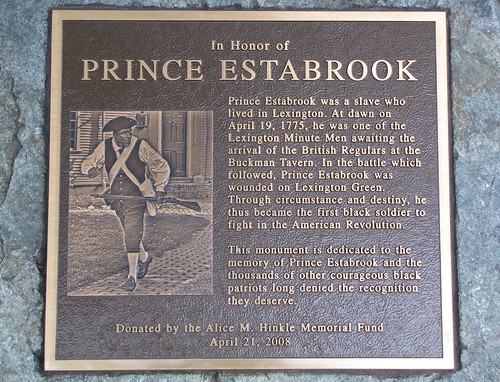
I, Prince Estabrook, tried my best to hide all sense of fatigue. I, with my fellow militiamen, listened to Captain John Parker and his orders. Captain Parker was a local farmer turned commander, from Lexington, and had been appointed the leader of our militia. I was an emancipated slave from Ashby, Massachusetts, a town 40 miles away from Lexington. I had traveled down to Lexington a few months ago so I could become a minuteman and fight for America’s freedom. Our militia had been spending months prior to this event preparing. Captain Parker had led us through some basic drills that taught us how to use a rifle. Earlier in the morning of April 19th, 1775, at around one am, we heard Paul Revere ride in from Concord warning that the British were marching to Concord and we would have to delay them as they passed through the Lexington Common. We were instructed to try and delay the British so that fellow colonists at Concord would have enough time to hide the supplies that the British were trying to destroy. All the supplies were to be distributed among neighboring towns and then collected once the British departed. It had been a chaotic night and Revere was trying to gather another militia so that they could defend the village. In our Province of Massachusetts Bay, a third of all men between 16 and 50 were ready to bear arms and defend the colonies at a minute’s notice. This is how we were able to pull together a militia with such immediacy. We continued waiting, and just as Captain Parker told us to go home, we heard the sound of British marching troops.

At 5 am, an hour after we assembled under the bridge, our small militia of 60 men began moving toward the Lexington Common. Soon after, we saw the redcoats arrive. There were about 1,000 British soldiers: a wall of bright red approached. We were a militia made up of men that had been trained for only a few months, and we were fighting against the most powerful army in the world. All of us feared for what could happen next. My heart pounded heavily during the preparation for the fight as I, an emancipated slave from Ashby, began to assemble all my supplies for the fight. I thought about my family and everything that was at stake. The atmosphere grew more and more tense as it overflowed with soldiers running around – the Common was alive with all different kinds of feelings. Some people were anxious to fight, while others, like me, were beginning to wonder why they were here. Our militia had been up all night, yet we still itched with excitement to finally get the chance to fight for freedom. The sun slowly rose, the horizon glowed with orange, and the silhouettes of all the soldiers bobbed up and down.  But who was I to stand up against our commanders? I was just a single soldier fighting for the colonies in a rivalry against the British, in the attempt to address all things political, social, and economical. We were no longer fighting for what we wanted individually, but we were fighting for the country. We as individuals wanted less taxes, but the country wanted freedom. It was a standoff between the two sides, British and American. The field was silent, and all we could hear were the sounds of insects waking up.

“Stand your ground; don’t fire unless fired upon, but if they mean to have a war, let it begin here,” Parker hollered. We stood, nervously staring at the other side, knowing that we were at disadvantage, and that the British could destroy us at any moment. Sweat from the intensity of the stare down caused the gun to begin slipping out of my hands. Suddenly, a shot from someone somewhere was fired, and that’s when all hatred flooded out of our bodies like a river though a dam. British General Pitcairn rode forward waving his sword around ordering his men to charge. Thus, the giant fleet of redcoats ran forward, yelling and thrusting their bayonets in the air. The scene was so intimidating and we all stood frozen, like deer staring at an approaching buggy. Suddenly, Captain Parker yelled, “Disperse you rebels; throw down your arms and disperse!” Having been commanded by Captain Parker thus, we all ran for our lives into the forest behind us. I ran for my life, but could not outrun the bullets. Soon after I entered the forest, I was hit. The bullet, despite being so small, flung me to the ground as I grabbed my shoulder in pain. Blood oozed out. The bleeding fueled by my hate and the desire to break free became stronger. The physical challenges became clearer as we had our first taste of war. The tipping point became reality, and the hatred between the two sides grew stronger. Before most soldiers and militiamen knew it, the American Revolution was underway.     

The American Revolution occurred from 1775-1783 and was the war that gave America independence, forming the sovereign state of the United States. But the war did not just happen. It occurred slowly, and one of the root causes was the French Indian War. The French and Indian War lasted nine years and ended in 1763. It was a British victory, but it cost them a great deal. The British were $132 million in debt (equivalent of tens of trillions of dollars today), but the colonists were just $2 million dollars in debt. The British had no other way to regain the money, they thought, than to tax the colonists. For the next 10 years, all sorts of acts, such as the Townshend Act, which taxed glass, paint, oil, lead, paper and tea, and the Stamp Act, taxing all paper items, were put in place in order to get money out of the colonies. Many colonists argued that it was not fair that they were taxed without being represented in Parliament.

The colonists were made up of patriots and loyalists. Patriots wanted independence, but loyalists wanted to remain loyal to Great Britain. These two points of view were contradictory. Even though they were taxed unfairly, the loyalists argued that they were only paying 1/27th of what the British in Great Britain had to pay, which was true. This still made the patriots furious. King George III then passed acts in addition to taxing that also restrained the colonies, such as the Quartering Act, enforcing colonists to house British soldiers upon command. Acts like these were a misuse of power as Great Britain had the strongest military and navy in the world at the time, and the colonies were still developing. The colonists suffered through years of mistreatment and invasion of privacy, suffering in silence, all the while yielding to British demand. The colonies were very evenly split. Some wanted to go to war with Britain and fight for independence, but some saw that as an idiotic idea because of how powerful Britain was. The First Continental Congress was established in Philadelphia, on September 5, 1774, and had representatives from each colony. How could the Continental Congress agree that revolution was the only way forward when they had many very different and contradicting views? But more importantly, how were the colonies able to pull together and somehow, against all odds, overcome adversity and defeat the greatest empire in the world when they were made up of nothing more than militias, constituted from civilians, or untrained soldiers?

The Americans were taxed, yet they had no representation in Parliament. They had no say in the way the British governed them, and even when they thought it was unfair, they weren’t allowed to speak up for themselves. It was almost like a dictatorship. They felt an overwhelming misuse of power by King George III and they felt that their basic human rights were being abused. Colonists believed that people who were elected without their input shouldn’t tax them. The colonists needed representation in Parliament. The British had full control over everything the colonists did: they even controlled their trade. When King George III passed the Navigation Act, he restrained the colonists’ trading options by only allowing them to trade with Britain. Colonists also suspected that King George III had set up a corrupt government. He was suspected of being guilty in judicial bribery as he adjusted the salaries of judges solely depending upon how well they interpreted the laws in favor of Britain. The Boston Massacre is perhaps the best example of this: despite killing five innocent civilians, the British soldiers were ruled not guilty, following a request from King George III.

The loyalists, also called royalists, had a very strong argument. They knew that Britain was the strongest empire in the world, not only militarily, but economically as well. Many feared the power of Britain and therefore remained loyal. Britain was the prime buyer of American raw materials and agricultural products. Loyalists knew that if they were to go to war, that their economy would crash, win or lose. They would not have any trading partners because Britain was literally their only customer. Britain’s navy was also very beneficial to colonial trade. The British Navy protected their ships, as there were many pirates and privateers preying on shipping lanes. In addition to protection on the sea, the British also provided protection on the land. British troops defended the frontier along the Appalachian Mountains from the Native Americans. The colonists certainly didn’t want to lose the protection they got there as well.

However, many also thought that it would not be smart to keep listening to Britain’s commands. They wished to stick up for themselves and form a new nation. Even before the real revolution began, there was already disagreement amongst the colonies. How were they going to beat Britain when they didn’t even agree among themselves?  The most important advantage for the colonists was their communication system of messengers on fast horses. If their communication had not been as efficient, then the colonists wouldn’t have had their militias organized on time.

This strong communication system gave the colonists enough information prior to the Battle of Lexington and Concord, the battle that would start the eight-year Revolutionary War. The British began planning to confiscate weapons hidden by the patriots in Concord on April 14, 1775, five days prior to the outbreak of the Revolutionary War, when Colonial Secretary William Legge commanded General Thomas Gage to find and destroy the weapons. Paul Revere and Joseph Warren intercepted the message to Gage thanks to Margaret Gage, the wife of the General. Late on the night of April 18th, Paul Revere rode to Concord and warned the patriots that British soldiers were coming. In order to prevent loss of supplies, the townspeople decided to redistribute everything to towns nearby and recollect them later. Between 9 and 10 pm on April 18th, one day prior to the battle, Joseph Warren told William Dawes and Paul Revere to warn the town, so they set out on their famous Midnight Ride and warned everyone about the British troops. Once Revere, Dawes, Hancock and John Adams arrived in Lexington, they organized the militia for the battle. Revere, Dawes, and Samuel Prescott were sent to Concord, but on the way there, Revere was captured and Dawes was ambushed. But because of a system that had been set up months before, they still got enough people to fight at Concord. The system was a network of notifications that would get the militia organized very quickly. The system was so effective that people within 25 miles of Boston would know about the enemy’s movement while they were still unloading boats in Cambridge (Boston).

Concord Village Common, Province of Massachusetts Bay, 9 AM April 19, 1775: first person account by Mark Gallagher.

Having been warned through our communication system, we were able to set up a militia to defend Concord. Numbering about 250, our militia marched on the road towards Lexington, seven miles away.

“Mark Gallagher, prepare the others for a retreat, I indistinctly see the redcoats marching towards us, and from the looks of it, we have no chance,” Colonel Barrett barked. After marching for a short while, we suddenly spotted about 700 British troops. We were all shocked by the overwhelming size of the British, and knew that there was no way we could defeat them. Thus, we retreated back to Concord and took up our positions on a ridge overlooking the town. We sat there, looking at the town. We studied the scene. The morning light dawned on us and the smell of plants and life arose – this was not a scene that anyone would expect to have a war in. We looked over the town, and when the huge British army entered the village, we retreated again. We abandoned Concord to buy some time by retreating to Punkatasset Hill. We moved frantically but remained cautious, aware that there were British troops very near. We all knew that one misplaced person could give away the entire militia’s position. Punkatasset Hill was about a mile to the north of Concord. From there, we were able to watch over all activity in Concord. While we were waiting up on the hill, we quickly gathered militiamen from nearby towns. We needed more militiamen if we hoped at having any chance in defeating the British army.

As we gathered troops, we continued watching the British. The British did not find the supplies they were searching for. They searched through every single building in the village but couldn’t find anything. We looked down on them and laughed at them, for we had hidden all the supplies they were searching for in nearby towns. The British were now very frustrated, so they destroyed whatever they could find, including some cannons. What was the most devastating was the fact that they were burning houses. But luck was on our side, for I could see some woman who appeared to convince the British to put out the fires, and they did, saving the courthouse. In the meantime, our militia, under Colonel Barrett, decided to leave our location on Punkatasset Hill, arriving at a lower hilltop close to the North Bridge in Concord. Our militia now had about 400 men. Once we arrived at the hilltop, Colonel Barrett decided to advance with loaded weapons. We lined up, received our guns, and began advancing to Concord. Colonel Barrett ordered us not to fire, except in self-defense. We crossed the North Bridge and due to a poor defensive strategy by Captain Laurie, a British captain, the British troops were put into a disadvantageous position. The ensuing firefight saw the British outnumbered and outmaneuvered, and they fled, abandoning the wounded, to the safety of their own lines, barely making it out alive. It was a horrific scene: dead and wounded soldiers lay everywhere, and I had the urge to help them until I realized that they were British and my anger returned. We were stunned by our success. We had not imagined defeating the British, yet we defeated them so easily and quickly. We realized that it wasn’t about the amount of power an army had, but that tactics were vital, along with how willingly you fought. We moved on, knowing that it was not the end of the battle. We quickly gathered on the hilltop 300 yards from the bridge and another half of our militia gathered across the bridge.

British Lieutenant Colonel Smith had heard the exchange of fire and rushed reinforcements to help Captain Laurie and his men, and they continued searching and destroying military supplies of the militias. The British left Concord in the afternoon, and this delay gave us more time to gather more men and cut off the road back to Boston.

The next challenge the British faced was to cross a small bridge outside of Concord. The narrow bridge forced the troops to cross three soldiers at a time. They struggled by, barely making it over the bridge, and as soon as they stepped onto the bridge, we fired at them and about two British troops were killed every time. The 500 of us had gathered near the woods on Brooks Hill further down the road from the bridge. When the British troops reach a curved road through a wooded area, we remained in the woods and fired upon the British from both sides of the path.

Our militia continued to grow, eventually amounting to around 2,000 men. Though we had gained a huge advantage, we were running short of ammunition and were tired. Some of the British troops surrendered, and the rest ran forward. The possibility of the British surrendering was becoming more and more likely, when suddenly Earl Perch, a British General, arrived with a brigade of 1,000 men, with artillery reinforcing them.

Brigadier General William Heath took control of our militia and changed tactics. We scattered and were commanded to snipe from a distance because this could cause maximum damage with least risk. We would also ride ahead on horses, wait until the British came within range, fire, and then disperse. We kept flanking the British. By next morning, we had a huge militia of more than 15,000 men surrounding Boston.

The Battles of Lexington and Concord were fought between a militia that had only been training a few months against the strongest military in the world. The battle of Lexington was declared a British victory, but the battle of Concord was declared an American victory. But overall, the Battles of Lexington and Concord were an American victory. In total, there were 273 British casualties, and only 94 colonist casualties. These statistics were enough to turn some loyalists into patriots, as happened one year later while the Continental Congress was deciding on the appropriate steps forward.

The Battles of Lexington and Concord were the first battles of the American Revolution, and made many colonists believe that it would be possible to win. They had doubted their militia, thinking that they would definitely lose, but these successes brought new hope. Throughout the Revolution, the British won more battles than the colonists, but the colonists won the important ones. Perhaps the one person that deserves the most credit was General George Washington, the commander in chief of the Continental Army. If it wasn’t for him, then the colonists may have lost the revolution. The colonists also had support from France. France not only supported the colonists economically, but also busied the British. They were also fighting Britain, and in war with a neighboring country, supplies and soldiers are quickly drained. The British were spread out throughout the world, and their ultimate authority was two months away by boat. Furthermore, the colonists’ fighting strategies and supplies were more advanced than the British. The British kept to their traditional fighting style of wearing bright red coats, standing in a rigid, straight format, and firing upon command, whilst the colonists wore camouflage and normal clothes, hid behind trees, firing freely. The British weaponry was also very inaccurate because of how the guns were not rifled, which was a method of making grooves on the barrel of a gun to provide a spin to the bullet, stabilizing it. Britain’s guns were so bad that it was almost impossible to hit an intended target from more than 30 feet away.

A little more than one year after the Battles of Lexington and Concord, Lee’s Resolution, the resolution of fighting for independence, authored by Richard Henry Lee of Virginia, was presented to Congress on June 7th, 1776. However, from the start, New York, New Jersey, Pennsylvania, Delaware, Maryland, and South Carolina were unwilling to approve it. Thus, they delayed the vote until July 1. During that time, Congress appointed the Committee of Five: John Adams, Benjamin Franklin, Roger Sherman, Robert R. Livingston, and Thomas Jefferson. Thomas Jefferson was known to be the best writer in the group, so he was appointed the primary author of the Declaration of Independence, and they presented the document to Congress on June 28th. Congress continued debating the resolution, and thought it would have to be a unanimous vote if they were to fight the strongest empire in the world. Thus, they delayed the final vote to July 2nd while they waited for New York to finally decide. One of the strongest arguments the patriots used were the battles of Lexington, Concord, and Bunker Hill. In the Battle of Lexington and Concord, the casualty count was 273–94 in favor of the colonists. In the Battle of Bunker Hill that took place on June 17, 1775, the casualty count was 1,150–450 in favor of the colonists. These statistics showed the Congress that even though they only had militias, that they could defeat the British. When New York finally approved the resolution, the delegates of Congress all signed the Declaration of Independence, marking the beginning of the political battle between Britain, and the future United States of America.