
Monthly- Archives: October 2011


LARRY H

Oscar Wilde is known for his plays, his social criticism and poetry, as well as his fables.  One such fable, “The Happy Prince” was a particular favorite of Larry’s, and he decided to write his own version of the story.   The assignment required matching Wilde’s syntax exactly, as well as following the thematic arc of the story.  Larry’s accomplishment, “The Wise Man with the Hawk”, is by turns humorous and touching.
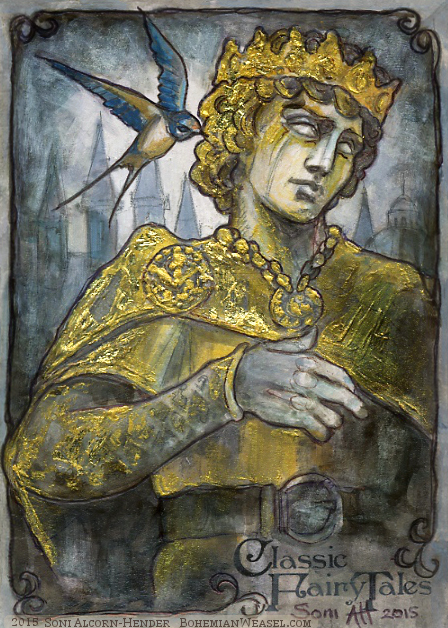
The Wise Man with the Hawk


Right in the middle of the city, on a flat platform, sat the wise old man with his hawk. He was tattered all over with wrinkles of dirty fabric, for his eyes he had very big glasses, and a fierce hawk stood on his shoulder.

He was very much admired indeed. “He is a wise old owl,” remarked one of the old councilmen who was known for his kindness and good taste.

“Why can’t you be like the wise man with the hawk?” said a stockbroker to his assistant who was crying for a raise. “The wise man with the hawk never dreams of a raise.”

“I am glad that someone in the world is quite relaxed,” muttered the mayor of the town.

“He looks just like the Buddha,” said the Buddhist monk as he came out of the bathroom in his 200 year-old robe passed down from his master.

“How do you know?” said the Christian monk, “you have never seen him.”

“Ah! But you haven’t seen Jesus either,” answered the monk; and the Christian monk frowned and glared severely, for he did not approve of him criticizing his religion.

One night there flew into the city a rich handsome man in his jet. His friends had gone away to the US six weeks before, but he had stayed behind, for he was in love with the most beautiful girl. He met her early in the spring when he was on vacation catching a fish.

“Shall I love you?” asked the rich handsome man, who likes to be straight forward, and the pretty young girl pecked him on the cheek. He went back and forth to his car, and touched the woman with his hands and offered her many many presents. This was to show his love and it lasted all through the winter.

“It is a ridiculous attachment,” tweeted the other men; “she has no money, and far too many relations”; and indeed the town were quite full of her cousins. Then, when the autumn came they rode away.

After they had gone he felt lonely, and began tire of his lady-love. “She has no words,” he said, I am afraid that she is unattainable, for she is always flirting with the doctor.” And certainly, whenever the other man came the beautiful woman would giggle and laugh. “I admit that she is shallow,” he continued, “but I love spending money, and my wife, consequently, should love spending money also.”

“Will you travel to the US with me?” he said finally to her; but the beautiful woman shook her head, she was sick she could not travel.

“You have been cheating with me,” he cried. “I am off to the Oscars. See-ya!” and he flew away in his custom Air Force 1 plane.  All week long he traveled, and at nighttime he arrived at the town. “Where is the 5 star hotel?” he said; “I hope the town has an Apple store.”

Then he saw an old homeless man.

“I will sleep in that 5 star next to the old man,” he cried, “It is a fine hotel, with plenty of wi-fi service!”

“I have a great and beautiful bedroom,” he said loudly to himself as he looked around and prepared to eat a snack; but just as he was putting the food in his mouth a loud tap pounded on his door. “What a curious thing!” he cried; “there is not a soul on this floor and the lights are all down, and yet someone is knocking.  People in this town are really dreadful My girl friend used to like people knocking but that was merely her craziness.”

Then another pound came.

“What use is this hotel if it cannot keep people out?” he said; “I must look for a better room,” and he was determined to be driven away.

But before he had dialed his driver’s number, a third pound came, and he looked up, and saw – Ah! What did he see?

The eyes of the wise old man were filled with fear, and shivers were running down his fragile spine. His face was so shocking in the streetlight that the young man was filled with pity.

“Who are you?” he said.

“I am the wise old man.”

“Why are you pounding on my door then?” asked the young man; “you have quite annoyed me.”

“When I was young and was very rich,” answered the man, “I did not know what poverty was, for I lived in the Beverly Hills, where poverty was not allowed to enter. In the daytime I shopped with my friends in the mall, and in the evening I led the walk of the red carpet. Round the Beverly Hills ran an invisible wall, but I never cared to seek what lay beyond it, everything about me was so elegant. My friends called me the happy man, and happy indeed I was, if pleasure were happiness. So I lived, and so the stocks fell. And now that I am poor they have set me close to the forest where I can see all the cruelty and all the torture they have done to the animals, and though my brain is far too stupid I cannot chose but to seek help.”

“What, is he not that wise after all?” said the young man. He was too polite to yell it out loud.

“Far away,” continued the wise man in a croaky loud voice, “far away in a cave there is an injured leopard. One of the leopards is awake, and I can see him lying on the ground. His face is scratched and bleeding.”    
             “Young man, young man, oh handsome young man,” said the wise man, “will you not stay with me for a while, and be my helper? The cub is young and wrecked, and the mother so helpless.”

“I don’t like animals,” replied the young man. “Last winter, when I was staying in L.A., there were three annoying dogs, the manager’s dogs, who were always chasing me. They never caught me, of course; I was too smart for that, and besides, I come of a family famous for its intelligence; but still, it was a sign of disrespect.”

But the wise man looked so helpless that the young man was sorry. “It is very hot here,” he said; “but I will stay with you for a while, and be your helper.”

“Thank God,” said the wise man.

So the young man commanded his men to take the great burger-making machine from the wise man’s magical bag, and drove away with it in his back trunk.

He passed by the jungle, where the deer were being prepared. He passed by cave and heard the sound of eating. A beautiful leopard came out on the balcony with her mate.   “How wonderful the food is,” he said to her, “and how wonderful is the power of love!”

“I hope my deer will be hunted in time for the party,” she answered; “I have ordered five sets of deer; but the hunters are so lazy.”

He passed the main cave and saw the monkeys hanging from the branches of tree. He passed the ghetto and saw the male leopards fighting with each other, trying to get food for their families. At last he came to the wrecked cave and peeked in. The cub was coughing terribly in bed, and the mother had passed out, she was so tired. In he crept, and put the burger-making machine on the floor. The he walked slowly round the bed, and put a bandage on the leopard cub’s paw leg.  “How nice I feel,” said the cub,  “I must be getting Advil,” and he fell fast asleep.

Then the young man drove back to the wise man, and told him what he had done. “It is curious,” he remarked, “but I feel quite warm now, although it is very cold.”

“That is because you have done a good deed,” said the wise man. And the young man began to think, and then his head hurt. Thinking always made his head hurt.

When day broke he drove down to his hotel and had a shower. “What a remarkable thing,” said a girl as she was passing the hotel. “A star!” And she wrote it on Facebook. Every one quoted it, but as it was so poorly written, no one knew what she was talking about.

“To-night I go to U.S.A.,” said the young man, and he was in high spirits at the prospect. He visited all the bars, and stayed a long time on top of the skyscrapers. Wherever he went the girls spied, and said to each other, “What a distinguished foreigner!” so he enjoyed himself very much. When the moon rose he drove back to the wise man.

“Have you any friends in U.S.?” he cried; “I am just starting to go.”

“Young man, young man, oh handsome young man,” said the wise man, “will you not stay with me a little longer?”

“I am waited for in US,” answered the young man. “To-morrow my friends will drive to downtown. The addicts sit there among the cops, and in great hotels lay the street racers. All night long they race on the mountains, and when the morning star shines the winner utters one cry of joy for he has won the race. At noon the red-eyed gambler comes by the casinos to gamble. They have money like hair, and their loss is worse than the NCAA’s North Carolina game against Kentucky.”

“Young man, young man, oh handsome young man,” said the wise man, “far away across the seas I see a young wolf in hiding. He is leaning over a tree branch, and in a bush near him are the remains of his tail. His fur is gray and white, and his eyes are red as a pomegranate, and he has large and wishful eyes. He is trying to hide from the hunting guild, but he is too cold to run any more. There is no food nearby, and hunger has made him faint.”

“I will stay with you a little more,” said the young man, who really had a good heart. “Shall I take him another burger-making machine?”

“Alas! I have no burger-making machine now,” said the wise man, “all I have left is my tactical nuke. They are made of TNT, which were brought out of the Manhattan Project years ago. Take one from my magical bag and go. You will call an airstrike on the guild and the wolf will be able to run away.

“Dear wise man,” said the young man, “I cannot do that”; and he began to weep.

“Young man, young man, handsome young man,” said the wise man, “do as I say.”

So the young man took the tactical nuke, and flew away to the wolf. It was easy enough to get to, as there were no clouds in the sky. Through this he dashed, and came close to the wolf. The young wolf had his head buried in the snow, so he did not notice the young man nearby, and when he looked up he saw an amazing sight of a mushroom cloud.

“I am beginning to be appreciated,” he said; “this is due to an animal lover. Now I can run away,” and he looked quite happy.

The next day the young man drove down to the airport. He waited in the limo and watched staff haul big packs of luggage on to the plane. “Hu-Ha!” they shouted as each bag came up. “I am going to Vegas!” cried the young man, but nobody cared, and when the moon rose he drove back to the wise man.

“I have come to bid you good-bye,” he cried.

“Young man, young man, handsome young man,” said the wise man, “will you not stay with me one night longer?”

“It is hot,” answered the young man, “and the heat wave will soon be here. In Egypt the hotel had a/c, and the tenants lie in their bed and watch TV. My companions are building a hotel near the Vegas sign, and the pink and white chicks are watching them, and sitting next to each other. Wise man, I must leave you, but I will never forget you, and next fall I will bring you back two presents in place of the things you have given away. The burger-making machine shall be a new model and the tactical nuke will be developed with the Pentagon.”

“In the square below,” said the wise man, “there stands a little cat. She has broken her leg when pursued, and is bruised. Her keeper will lock her into her cage if she does not come back, and she is crying. She has no claws or strength, and her little head is bare. Take my satellite controlled GPS that can attach on her leg so she will not be caged.”

“I will stay with you one night longer,” said the young man, “but I cannot take your GPS. You would be quite lost by then.”

“Young man, young man, handsome young man,” said the wise man, “do as I say.”

So he took the GPS from the old man’s magical bag, and drove down with it. He drove past the cat, and dropped the GPS into the palm of her paw. “Meow, Meow, Meow,” cried the little cat; and she ran home, purring.

Then the young man came back to the wise man. “You have nothing now,” he said, “so I will stay with you always.”

“No, young man,” said the poor wise man, “you must go away to the US.”

“I will stay with you always,” said the young man, and he slept near the wise man.

All the next day he sat near the wise man, and told him stories of what he had seen while traveling the world. He told him of the soccer players, who stand in long rows when there is a foul, and shoot balls into goals; of the Eiffel Tower, which is as complicated as the world itself, living in the city, and seeing everything; of the rich, who anxiously wait for their pure gold Mercedes, and wear platinum Hugo Boss watches on their wrists; of the city San Diego, which is as hot as a desert, with waves rough as concrete; of the great green car that rests in a parking lot, and the twenty PepBoys employees to outfit it with new tires; and of the midgets who rode over big hills on small, round bikes and are always at war with the squirrels.

“Dear young man,” said the wise man, “you tell me of interesting things, but more interesting than anything is the suffering of animals. There is no Mystery so great as Misery. Drive around my town, young man, and tell me what you see there.”

So the young man drove through the small town, and saw the pets lavished in their expensive beds, while the beggars were sitting at the gates. He drove into dark lanes, and saw the dark faces of rabid dogs looking out listlessly at the black streets. On the branch of a tree two birds were trying to hide from a mad hunter. “How tired we are!” they said. “You must not stay here,” shouted the caretaker of the tree, and they flew out into the rain.

Then he drove back and told the wise man what he had seen.

“I have my hawk,” said the Wise Man, “you must help him off my shoulder, inch by inch, and send him to my poor birds; the living always think that companions can make them happy.”

Inch after inch the young man helped the fine hawk off, till the wise man looked quite old and skinny. Mile after mile the hawk flew to the poor birds, and their faces grew wider, and they laughed and played games in the sky. “We have a protector!” they cried.

Then the heat came, and after the heat came the heat wave. The streets looked as if they were being boiled, they were so bright and hot; long waves of heat were like the steam that came from hot water. Everybody went about in shorts, and the little boys wore Yankee hats and stayed inside with the air conditioning.

The poor young man grew hotter and hotter, but he would not leave the wise man, he loved him too well. He went to CVS to buy medication for his heart problems when the old man was sleeping, and tried to stay in the shade to stay cool.

But at last he knew that he was going to die. He had just strength to go up next to the wise man once more. “Good-bye, dear wise man!” he murmured, “Will you let me kiss your hand?”

“I am glad that you are going to US at last, young man,” said the wise man, “you have stayed too long here; but you must hug me, for I love you.”

“It is not to US that I am going,” said the poor young man. “I am going to the Mansion of Death. Death is the brother of Sleep, is he not?”

And he hugged the wise man, and fell down dead at his feet.   At that moment a curious scream sounded inside the wise old man, as if something had popped. The fact is that the red heart vein had popped right out. It certainly was a dreadfully intense heat wave.

Early the next morning the old councilman was walking in the square below, in company with the assistants. As they passed the column he looked up at the flat platform. “Dear me! How white the wise man looks!” he said.

“How white indeed!” cried the assistant, who always agreed with the old councilman; and they went up to look at him.

“The burger-making machine is gone, his hawk is gone, and he is stacked with gadgets no longer,” said the old councilman. “In fact, he is little better than a beggar!”

“Little better than a beggar,” said an assistant.

“And here is actually a dead man at his feet!” continued the old councilman. “We must really issue a proclamation that men are not to be allowed to die here.” And the Town Clerk made a note of the suggestion.

So they took away the wise man, “As he is no longer wise and he is no longer useful,” said the Art Professor at the University.

Then they burned the body at the fire, and the old councilman held a meeting with the temple priest to decide what was to be done with body. “We must have a wise man, of course,” he said, “and it shall be myself.”

“No, it shall be myself,” said assistants, and they quarreled. When I last heard of them they were quarrelling still.

“What a strange thing!” said the priest. “This old heart will not burn, it must be buried.” So they buried it in the dust heap where the poor young man was also lying.


***


“Bring me the two most precious things in the city,” said God to one of His Angels; and the Angel brought Him the unburnable heart and the poor young man’s body.

“You have rightly chosen,” said God, “for in my garden of Paradise this young man shall help me forever more, and in my city of gold the wise man shall advise me.”


DORRY ZHAO

Stephen Crane – The Natural World


Stephen Crane is one of the most celebrated authors in the United States. He created masterpieces as detailed and realistic as they were recognizable. He was skilled in many types of description, such as his masterful depiction of street life apparent in Maggie: Girl of the Streets, as well as describing battle in The Red Badge of Courage so realistically that veterans thought that he had to have had battle experience. However, perhaps his greatest type of description was his unparalleled skill in depicting nature and the natural world, as well as the animals that inhabit it. In varying ways, Crane employed figures of speech to portray nature as she is: powerful, irreducible, empty of any interactive capability; he also explored the human tendency to personify nature. With regard to animals, Crane possessed a piercing ability to empathize with pets and farm animals, as well as wild animals, and portrays both pets’ thoughts, and the effect of wild animals, with deftness.

Crane especially liked to use figures of speech to describe nature. One prime example would be “The Blue Hotel”, a tale, whose characters battle a fierce Nebraska snowstorm.  Holed up in the hotel, the characters hear something beating on the walls “like a spirit tapping” (8, Blue). This is an example of Crane using a simile to help describe nature. However, he also used metaphors help describe the natural environment. One example of this is when he describes flakes of snow being swept southwards with “the speed of bullets” (28, Blue), and when he likened the Earth to a “whirling, fire-smote, ice-locked, disease-stricken, space-lost bulb” (39, Blue). The Earth isn’t really completely like that, but when one reads this, they get a sense of how chaotic and bleak the winter in Nebraska can be. In “The Dark Brown Dog”, one of Crane’s New York stories, when a child beats the dog, he uses personification: the dog doesn’t try to “look to be a martyr” (5, Dark). The dog cannot look like a martyr in the sense that we can, but in using that metaphor, we can imagine how the dog related to his owner, and we can gain a better understanding of the intended tone for that particular scene.

As mentioned, Crane used personification to aid his depictions of nature. The waves in his masterpiece, “The Open Boat”, had a type of “terrible grace” (2, Open) to their movements. Here, he used personification to help readers better visualize the waves, and the ocean on which this story takes place. Also, another example of this was when a wave “moved forward, huge, furious, implacable” (25, Open). The wave isn’t really furious, but personifying it like that helps visualize the moment, as well as aids us to see the wave.  Similarly, he wrote that a wave “fairly swallowed the dingey” (25, Open). The wave didn’t really swallow the boat – it doesn’t have a mouth. However, it helps to show how and where the boat went, and reveals just how large the wave was in comparison to the boat.

Crane also possessed an uncanny ability to portray the thoughts and intentions of domesticated animals. He portrayed the dog in his story “The Dark Brown Dog” as being humble, forgiving, and loyal. He fully expressed the extent of dog’s “devotion to the child” (Dark, 6), as being “a sublime thing” (Dark, 6). Here we can imagine how Crane related to an animal’s thoughts, intentions, and feelings.

In The Third Violet, a love story set in upstate New York, and later in Manhattan, Crane has ample opportunity to paint the portraits of pets and farm animals.  A beautiful young lady, Ms. Fanhall, flirting with a painter, Will Hawker, meets a team of oxen lumbering through a meadow as she stands talking to the oxen driver’s son.  She inquires about the beasts as Crane gives these adjectives: “humble, submissive, and toilsome” (57, Third).

Ms. Fanhill and the painter’s father, Mr. Hawker, then get into a philosophical discussion about the animals; they discuss their wellbeing, as well as their happiness amidst unending toil.  Ms. Fanhill and old man Hawker are “meditating” (61) on the oxen, and asking questions like “are they happy?” (61): these could be Crane’s thoughts towards animals, embedded in his fiction.  When Hollenden (a friend of Hawker’s) and Ms. Fanhill see Stanley, the Hawker family dog, running by, they both praise him, and discuss at length Hawker’s treatment of the dog.  As mentioned, deep kinship between man and beast also occurs in “The Dark Brown Dog”, when the child befriends a dog.  The child and the dog become very close, with the child “championing” the dog.  This perhaps shows Crane’s feelings about animal and human relationships, and their meaning.

Crane was also extremely skillful in writing about wild animals. He could both describe their physical looks to the last hair, as well as relate them to the story, making them a valuable asset in his writing career. One example is the seagulls from his short story, “The Open Boat”. He describes them so masterfully that they seem to be not in the book, amongst the pages, but trying to land on your head. For example, he describes one that flew “parallel to the boat and did not circle, but made short sidelong jumps in the air in chicken-like fashion. His black eyes were wistfully fixed upon the captain’s head”. It seems quite easy to see that bird in your head, making those odd-looking hops, just … looking at you. However, Crane also used wild animals to tie into the story, frequently using them as portents to show when something might happen. For example, the same gulls in “The Open Boat” struck the crew as “as being somehow grewsome (sic) and ominous”. Soon  after this, the dingey sinks.  Crane both describes wild animals very well, and uses them skillfully to foreshadow other events.

Stephen Crane is immortalized by his work. His personification of nature, his describing nature with expert constructions and his nimble (and sometimes creative) use of words, his understanding of and the describing of domesticated animals skillfully, and both describing wild animals and using them as portents – all these methods bring us his fin de siècle world, encompassing its raw natural beauty and its harsh social conditions, lensed through animals.


BING BING XIE


 END OF YEAR REFLECTION


In the past year I have learned that hard work pays off. Even though this statement has become a cliche, I never really thought much of it other than it being just another meaningless saying. I also didn’t consider myself much of a hard worker. I was one of those kids who got good grades, not great grades, and who didn’t study much. It wasn’t until this year, when I was put into more challenging courses that I realized that I needed to put in a whole lot more effort. This didn’t only apply to schoolwork. Last year was my first wrestling season. I was recruited because I was small, just 96 pounds. I had a mediocre season, winning only here and there solely on forfeits, because no one was as light as me to compete. I realized that I could not continue on this path if I wanted to be competitive.

So I signed up for John Degl’s Iowa Style Wrestling, the top club for wrestling in New York. I expected it to be tough, but nothing could prepare me for the beating I was about to receive. The motto of the club was RELENTLESS and the training there was nothing short of that.

I walked into the gym, which was pretty much a large warehouse with black and gold mats lining up the empty space. As I walked in I spotted a rather large man who seemed to be in charge of things. I told him that this was my first practice and he said “Ok, why don’t you wrestle Penn Gottfried over there.”  Unaware that John Degl loved to chew out the new kids, and that he routinely sent them against the best wrestlers to show them how tough the training was, I faced Penn, ready to tangle.

Ok, I thought, he looks scrawny enough, I can take him on. Then, suddenly he shot on me with the force of a bull: I was blasted to the ground, I felt like I was hit by a freight train. Get up Bing Bing, I thought, but it was no use. No matter how much I tried I was still stuck on the ground. Then to publicly humiliate me, John Degl sauntered over, yelling, “Hey everyone, look at this. The new kid is getting pinned. Why don’t you get up buddy, fight your way up!” I noticed he said “new kid” with great distaste. As much as I tried to get up, I couldn’t. I used every move in my arsenal, trying to escape, but it was no use. “Get up, quit being a pansy.”  John Degl’s voice rang in my ears. No matter what I tried, it was no use: Penn Gottfried’s hold was inescapable. Suddenly Degl bent over me. Maybe he’ll let me go, I thought. Little did I know how wrong I was.  A hand came over, covering my mouth and nose, suffocating me.  He’ll let me go eventually, he’s just scaring me, that’s all, I reassured myself; he didn’t. I started to panic.  This John Degl is a nut, I thought to myself. I realized that he wasn’t going to let go. I started thrashing, squirming, twisting in every angle with a new-found strength until I finally escaped Penn’s hold. “You can get out NOW but you couldn’t before? Every time you are on your back you have to feel like you’re dying! This is a fight! Be RELENTLESS!” he screamed louder and more angrily than before. This guy is insane, I thought after practice. My shirt was soaked through, I could wring out sweat if I wanted to, every part of my body ached, I could barely stand up. I limped, well, hobbled to be more accurate, into my father’s car. “There is no way that I will ever return to that godforsaken place,” I thought to myself before immediately slipping into deep sleep.

But I did, nevertheless. I realized that although he might be a little crazy, even sadistic, that he knew what he was doing and in the end he was trying to help. After 6 months, from at the end of freshman year until the start of the new season this past year, I improved exponentially. I tripled my wins and halved my losses getting All League honorable mention and making it to sectionals. I would give all the credit to John Degl’s bitter training, which made me tougher and better. Even though his methods are a little unorthodox, it worked. Now I do my fair share of “chewing out the new kids” and Penn and I are good friends. This rather painful and heinous experience showed me that hard work eventually pays off. It showed me that no matter how hard or rigorous something is, be it a training session or a tough study day, dedication to the task makes all the difference.


ROBERT CHENG

End of the Year Reflection

My second year of high school has certainly been an enlightening and eventful experience. Throughout the school year, I have learned many lessons that I believe will affect me for the rest of my school years, and possibly my life.

One important lesson that I take away from this school year is that of time management. Prior to this year, I had never had difficulty with completing any amount of work presented to me. In fact, I had always been the kid with too much time on his hands that seemed to be able to do anything. This year, however, for the first time, the total work from all of my classes often seemed massive to handle. It often wasn’t the difficulty of the work at all – it was just the sheer amount. As my workload piled up, I came to appreciate the value of time. The realization that time was one of the most important things in the world actually arrived to me in a strange way. This year, I studied AP Microeconomics independently. While I was reading my textbook, Principles of Microeconomics by Gregory Mankiw, one of the first principles that I came across was a concept called opportunity cost. The opportunity cost of something is the total amount that you give up to obtain it. The book listed college as an example – its opportunity cost consisted of some obvious elements: tuition fees, room and board, materials, etc. However, Mankiw wrote that the biggest portion of the opportunity cost of college came from the four or more years of one’s life spent there. His defense of his own statement was impossible to argue with – the things that one human being can achieve in four years are almost infinite. The more I thought about this property, the more I started applying it to my own life. I started to read or do homework on the half-hour bus rides to and from school, and even ran back to my house from my bus stop in order to save time. I’m glad I learned this lesson early in the school year, because as my classes progressed, and some of my other classmates began to fall behind on work, I realized that I had developed the good habit of saving little bits of time that eventually added up. Now, one must realize that there is a huge difference between idleness and relaxation. For example, I never felt bad taking a few hours off on a day where I had free time to hang out with my friends and enjoy each other, and the moment. Idleness is where you have nothing to do, and nothing that you want to do – and it was these moments that I tried to eliminate from my life throughout the school year.

Even though my time management skills seemed to improve as the year progressed, I still found myself facing another difficulty – that of sleep deprivation. Unfortunately, I have not been able to solve this problem yet (I think that if I could, I would be a hero to millions of high-schoolers across the country), so all I can do is offer advice on how to deal with it. First off, one should not expect to get eight or even seven hours of sleep a night. I find setting a certain amount of sleep to arrive at every single night is absurd and often impossible, except for the most organized of people. For the rest of us, it is beneficial to simply appreciate and try to maximize whatever amount of sleep we get every night. Distractions like the phone and the iPod in bed steal sleep like nothing else. I have also learned that the snooze button is my enemy. Those ten minutes of tentative sleep after the alarm sounds for the first time are comparable to one’s ten last minutes on earth. It is better to just force yourself out of bed ten minutes later and not have to face that limbo period. Finally, sleeping on the bus right before school, or even during class, is a bad idea. While the thought of resting your eyes even for just a few minutes might be enticing, that groggy, lingering feeling that you experience when waking up from a nap is simply not worth it.

This year has certainly presented its challenges to me, but I’ve also made some great progress. I had left last year feeling academically defeated. I took the American Math Competition (AMC) 10 in February, and didn’t make it to the next round. Then, in June, I also learned that I didn’t make the Columbia Science Honors Program. I had known that both would be extremely hard to make, but it still came as a shock to me that I hadn’t gotten into either. Before entering high school, I had never really measured myself against the other bright students across the country. I had done very well in the county and state-wide competitions (perhaps in part due to luck), but outside of Connecticut, I didn’t have an idea of how smart other students were. Even after taking the AMC 10 and Columbia SHP entrance exam, I still hadn’t gotten a gauge of how far off I was from my peers. All I could do was try and improve myself, and see if I had done enough this year. I set aside a couple hours every day last summer, and even on weekends during the school year, to study math and science. At times, it seemed like I was getting nowhere; none of the competition-based material was relevant in my classes, and I still would have no idea of how I was progressing until the competitions themselves. However, with a little encouragement from my dad, I kept at it for the entire year. When the time came this February for the AMC 10 test, it was markedly easier for me; I now knew how to approach most of the problems, and had the background knowledge to unravel them further. I ended up making the next round, the American Invitational Mathematics Examination, where the top 2.5% of scorers on the AMC 10 are administered a second test. I had even tried the AMC 12 in preparation for my junior year, just to test the waters. Surprisingly, I scored in the top 5% of AMC 12 takers, and was invited to the AIME again. The same thing happened for the Columbia SHP entrance exam – all of my hard work seemed to come to fruition. This year, I was accepted into the program, and I look forward to learning from Columbia University professors next year.

Overall, this has been an amazingly productive year for me. Next year, I hope to repeat or even magnify this progress by applying some of the lessons that I learned this year – that time is of the essence, and that hard work pays off.


ROBERT C

John Donne


John Donne was an English metaphysical poet who lived from January, 1572 to March, 1631. As a poet, he was widely known for his use of parody, irony, and wit. As a priest, Donne was widely known for his meditations and sermons on love and death, and his inner conflict with both.

Donne merges religion with language in what is perhaps his most memorable poem, The Canonization. The Canonization largely reflects certain themes of Donne’s own life, and is characterized by religion, wit, eloquence, and most of all, paradox. A paradox is an idea that in its very nature is contradictory to itself, and therefore can never be proven correct or incorrect. A true paradox can only ever exist. We see throughout Donne’s life that he is serious about death because he preaches and writes about it with frequency and aplomb, but many of his poems take mocking tones with death. Donne’s relationship with death is a paradox, because he is both serious and flippant towards it.

The Canonization is told from the point of view of a lover, who is being criticized for loving, and has to defend his love. The narrator is the embodiment of Donne’s own ideas and reasoning. In The Canonization, Donne artfully utilizes parodies. A parody is a humorous reflection of another work, observation, or idea.  He uses these clever imitations as tools to help him express his main paradox, the idea that love is both the weapon that can hurt a human the most, and that it is the antidote to any of life’s poisons. Through logical parodies, Donne is able to create a paradox that escapes the realm of reason.

Donne exclaims in the first line of his second stanza “Alas ! alas ! who’s injured by my love? / What merchant’s ships have my sighs drown’d? / Who says my tears have overflow’d his ground?” At first, Donne seems to promote the innocence of love. In later stanzas, however, Donne answers these questions himself, contending that love is a weapon that can severely injure both emotionally and physically: “We’re tapers too, and at our own cost die.” Donne is conveying that the two lovers are like candles; like the gradual degradation that a flame brings to the wax of a candle, their love, their fire for each other, consumes their beings and eats them alive, until they finally melt away.

While Donne acknowledges that love can cause people great harm, he still writes in its defense. At the beginning of the poem, he recounts a list of things that love has made him oblivious to: his ailments, his old age, and his troubled finances. Donne knows that the readers of The Canonization will criticize him for putting so much faith in love, but he still does it. He is content with the fact that he and his love are together, and “are made such by love.” Even though the narrator leads a troubled life, love can remedy all of his problems. Throughout his poem, Donne openly acknowledges the great conflict and paradox of love. He compares the two lovers to phoenixes, who “die and rise the same, and prove Mysterious by this love.” Donne contests that love is enough for him, both in life and death. Arguing that his love is legendary, Donne says that a little goes a long way “as a well-wrought urn becomes / The greatest ashes, as half-acre tombs,” and that everyone craves love. “Countries, towns, courts: beg from above / A pattern of your love.” Ultimately, Donne uses his repartee to charm the reader, and make them more easily understand his relationship to love.